
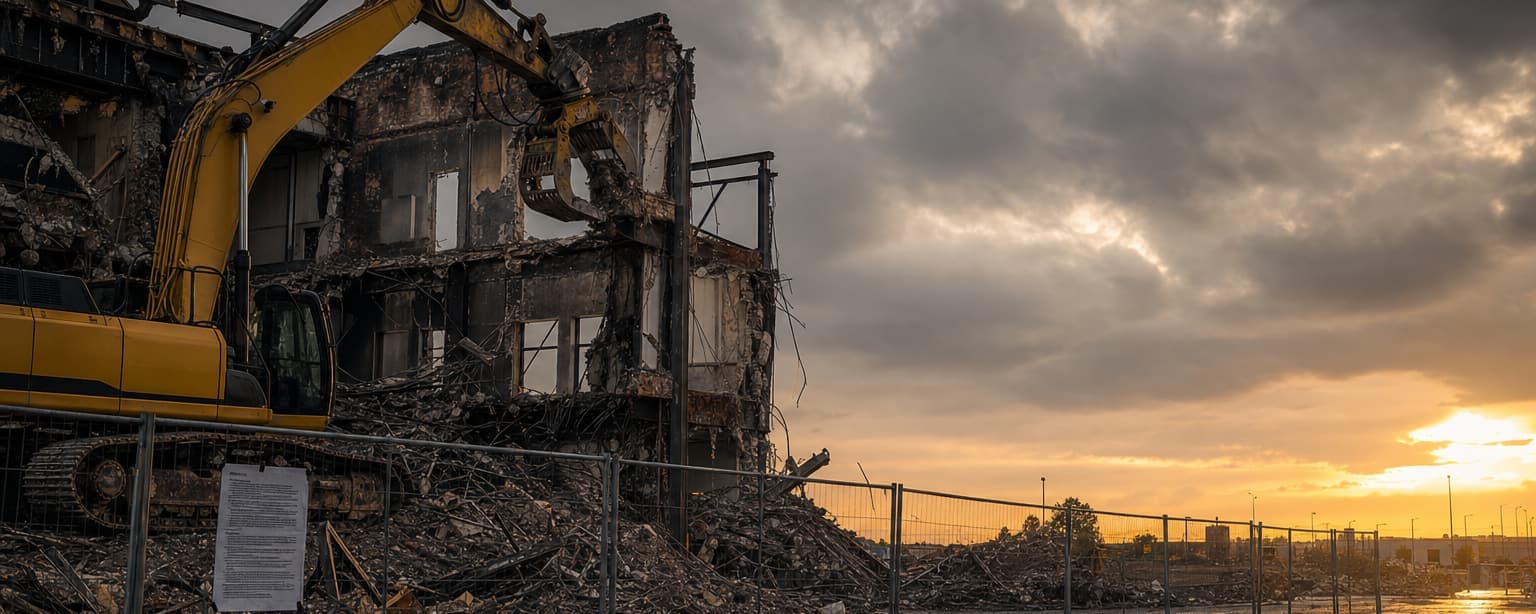
The policy rebuilds what you had. The city requires what you did not.
After a loss, current building codes can force you to demolish the undamaged portion too. That cost, the demolition and the upgrade are three separate limits, and we set all three.
Tell us the situation.
One licensed human replies the same business day — not five agents, not an auto-responder. If the policy you have is already the right one, we will tell you.
We use this to quote and service your insurance, and we do not sell it or pass it to lead networks. Privacy policy.
Send us what you have. We’ll tell you if it’s right.
Your current policy paperwork, a renewal notice, or nothing at all. A licensed agent reads it and replies the same business day.
What ordinance or law actually covers.
Coverage A — undamaged portion
The value of the standing part of the building you are required to tear down.
Without it — A 60% loss can become a 100% demolition and the policy pays for 60%.
Coverage B — demolition cost
The cost of demolishing and removing that undamaged portion.
Without it — Demolition of sound structure is not a covered loss without this.
Coverage C — increased cost of construction
The extra cost of rebuilding to today’s code rather than to what stood there.
Without it — Seismic, accessibility, fire, energy and egress upgrades all fall here.
Time element
The extra income loss caused by the longer rebuild that code compliance forces.
Without it — Standard business income runs to the ordinary repair period, not the code one.
Where ordinance or law shows up.
- Museums and Cultural Institutions
A replacement cost policy pays to rebuild what stood. Code upgrades in an old building can add a large share on top.
What clients with ordinance or law ask us.
Why would I have to demolish an undamaged part of my building?
Because most jurisdictions have a threshold, often around 50% of value, beyond which a damaged building cannot simply be patched and must be brought into full compliance. If the standing portion cannot economically be made compliant, it comes down. A property policy pays for the damage it insured, so without ordinance or law the owner funds the demolition of the sound half and the difference in rebuild cost themselves.
Which of the three parts matters most?
Coverage C, the increased cost of construction, in almost every older building. Codes have moved a long way on seismic bracing, accessibility, sprinklers, egress, insulation and electrical, and a building from the 1970s rebuilt to current standards costs substantially more than a like-for-like reconstruction. A and B matter most where the building is large and the damage is partial. Buy all three; they are usually cheap relative to what they answer.
How much should the limits be?
Not the default, which is typically a token percentage of the building limit and bears no relation to what an upgrade costs. Set it from the building’s age and the local code gap. An owner of a pre-1980 commercial building in a seismic or coastal jurisdiction should assume a serious number. This is one of the more common causes of a claim settling well below the cost of getting the building back.
Commercial insurance is 96% of what we do — it is not a department here, it is the whole business. Not ready to talk? The guides answer the questions this page raises in more depth. Already insured with us and need a certificate or a policy change? Ask the service team rather than starting a quote — it is faster and it goes to the people whose job it is. We also write home and auto, which is usually cheaper alongside the business policy than apart from it.
Handed a lease, a vendor packet or a client contract with insurance requirements? Paste it into the COI Requirements Decoder to see what each one means for your business, or read what the requirements mean.