
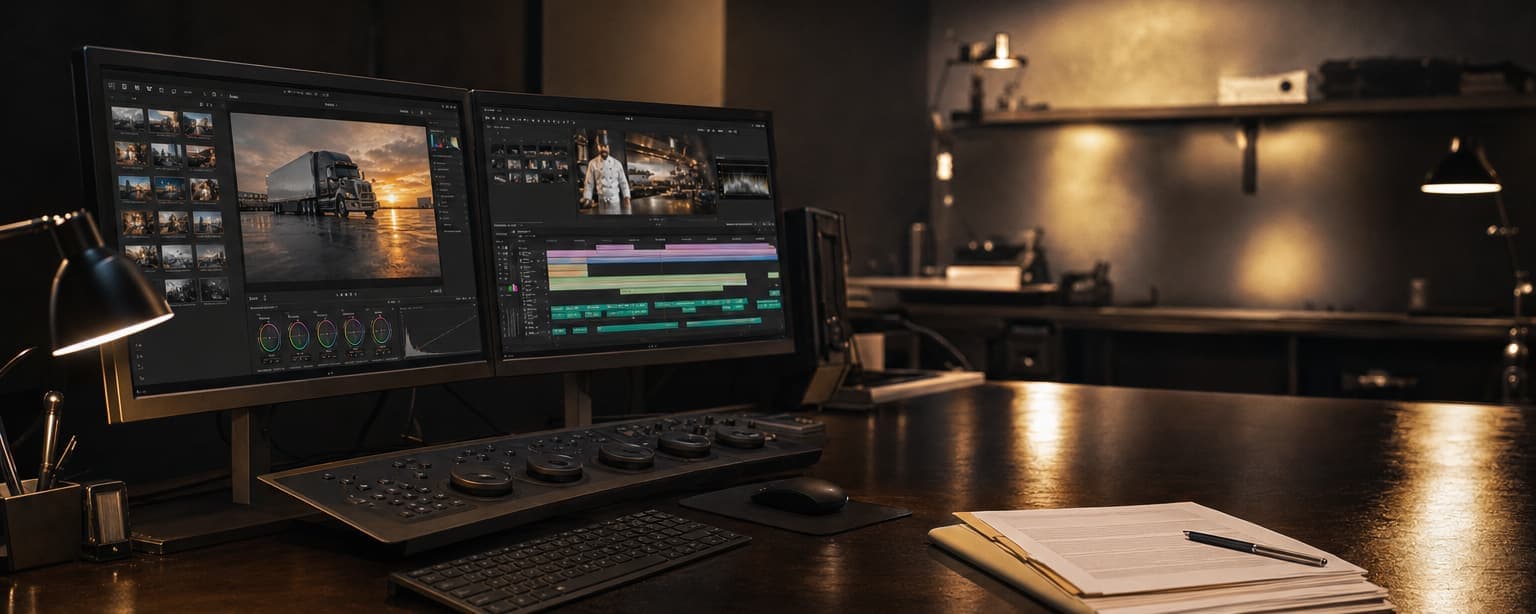
Defamation, copyright, a face you did not clear. The claims general liability was written to exclude.Founded by an Emmy-nominated television editor.
Media liability insurance covers claims arising from what you publish: defamation, copyright and trademark infringement, invasion of privacy and misuse of someone’s likeness — on an annual policy for creators, podcasters, publishers, authors and agencies. It is the coverage a streamer or brand asks for before a licensing deal is signed.
Tell us the situation.
One licensed human replies the same business day — not five agents, not an auto-responder. If the policy you have is already the right one, we will tell you.
We use this to quote and service your insurance, and we do not sell it or pass it to lead networks. Privacy policy.
We were editing television long before we were insuring it.

Kevin Kelsey
Founder | Principal Agent
IATSE Local 700 member
Boring’s founder, Kevin Kelsey, edited television for fifteen years before he sold a policy. He was Emmy-nominated for The Muppets Mayhem, cut Shark Tank, Big Brother, Dancing with the Stars and Wheel of Fortune, and handled compliance and risk for some of Hollywood’s largest production companies. So the person building your coverage has been on a crew list, dealt with the permit offices, and met network and streamer requirements from the production side, rather than working from a rate manual. He also builds post-production software. Baton is the board episodic post teams use to track every episode, and B/side is a video editor for people who cut together. He holds a number of patents on that software. So he knows the post side of a production as a vendor to it. We insure productions from Los Angeles to Atlanta, New York and Toronto, with worldwide and foreign production coverage.
The work is placed with the markets that actually write film, television and live entertainment — Zurich through ISC Entertainment (formerly Abacus), Philadelphia Insurance Companies, Take1 and Alive Risk — rather than with a general small-business carrier asked to try.
Send us what you have. We’ll tell you if it’s right.
Your current policy paperwork, a renewal notice, or nothing at all. A licensed agent reads it and replies the same business day.
What media liability actually covers.
Defamation
Libel and slander: a statement about a person or a business, in an episode, a video, a post, a book or a newsletter, that they say was false and damaging.
Without it — General liability’s personal and advertising injury grant excludes businesses whose product is the content, which is exactly what a publisher is.
Copyright and trademark infringement
A clip, a track, a photograph, a thumbnail, a logo or a title that someone else holds the rights to, used without a license that covers the use you made of it.
Without it — Fair use is a defense argued in court after the claim arrives, not a status you can buy in advance, and the defense costs are the claim.
Invasion of privacy and right of publicity
Publishing private facts, filming where someone had a reasonable expectation of privacy, or using a person’s name, face or voice in a way that trades on them without consent.
Without it — A release covers the people you asked. The person in the background of the shot, and the one whose old footage you re-used, did not sign one.
Defense costs
Lawyers’ fees and court costs for a covered claim, usually the largest part of any media loss and often the whole of it.
Without it — Most media claims never reach a judgment. They reach a bill for defending them, which a publisher without coverage pays in full whether or not the claim had merit.
Retroactive coverage
Claims made during the policy period about content published after the retroactive date, which, on a first policy, is usually the day it starts.
Without it — Everything you published before the retroactive date is uninsured, permanently, on every policy that follows. The date has to be negotiated on day one and never allowed to move forward.
Contract compliance
The limits, the additional insured wording and the certificate a streamer, network, brand or publisher requires before signing.
Without it — A licensing deal stalls at the insurance clause, and a policy bought for the deal with the wrong retroactive date does not satisfy it.
The claims we actually see.
Ordered by how often we see them, not by how dramatic they are. Each one names the coverage that answers it — and the policy people wrongly assume already does.
Most common
A cease-and-desist over music, a clip or a photograph used in an episode
Covered by Media liability — copyright and trademark
People assume a short clip, a licensed-for-personal-use track or a credit line makes the use fair. Fair use is decided after the claim, and the cost of arguing it is the loss.
Common
A demand letter from a person or a business you named, reviewed or accused
Covered by Media liability — defamation
General liability is assumed to cover it. Its personal and advertising injury grant excludes businesses in the media and publishing trade, and a monetized channel is one.
Common
Someone identifiable in your footage objects to being in it
Covered by Media liability — privacy and right of publicity
A public place is assumed to mean no privacy claim. Filming in public is usually lawful; publishing a person for profit in a way that trades on them is a separate question, and the background of a shot is full of people who did not consent.
Less common, severe
A guest or a co-host says something actionable on your show
Covered by Media liability — defamation, with the publisher as the named defendant
Hosts assume the guest owns what the guest said. The claim is addressed to whoever published it, and the guest’s release does not indemnify you for a claim by a third party.
Common
A streamer, network or brand refuses to sign until you show coverage they specify
Covered by Media liability at the limit the contract names, with a certificate
An online “content creator” policy bought in an afternoon is assumed to satisfy it. The limit is usually too low, the retroactive date is wrong for a back catalog, and the additional insured wording is missing.
Where media liability shows up.
- Content Creators & Influencers
Copyright, defamation and right-of-publicity claims come from the content itself, and a licensing deal with a streamer specifies the limit before anyone signs.
- YouTubers
The content is the exposure — copyright, defamation, a face or a song you did not clear — and a streamer licensing the channel names the limit it wants, which for one of them is five million dollars.
- Farm & Ranch YouTubers
Copycat injury is written here, as contingent bodily injury, along with the copyright, likeness and defamation claims every channel carries. Ask for the endorsement by name and read its sublimit.
- Videographers
General liability excludes what you publish, and a brand or a streamer will ask for this before they accept delivery.
- Podcasts
Every episode is a publication. A guest’s remark, a clip under the intro, a review of a real business: the claim names the show, not the person who said it.
- Marketing Agencies
The general liability form excludes personal and advertising injury for businesses whose work is advertising or website content, and it excludes infringement in work made for others.
- Advertising Agencies
The general liability form excludes personal and advertising injury for an insured in the advertising business, which is a description of you.
- PR Firms
The firm that wrote and sent a statement can be sued as its publisher, and general liability excludes businesses in the publishing and advertising trade.
- Graphic Designers
General liability excludes infringement in work made for others, so the stock photo letter and the logo dispute land on you.
- Web Designers & Developers
The standard general liability form removes personal and advertising injury entirely for a business that designs website content for others.
What clients with media liability ask us.
What is media liability insurance?
It is the policy that covers what you publish. General liability covers what your business does physically, meaning someone hurt or something damaged. Media liability covers the claims that come from the content itself: that you defamed someone, used copyrighted or trademarked material without the right to, invaded someone’s privacy, or used a person’s name or face without consent. It is written for anyone whose product is published material — podcasts, channels, newsletters, publishers, authors, agencies that produce content for clients — and it pays for the defense, which in most media claims is the whole cost.
What does media liability insurance cover?
Defamation, meaning libel and slander. Copyright and trademark infringement, including clips, music, images and titles. Invasion of privacy and misuse of someone’s likeness, which includes the person you did not get a release from. Usually plagiarism and unfair competition arising from content, and often negligent publication — harm from something you published that turned out to be wrong. Every form has its own edges, and the ones to read are the exclusions for deliberate infringement, for contractual disputes over rights you agreed to pay for, and for anything published before the retroactive date. Those three are where media claims are declined.
Is media liability the same as film errors and omissions?
Same family, different policy. Film E&O, producers errors and omissions, is bought per title, around delivery of a finished production, and a distributor requires it to run for the term of the distribution agreement, commonly three years. Media liability is an annual policy covering everything you publish during the year, which is the right shape for a podcast, a channel, a newsletter or a publisher that puts out material every week. A creator whose channel or series is being licensed to a streamer or network usually needs the annual form at the limits the licensor names, with a retroactive date that reaches back over the catalog being licensed. If you are delivering one finished film to a distributor, you want the other page.
Do I need media liability and cyber, or does one cover the other?
They are sold together because they are next to each other, not because either does the other’s job. Cyber answers a breach of your systems: an account takeover, ransomware, stolen subscriber data, the cost of telling people about it. Media liability answers what you published. The overlap that confuses people is a hacked account used to publish something defamatory, which is a cyber event that produces a media claim; a combined form or two policies from the same carrier handles that without an argument between two insurers about which one it was. Most publishers with an audience and a mailing list need both, and the cost of adding one to the other is usually modest.
Does general liability already cover defamation and copyright?
It carries a grant called personal and advertising injury that includes libel, slander and some privacy claims, and then excludes any insured whose business is advertising, broadcasting, publishing or telecasting, and excludes copyright infringement except in your own advertisement. A monetized channel, a podcast with sponsors or a newsletter with subscribers is in the publishing business as far as that exclusion is concerned. So the answer is that general liability covers a plumber who says something unwise on a job site, and not a publisher who says it on air. Publishers need the media form.
A streamer or network wants to license my channel. What will they ask for?
Media liability at a limit they specify, evidenced by a certificate, and often a retroactive date that covers the catalog they are licensing rather than just the new episodes. The limit can be far above what an online policy offers: Tubi, on a deal we handled, asked for $5,000,000 of media liability before it would license a creator’s channel. Some licensors also want general liability and to be named as an additional insured. The clause is in the licensing agreement; read it before you buy, because a policy bought at the wrong limit or with today’s date as the retroactive date has to be replaced, not endorsed. Video podcasts and series going to a network hit the same requirement.
My channel makes ad revenue but has no licensing deal. Do I need this?
Nobody will make you buy it, which is different from not needing it. The exposures exist from the first upload — a clip, a review, a face in the background — and they grow with the audience, because a claim is worth bringing against a channel with revenue. What triggers most purchases is a contract: a brand deal, a sponsor, a network, a streamer. If none of those is on the horizon, the honest position is that general liability and coverage for the gear are the first two policies and media liability is the third, bought when the channel is large enough that a defense bill would hurt or the moment anyone puts an insurance clause in front of you. We would rather say that than sell it to everyone.
What does media liability insurance cost?
A range rather than a number, and the range is driven by what you publish, how much of it and to whom. Underwriters rate on revenue, on the kind of content. A true-crime podcast and a cooking channel are not the same risk — on whether you review, investigate or name people, on the size of the audience, and on the limit and retroactive date you need. A small publisher with a clean clearance process and a modest limit sits at the low end; a channel being licensed at $5,000,000 with a catalog to cover retroactively is a different purchase. The application asks for the things that move the price, so the fastest route to a real figure is to answer it.
What does the application ask for?
What you publish and where, revenue and its sources, audience size, whether you use third-party material and how you license it, whether you name or review real people and businesses, whether you have a release process for the people who appear, who reviews contentious material before it goes out, and any prior claims or demand letters. It also asks for the retroactive date you want, which is the question to answer carefully: a first policy defaults to the day it starts, and if a licensor wants your back catalog covered you need to ask for a date that reaches it. Having a written clearance routine, even a short one, improves both the price and the answer.
Am I covered for what a guest says, or what appears in the comments?
For a guest, generally yes: a defamation claim over something said on your show is addressed to you as the publisher, and that is what the policy responds to. For user comments the answer depends on the form; some cover user-generated content on your platforms and some exclude it, and the difference matters to a channel with an active comment section or a community forum. Say on the application that you host user content so the right form is chosen, and remember that a guest release protects you from the guest, not from the person the guest talked about.
Does media liability insurance cover content made with AI?
Some forms do, in writing, and some now exclude it. Until 2026 most media policies were silent and covered AI-generated output by default. In January 2026 ISO published generative-AI exclusions for general liability and several carriers filed their own for professional lines; others, Beazley among them, said they would keep covering AI and added affirmative wording. The certificate looks the same either way. Ask for the affirmative AI endorsement, or written confirmation that no exclusion is attached, before you publish anything a model wrote.
A studio wants $5,000,000 of media liability for an AI-generated series. Is that placeable?
With a short list of entertainment and media markets, yes, and the submission is the work. The underwriter asks which models, on what license, how they were trained, what you put in, who reviews the output, whether any real person appears and what the contract makes you promise. A video producer’s $5,000,000 placement through us ran about $8,000 a year; an AI-native shop should expect more and about a week for a yes or no. We tell you which you are before we spend the week.
We are the studio or network buying AI content. How do we insure our side?
With your own media liability program, read for AI wording on every layer, production E&O whose application disclosed the AI use, and vendor contracts that require the vendor’s own AI coverage. An AI tool’s indemnity protects only the tool’s customer, which is usually the vendor, so it rarely reaches the company that distributes the work.
Are defense costs inside or outside the limit on a media liability policy?
Often inside, which means lawyers’ fees reduce what is left to pay a settlement or judgment. On a $1,000,000 limit, a claim that costs $300,000 to defend leaves $700,000. Some forms put defense outside the limit or add a separate defense limit for more premium. For a reporter or a news channel whose likeliest claim is a long defense of a story it wins, that clause matters more than the headline limit. The limits section of the quote says which one you have.
Retroactive date, defense costs, deductible and freelance work
I am a freelance journalist. Is this the right policy?
Yes, it is the same form, and a reporter has questions a creator does not. The person most likely to sue is often a public official, who has to prove actual malice under New York Times v. Sullivan, and many states, Texas among them, have an anti-SLAPP law that can end a suit early. Freelancers also need to know whether the outlet’s policy covers them and whether their own policy names the outlets they write for.
Guides on media liability.
- Streaming Platform Insurance RequirementsPlatforms set their own limits and ask for media liability with a retroactive date, general liability, and often an umbrella. The limits are in the agreement you were sent.
- AI content creator E&O insuranceAI content creators can buy media liability (E&O) that covers AI output. It is insurable, by a handful of media and entertainment markets, on a submission that documents the tools, the inputs, the review and the releases. The training data behind a third-party model is the one question nobody can answer, and the rest of the application exists to make up for it.
- Copycat injury insurance for creatorsCopycat injury is written on a media liability policy as contingent bodily injury, with its own sublimit. General liability for creators excludes it, and the endorsement usually stops at injuries involving tools, machinery or products.
- AI Content Contract Insurance RequirementsA buyer contract with AI clauses asks for licensed tools, no training on its material, a tool indemnity, a disclosure log and E&O including AI related claims. Here is what each clause asks, what your insurance has to do about it, and which exclusions to check before you sign.
- AI Indemnity Without an Enterprise PlanWhich AI tools indemnify their output, on which plans, and how to get AI indemnity without an enterprise plan, for AI-generated films and other work. Read from each vendor’s current terms, with what a studio or vendor does without one: buy media liability with affirmative AI wording and offer its own capped indemnity, which buyer contracts commonly accept.
- AI Media Liability Insurance: What to CheckA media liability policy with affirmative AI wording is what a studio or vendor making AI content should carry. This guide reads the policy feature by feature, using CapSpecialty’s CapMedia form and CFC’s published AI clause as real examples, and says why a general video production policy is often not enough.
- AI Indemnity for Studios and NetworksStudios, networks and streamers carry AI content claims their tools and vendors may not indemnify. Where the exposure sits, and how to insure it.
- AI Indemnity for AI-Generated FilmsYou do not need an enterprise AI plan. Production E&O with affirmative AI wording covers an AI-generated film. What to ask for, and who quotes it.
Commercial insurance is 96% of what we do — it is not a department here, it is the whole business. Not ready to talk? The guides answer the questions this page raises in more depth. Already insured with us and need a certificate or a policy change? Ask the service team rather than starting a quote — it is faster and it goes to the people whose job it is. We also write home and auto, which is usually cheaper alongside the business policy than apart from it.
Handed a lease, a vendor packet or a client contract with insurance requirements? Paste it into the COI Requirements Decoder to see what each one means for your business, or read what the requirements mean.