
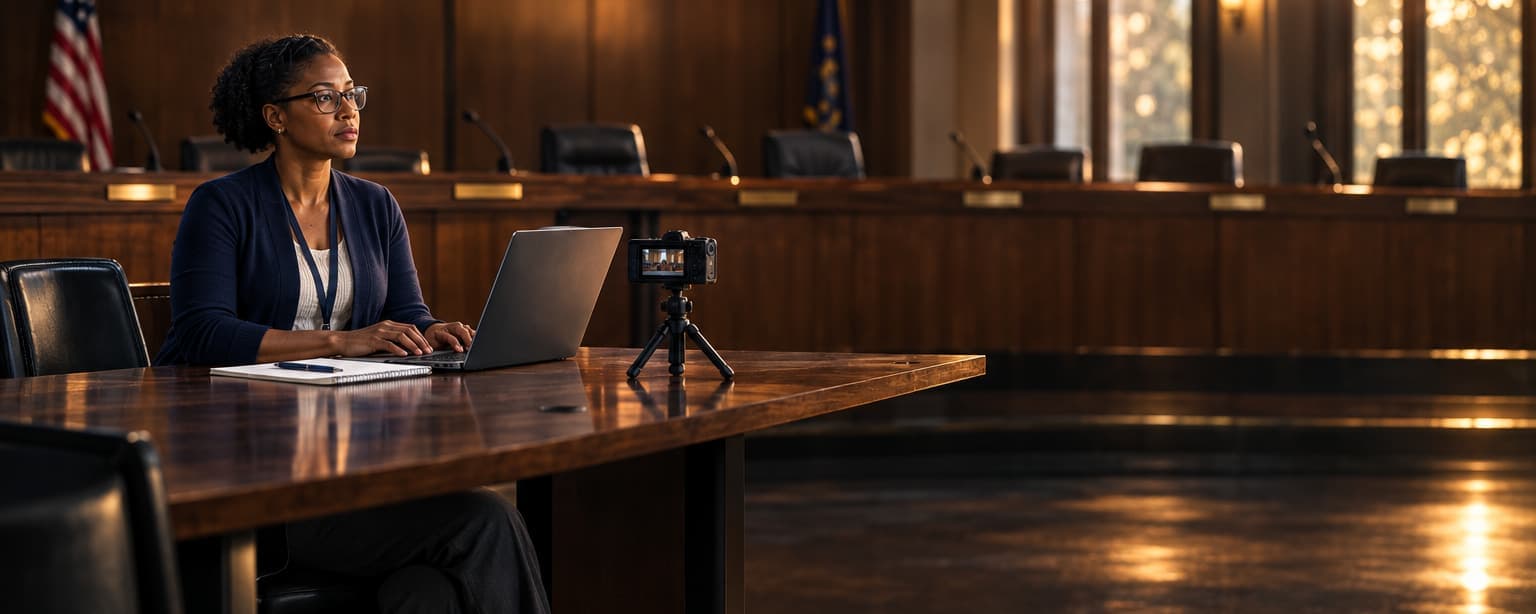
You cover the council. Not everyone on it likes the story.
We insure independent journalists, freelance reporters, local and civic news sites, newsletter writers and YouTube or Facebook news channels with media liability. It is the policy that defends a defamation, privacy or copyright claim over what you publish. When the person suing is a public official, the defense bill is usually the real cost, and the policy is built to pay it.
Tell us the situation.
One licensed human replies the same business day — not five agents, not an auto-responder. If the policy you have is already the right one, we will tell you.
We use this to quote and service your insurance, and we do not sell it or pass it to lead networks. Privacy policy.
Send us what you have. We’ll tell you if it’s right.
Your current policy paperwork, a renewal notice, or nothing at all. A licensed agent reads it and replies the same business day.
What independent journalist businesses actually need.
Defamation, libel and slander
A claim that a statement you published or said on air about a person or a business was false and damaged their reputation, in an article, a post, a newsletter, a livestream or a video.
Without it — General liability’s personal and advertising injury grant excludes insureds in the business of publishing or broadcasting, which a news channel is.
Invasion of privacy
Claims that you intruded on someone’s seclusion, published private facts that were not newsworthy, or portrayed someone misleadingly. The form covers the privacy theories a state recognizes.
Without it — A release protects you from the person who signed it. The member of the public at the microphone did not sign one.
Intellectual property in content
Copyright and trademark claims over photos, footage, music, graphics and titles you used, plus plagiarism and misappropriation of ideas on most forms.
Without it — Copyright suits can be brought up to three years after the claim accrues, so an old video is still exposed long after a libel deadline has passed.
Defense costs
Lawyers’ fees, an anti-SLAPP motion, expert and court costs for a covered claim, whether or not the claim had merit.
Without it — The bill for winning is the loss most reporters actually face. Ask whether defense sits inside the limit or in addition to it.
Your own channels and your freelance work
Content on the websites, newsletters, YouTube channels and Facebook pages you run, and the stories you sell to outside outlets, each named in the policy’s definition of covered media.
Without it — A policy that schedules only your own channels can leave out the story you sold to a newspaper. Name every outlet on the application.
Cyber & tech E&O
Breach response, ransomware and the notification costs that follow. Technology errors and omissions sits on the same policy and covers the software or service itself failing a client, which is the half most tech companies find out about too late.
Without it — A hijacked channel or newsletter list, and the cost of notifying subscribers, are cyber claims and not media ones.
Inland marine & equipment
Tools, equipment and property in transit. It picks up exactly where commercial property stops, which is the moment the item leaves the building.
Without it — Cameras, microphones and the laptop travel to every meeting, and a homeowners policy caps business property at a small amount.
What the regulators actually wrote down.
A public official cannot recover damages for a defamatory falsehood about official conduct unless he proves the statement was made with actual malice, meaning knowledge that it was false or reckless disregard of whether it was false.
New York Times Co. v. Sullivan, 376 U.S. 254, 279-280 (1964), Legal Information Institute · checked 2026-10-04
States may set their own standard of liability for defamation of a private person, so long as they do not impose liability without fault.
Gertz v. Robert Welch, Inc., 418 U.S. 323, 347 (1974), Legal Information Institute · checked 2026-10-04
Under the Texas Citizens Participation Act, a defendant sued over speech on a matter of public concern, which includes statements about a public official, may move to dismiss within 60 days of service, and all discovery is suspended until the court rules.
Tex. Civ. Prac. & Rem. Code §§ 27.001(7), 27.003 · checked 2026-10-04
Under the Texas Citizens Participation Act, the court may not dismiss if the plaintiff establishes by clear and specific evidence a prima facie case for each essential element, and when it does dismiss it shall award the moving party court costs and reasonable attorney’s fees.
Tex. Civ. Prac. & Rem. Code §§ 27.005(c), 27.009(a) · checked 2026-10-04
Texas law gives a person in attendance the right to record all or any part of an open meeting of a governmental body, and allows only reasonable rules on where the equipment goes and how recording is done.
Tex. Gov’t Code § 551.023, Texas Open Meetings Act · checked 2026-10-04
In Texas, a person may sue for defamation only after a timely and sufficient request for a correction, clarification or retraction, or after the publisher has made one, and a person who does not ask within 90 days of learning of the publication cannot recover exemplary damages.
Tex. Civ. Prac. & Rem. Code § 73.055, Defamation Mitigation Act · checked 2026-10-04
A libel or slander suit in Texas must be brought within one year after the cause of action accrues.
Tex. Civ. Prac. & Rem. Code § 16.002(a) · checked 2026-10-04
The Texas Supreme Court declined to recognize the tort of false light invasion of privacy in 1994.
Cain v. Hearst Corp., 878 S.W.2d 577 (Tex. 1994), CourtListener · checked 2026-10-04
The claims we actually see.
Ordered by how often we see them, not by how dramatic they are. Each one names the coverage that answers it — and the policy people wrongly assume already does.
Most common
A demand letter or a retraction request from an official or a business you reported on
Covered by Media liability, defamation
Reporters assume a true story ends the matter. Truth is a defense, and proving it is the work a lawyer bills for.
Common
A public official sues over your coverage, knowing the case is hard to win
Covered by Media liability, defense costs from the first dollar after the deductible
An anti-SLAPP motion can end the case early and win a fee award. The motion, the hearing and any appeal are paid for first, and the award arrives later, if the plaintiff pays it.
Less common, severe
Someone filmed at a meeting or an interview says the video invaded their privacy or misrepresented them
Covered by Media liability, invasion of privacy
Recording an open meeting is lawful in Texas. How the clip is cut, titled and captioned is a separate question, and a suit over it is defended the same way.
Common
A photographer or a broadcaster claims a photo, a clip or a piece of music in your video
Covered by Media liability, intellectual property in content
Fair use is argued after the claim arrives. A credit line or a short clip does not make the use fair in advance.
Less common, severe
A story you wrote for an outside newspaper draws a suit that names you as well as the paper
Covered by Media liability that lists freelance work as covered media, or the outlet’s policy if it extends to freelancers
Freelancers assume the paper’s insurance defends them. Some outlet policies do, many cover only employees, and a freelance contract can ask you to indemnify the paper instead.

Kevin Kelsey
Founder | Principal Agent
Edited television for fifteen years and was Emmy-nominated for The Muppets Mayhem. He also handled compliance and risk for large production companies. So he knows clearance and releases from the inside. Your media policy gets read here by someone who has met a network’s legal rules before air.
What the insurance company will ask about your independent journalist business
We read 3 applications the markets use for this kind of business and pulled out what they actually ask. Have these answers ready and a quote takes a day instead of a week, because nobody has to come back to you for the missing piece.
About the business
- What types of skiing trips do you offer (backcountry, heli-skiing, snow-cat, other)?
- How many clients do you take per year and how many days does each group typically ski?
- What elevations and terrain do you operate in?
- Are you a member of any professional ski guide organizations?
How you operate
- How do you decide when conditions are too unsafe or unskiable to run a trip?
- How do you update guides on current snow conditions between trips?
- What's your weather forecasting source and do you maintain your own weather records?
- Do you use snowmobiles or snow-cats to access terrain?
- Do you have lower-angle terrain available for bad weather days?
Safety and controls
- What are your protocols for finding and rescuing someone buried in an avalanche?
- Do you carry avalanche dogs or have access to them?
- How do you train clients to use avalanche transceivers?
- What's in each guide's pack?
- How often do you maintain and test avalanche transceivers?
Your history
- Have you had any incidents, claims, lawsuits or losses related to your ski guiding business?
- Have you ever been convicted of any crime?
- Do you currently have insurance with another company?
Money and people
- How much do you expect to earn annually from guided trips?
- What are the ages and experience levels of your guides?
Have these ready
- Your guide roster with each guide's age, experience, and resume for key staff
- Your avalanche transceiver maintenance records and schedule
- Your client release and acknowledgement of risk form
- All brochures and promotional materials showing how you market your trips
- Your previous insurance information if you have current or past coverage
You answer what you can; a licensed agent fills the rest with you.
What our independent journalist clients ask us.
What does media liability insurance cover for a journalist?
Claims that come from what you publish. That means defamation, which is libel in print or online and slander when spoken, plus invasion of privacy and copyright or trademark claims over material in your work. Most forms also pay the defense of those claims whether or not they have merit. For a reporter the defense is usually most of the value, because a well-sourced story can still draw a suit that costs real money to end.
Why would I need insurance if public officials have to prove actual malice?
Because the standard decides who wins, not whether you are sued. Under New York Times v. Sullivan an official must prove you knew the statement was false or recklessly disregarded whether it was, which is a high bar. A suit can still be filed, and answering it takes a lawyer, a motion and sometimes an appeal. A media lawyer decides how to defend a case. The policy decides who pays for it.
Does the Texas anti-SLAPP law mean I do not need coverage?
It helps a great deal and it does not replace coverage. The Texas Citizens Participation Act lets you move to dismiss within 60 days of service, pauses discovery and requires the court to award your fees if the case is dismissed. The motion still has to be written, argued and sometimes appealed before anyone is ordered to pay, and the award is only worth what the plaintiff can pay. A policy pays the defense as it happens. Ask a media lawyer how the statute applies to your story.
Does the newspaper I freelance for cover me under its insurance?
Sometimes, and only the paper can tell you. Some outlet policies extend to freelancers for work done for that outlet, many cover only employees, and some freelance contracts ask you to indemnify the paper. Before you file, ask your editor four things in writing. Ask whether freelancers are insureds on the paper’s media policy, and whether that covers your story. Ask who pays the deductible, and whether your contract makes you indemnify the paper.
Can one policy cover my own YouTube and Facebook pages and my freelance stories?
Yes, if the policy is written to. Media forms define the content they cover, often by listing the outlets on the declarations, sometimes as all media activities. Put every channel, page, newsletter and outside outlet on the application, and read the covered media definition before you bind. A form that schedules only your own channels can leave your freelance work out, and the outlet’s policy may not pick it up.
Can I record a city council or school board meeting in Texas?
The Texas Open Meetings Act says a person in attendance may record all or any part of an open meeting, by audio or video. The body may set reasonable rules about where the equipment goes and how recording is done, and those rules may not unreasonably impair the right. Closed sessions are not open meetings. Recording is lawful, and what you publish from it is still judged on its own, so captions and edits matter.
Someone asked me for a retraction. What happens next?
Tell your insurer and your media lawyer before you answer, because most media policies require prompt notice and many treat a demand as a claim. In Texas the Defamation Mitigation Act makes a correction request part of the process. A person who does not ask within 90 days of learning of the publication cannot recover exemplary damages. Whether and how to correct is an editorial and legal decision, and a lawyer should see the request first.
Do I need this if my news pages make no money?
A suit does not check your revenue. A civic news page with no income can be sued over a story exactly like a paid outlet, and it pays the same lawyer. What revenue changes is the price, since underwriters rate on what you earn and what you publish. Many reporters buy when the coverage starts naming officials or when an outlet or a platform asks for a certificate.
What does media liability cost for an independent journalist?
We do not publish a range, because we have bound only two media liability policies and two is not a sample. Those two cost $3,000 and $6,500 in premium a year before fees, and a $1,000,000 online content quote we obtained came to about $1,970 with a $5,000 deductible. The price moves with the limit, the deductible and whether you investigate or name people. Covering past work also moves it, and so does any demand letter you have had.
What does a independent journalist insurance application ask for?
The applications for independent journalist businesses ask about 4 things above all: what types of skiing trips do you offer (backcountry, heli-skiing, snow-cat, other); how do you decide when conditions are too unsafe or unskiable to run a trip; what are your protocols for finding and rescuing someone buried in an avalanche; have you had any incidents, claims, lawsuits or losses related to your ski guiding business. Have your guide roster with each guide's age, experience, and resume for key staff and your avalanche transceiver maintenance records and schedule ready and a quote takes a day instead of a week.
Guides on independent journalist.
Commercial insurance is 96% of what we do — it is not a department here, it is the whole business. Not ready to talk? The guides answer the questions this page raises in more depth. Already insured with us and need a certificate or a policy change? Ask the service team rather than starting a quote — it is faster and it goes to the people whose job it is. We also write home and auto, which is usually cheaper alongside the business policy than apart from it.
Handed a lease, a vendor packet or a client contract with insurance requirements? Paste it into the COI Requirements Decoder to see what each one means for your business, or read what the requirements mean.