
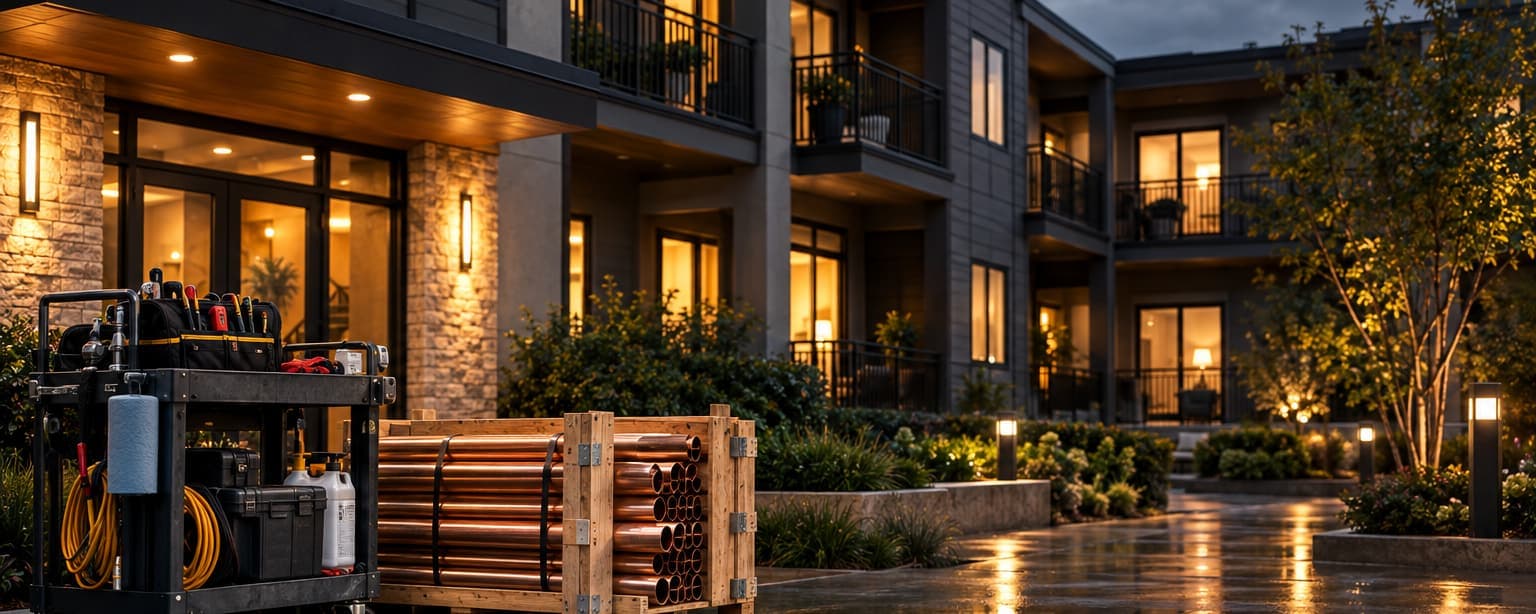
Apartments, condos and rented homes are the class carriers have been leaving. Here is who is still writing them.
Habitational is the insurance industry's word for buildings people live in that someone else owns: apartment complexes, condominium buildings, rented houses and mixed-use buildings with units upstairs. It has become one of the hardest property classes to place, because water losses in aging buildings, fire, liability for tenants and guests, and weather have pushed many standard carriers out. What is left is a market that asks detailed questions about the building's systems and the owner's management, and rewards good answers. We place habitational accounts from a single rented house to portfolios of buildings, and we start with the plumbing, the roof and the electrical, because the market does.
Tell us the situation.
One licensed human replies the same business day — not five agents, not an auto-responder. If the policy you have is already the right one, we will tell you.
We use this to quote and service your insurance, and we do not sell it or pass it to lead networks. Privacy policy.
Send us what you have. We’ll tell you if it’s right.
Your current policy paperwork, a renewal notice, or nothing at all. A licensed agent reads it and replies the same business day.
What apartment or residential building businesses actually need.
Property
The buildings and the owner's contents at replacement cost, with ordinance-or-law for code upgrades, equipment breakdown, and the deductibles the market now requires for water and wind.
Without it — The mortgage requires it, and an underinsured building is rebuilt at the owner's expense above the limit.
General liability
Injury and property damage to tenants, guests and the public from the premises: stairs, balconies, pools, parking, the tenant hurt by a condition the owner should have fixed.
Without it — A tenant's fall is a claim against the owner; a tenant's guest's fall is the same claim.
Loss of rents
The rental income lost while a covered loss makes units uninhabitable, through the rebuild.
Without it — The mortgage payment continues while the fire-damaged wing is empty for a year.
Umbrella
Limits above the general liability, usually required by lenders on larger buildings.
Without it — A fire with injuries or a balcony collapse is a claim past a primary limit.
Crime, cyber and employment practices
For managed buildings with staff: employee theft, tenant data breaches, and employment claims from on-site staff.
Without it — A property manager's office holds application data on every tenant.
Flood and earthquake
Separate policies for the two perils every habitational property form excludes.
Without it — Excluded, and required by lenders in mapped zones.
The claims we actually see.
Ordered by how often we see them, not by how dramatic they are. Each one names the coverage that answers it — and the policy people wrongly assume already does.
Most common
Water damage from a failed pipe, a water heater or a washing machine, into the units below
Covered by Property, above a water deductible that has grown large
Aging galvanized or polybutylene plumbing is the number one reason a habitational account is declined. Replacing it is the number one reason it is written.
Common
A tenant or guest falls on stairs, ice or a walkway
Covered by General liability
Lighting, handrails and a snow contract are the defense; maintenance logs are the proof.
Less common, severe
A fire started by a tenant
Covered by Property and loss of rents
Requiring tenants to carry renters insurance shifts part of the subrogation and is asked about on the application.
Common
A tenant alleges habitability problems, mold or a dog bite by another tenant's animal
Covered by General liability, with mold usually sublimited and animal liability sometimes excluded
Mold and animals are the two exclusions to read on every habitational quote.
What the policy will not cover.
Pick a procedure to see what the exclusion actually means and whether it can be placed somewhere else.
The questions are about the building and the management. Good answers get quotes from carriers that decline the class on paper.
What the habitational market asks before it quotes
Plumbing, electrical, roof and heating updates
The year each system was replaced, and for older buildings proof. Aluminum wiring, fuse boxes, original galvanized plumbing and a roof past twenty years are each a decline for many carriers.
Can it be placed? Yes, once updated, and at better rates than the owner expects.
Tenant screening and renters insurance requirements
Whether tenants are screened, whether leases require renters insurance, and whether the owner enforces it.
Can it be placed? Yes, with the lease terms in writing.
Vacancy
A building more than a third vacant is rated as vacant, and a vacant building is a different, harder policy.
Can it be placed? Yes, on a vacant building form until occupancy returns.
Short-term rentals
Units let by the night are a hospitality exposure on a habitational form, and most carriers exclude or decline it.
Can it be placed? Yes, on a short-term rental program with the units disclosed.
What the insurance company will ask about your apartment or residential building business
We read 8 applications the markets use for this kind of business and pulled out what they actually ask. Have these answers ready and a quote takes a day instead of a week, because nobody has to come back to you for the missing piece.
About the business
- What year was the building built?
- How many years have you owned this property?
- What is your occupancy rate?
- What percentage of your units are student housing, subsidized housing, or for elderly residents?
- Do you have a manager on the premises?
How you operate
- Is there a swimming pool on the property?
- Is there a playground? If yes, what equipment is there?
- Do you offer boat rentals? If yes, how many boats and do they have Coast Guard approved flotation devices?
- Are you currently renting all units, or are some for sale?
- Do tenants have pets? If yes, please describe what animals are allowed
Safety and controls
- Do you do criminal background checks on employees?
- Are all units re-keyed before new tenants move in?
- Do deadbolts work in all units?
- Are there pull cords in units?
- Is the complex fully gated?
Your history
- Have you had any housing violations? If yes, which properties and what violations?
- Has the building ever been condemned or scheduled for demolition?
- In the last three years, has any insurance company canceled, non-renewed, declined, or refused to insure you?
- Why was your coverage canceled or not renewed before, if it happened?
- Have you had any incidents or losses in the past that could lead to a claim?
Money and people
- Do you have central air conditioning or a swamp cooler?
- What is the building value, and what equipment and inventory do you have?
- Who is your current insurance company, or who was your last one?
- What were your annual premiums for the last three years?
- Do you require subcontractors to carry insurance limits equal to or greater than yours?
Have these ready
- Your property deed or ownership documents showing you own the building
- Your last three years of insurance history from all carriers, including company names, coverage types, dates, and annual premiums
- Certificates of insurance for all subcontractors and independent contractors you work with
- Photos or description of your security features (gates, locks, cameras, lighting)
- A list of any housing code violations or complaints filed against your properties in the past five years
You answer what you can; a licensed agent fills the rest with you.
What our apartment or residential building clients ask us.
Why is habitational insurance so hard to get right now?
Water losses in aging buildings, larger fires, weather and liability verdicts have made the class unprofitable for many standard carriers, and they have left it or restricted it to newer buildings. The market that remains is selective and asks for the building's systems, its maintenance and its management practices. Owners who can document those get quotes; owners who cannot get declines.
How much does apartment building insurance cost?
It is priced per unit and per dollar of building value, and then adjusted for the building's age and updates, its construction and protection, its location's weather and liability climate, the deductibles chosen and the claims history. A renovated masonry building with a clean record pays a fraction per unit of what an old frame building with two water claims pays, if the second can be placed at all.
What does a habitational insurance application ask for?
The applications we work from ask the number of buildings, units and stories, construction and year built, the year the roof, plumbing, electrical and heating were updated, the protection (sprinklers, alarms, hydrant distance), the occupancy rate and whether any units are rented short-term, tenant screening and renters insurance requirements, on-site staff and management, the pool, balconies and parking, five years of claims, and a statement of values for a portfolio. The systems questions are the ones an underwriter decides on.
Does my landlord policy cover a rented house?
A single rented house is written on a dwelling fire policy with landlord liability, which is habitational insurance at its smallest. From a few houses up, and for any building with several units, the account moves to a commercial habitational package, and the questions above apply.
Commercial insurance is 96% of what we do — it is not a department here, it is the whole business. Not ready to talk? The guides answer the questions this page raises in more depth. Already insured with us and need a certificate or a policy change? Ask the service team rather than starting a quote — it is faster and it goes to the people whose job it is. We also write home and auto, which is usually cheaper alongside the business policy than apart from it.
Handed a lease, a vendor packet or a client contract with insurance requirements? Paste it into the COI Requirements Decoder to see what each one means for your business, or read what the requirements mean.