
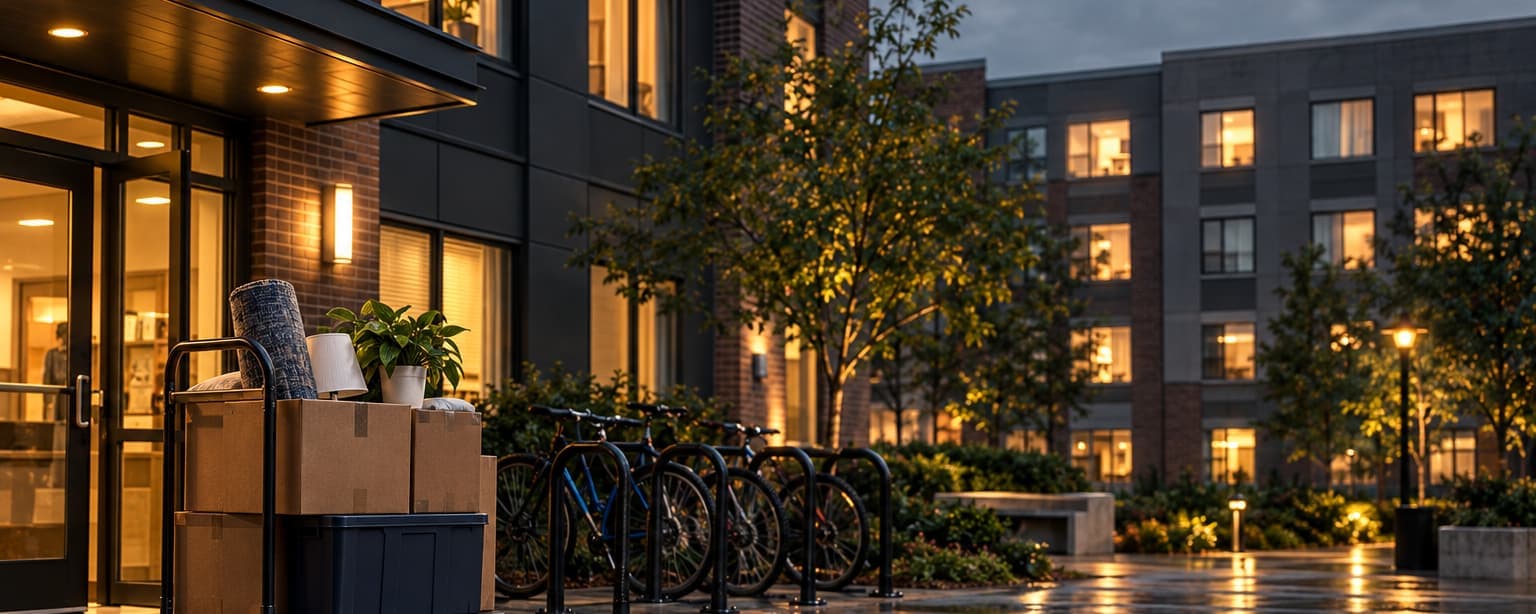
It is an apartment building where every tenant is nineteen and every lease turns over the same week. Carriers price that difference, and so should you.
Student housing is habitational property with a specific tenant: young, transient, often first-time renters, on twelve-month leases that all begin and end in August. The claims are the apartment claims, at higher frequency: water damage from an unattended bath, a balcony overloaded at a party, an assault in a stairwell, a fire from cooking, and the liability that follows alcohol on the premises. Purpose-built student housing adds amenity spaces, shuttle buses and a leasing operation that markets by the bed. The policy is a habitational package with the liability rated for the tenancy and the property rated for the turnover, plus the pieces a campus-adjacent operator needs: assault and battery, liquor where events are hosted, and auto for the shuttle. We place it for individual houses rented by the room through to purpose-built communities.
Tell us the situation.
One licensed human replies the same business day — not five agents, not an auto-responder. If the policy you have is already the right one, we will tell you.
We use this to quote and service your insurance, and we do not sell it or pass it to lead networks. Privacy policy.
Send us what you have. We’ll tell you if it’s right.
Your current policy paperwork, a renewal notice, or nothing at all. A licensed agent reads it and replies the same business day.
What student housing businesses actually need.
General liability
Tenant and guest injury on the premises, from a stairwell fall to a balcony collapse.
Without it — A student housing claim comes with a parent and a lawyer, and it settles on the building's maintenance records.
Property
The buildings, the amenity spaces and the furniture, where units are furnished.
Without it — Furnished by-the-bed housing has more contents per unit than any other apartment class, and it turns over yearly.
Loss of rents
Income lost while a covered loss keeps units empty.
Without it — A fire in July with leases starting in August is a full academic year of lost rent, not the repair time.
Assault and battery
Claims that inadequate security allowed an assault on the premises, with a sublimit.
Without it — Excluded or sublimited on most habitational forms, and it is the claim student housing has that other apartments have less often.
Liquor liability
Where the operator hosts events with alcohol in the clubhouse or pool area.
Without it — A resident event with a keg is a host liquor exposure the standard form does not fully cover.
Commercial auto
The shuttle to campus and the leasing office vehicles.
Without it — A shuttle carrying students is a passenger vehicle exposure rated on its own.
The claims we actually see.
Ordered by how often we see them, not by how dramatic they are. Each one names the coverage that answers it — and the policy people wrongly assume already does.
Most common
Water damage from a unit above
Covered by Property, and liability if a neighbor is damaged
Overflowed tubs, washing machine hoses and frozen pipes over winter break. Carriers ask about leak sensors and who checks empty units in December.
Common
A fall or injury at a party, including balcony and railing failures
Covered by General liability
Balcony load limits, railing inspections and occupancy limits are asked about because an overloaded balcony is the catastrophic version of this claim.
Less common, severe
An assault in a common area or parking lot
Covered by Assault and battery, up to the sublimit
Lighting, cameras, controlled access and a security contract are what the application asks about and what the plaintiff's expert will measure.
Less common, severe
A cooking fire
Covered by Property and loss of rents
Sprinklers, monitored alarms and stove-top suppression move the property rate more than anything else the owner controls.
What the policy will not cover.
Pick a procedure to see what the exclusion actually means and whether it can be placed somewhere else.
The policy covers the operator as a landlord and property owner: the buildings, the common areas, the staff and the events. Tenants' belongings and tenants' own conduct belong to the tenants.
Where a student housing policy stops
Tenants' personal property
A student's laptop and clothes are their own renters policy, which most operators now require at lease signing.
Can it be placed? Yes, by the tenant, on a renters policy.
Tenant-on-tenant conduct
Harassment, theft or assault by one resident against another is the resident's liability; the operator is named only where security or screening is alleged to have failed.
Can it be placed? The operator's exposure is covered under assault and battery; the resident's is not insurable here.
Habitability and discrimination claims
Fair housing complaints and habitability suits are excluded from general liability.
Can it be placed? Yes, under a tenant discrimination or landlord legal liability policy.
Fraternity and sorority houses
A chapter house is a different class, with the chapter's events and its national organization in the picture.
Can it be placed? Yes, through programs written for Greek housing.
What the insurance company will ask about your student housing business
We read 8 applications the markets use for this kind of business and pulled out what they actually ask. Have these answers ready and a quote takes a day instead of a week, because nobody has to come back to you for the missing piece.
About the business
- What year was the building built?
- How many years have you owned this property?
- What is your occupancy rate?
- What percentage of your units are student housing, subsidized housing, or for elderly residents?
- Do you have a manager on the premises?
How you operate
- Is there a swimming pool on the property?
- Is there a playground? If yes, what equipment is there?
- Do you offer boat rentals? If yes, how many boats and do they have Coast Guard approved flotation devices?
- Are you currently renting all units, or are some for sale?
- Do tenants have pets? If yes, please describe what animals are allowed
Safety and controls
- Do you do criminal background checks on employees?
- Are all units re-keyed before new tenants move in?
- Do deadbolts work in all units?
- Are there pull cords in units?
- Is the complex fully gated?
Your history
- Have you had any housing violations? If yes, which properties and what violations?
- Has the building ever been condemned or scheduled for demolition?
- In the last three years, has any insurance company canceled, non-renewed, declined, or refused to insure you?
- Why was your coverage canceled or not renewed before, if it happened?
- Have you had any incidents or losses in the past that could lead to a claim?
Money and people
- Do you have central air conditioning or a swamp cooler?
- What is the building value, and what equipment and inventory do you have?
- Who is your current insurance company, or who was your last one?
- What were your annual premiums for the last three years?
- Do you require subcontractors to carry insurance limits equal to or greater than yours?
Have these ready
- Your property deed or ownership documents showing you own the building
- Your last three years of insurance history from all carriers, including company names, coverage types, dates, and annual premiums
- Certificates of insurance for all subcontractors and independent contractors you work with
- Photos or description of your security features (gates, locks, cameras, lighting)
- A list of any housing code violations or complaints filed against your properties in the past five years
You answer what you can; a licensed agent fills the rest with you.
What our student housing clients ask us.
Why is student housing more expensive to insure than an apartment building?
Frequency. The same building with the same sprinklers has more water claims, more party injuries and more turnover damage when the tenants are undergraduates, and carriers have the data. Purpose-built communities with controlled access, sprinklers and on-site staff price closer to a conventional apartment; a converted house rented by the room near a campus prices furthest from it.
What does a student housing insurance application ask for?
The apartment owner applications we work from ask: how long you have owned the property, occupancy, whether a manager is on site, year built, gated access, deadbolts and 24-hour security, smoke and heat detectors and how often they are tested, pet rules, whether contractors carry insurance and provide certificates, code violations, and any cancellation in the last three years. For student housing, expect added questions on furnished units, by-the-bed leasing, parent guarantees, resident events with alcohol and the shuttle.
Do we need our tenants to carry renters insurance?
Requiring it, and offering a low-cost program at lease signing, is now standard in the class and carriers ask whether you do. It moves small claims off your policy, gives every tenant liability coverage for the bath they let overflow, and shows the underwriter that management is thinking about the risk.
Is a house rented by the room to students insured the same way?
It is habitational property with the student tenancy, and it is the hardest version of the class to place: no sprinklers, no staff, shared kitchens and a landlord who may be treating it as a rental home. It can be written, on a habitational or dwelling policy that knows the tenants are students, and it should not be on a homeowners policy.
Commercial insurance is 96% of what we do — it is not a department here, it is the whole business. Not ready to talk? The guides answer the questions this page raises in more depth. Already insured with us and need a certificate or a policy change? Ask the service team rather than starting a quote — it is faster and it goes to the people whose job it is. We also write home and auto, which is usually cheaper alongside the business policy than apart from it.
Handed a lease, a vendor packet or a client contract with insurance requirements? Paste it into the COI Requirements Decoder to see what each one means for your business, or read what the requirements mean.