
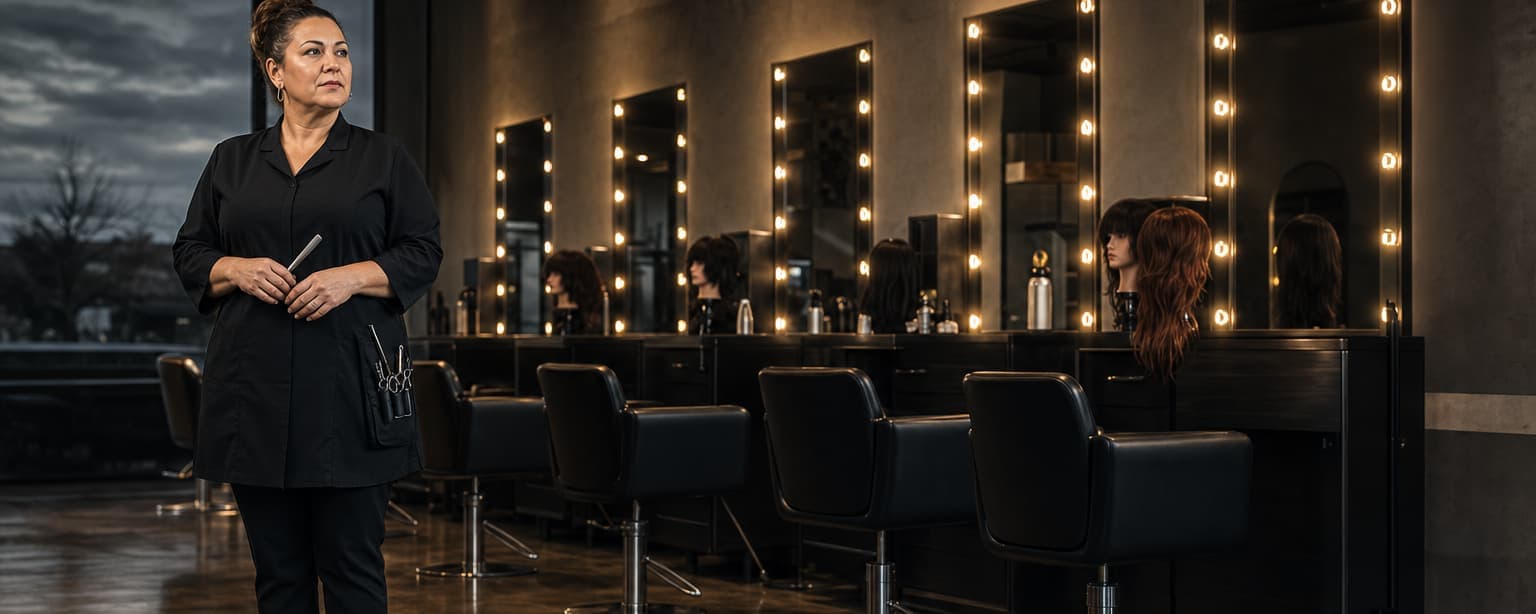
Students with knives, shears, chemicals and clippers, and a promise about a job.
Your students practice on the public and your equipment is the curriculum, but the largest claims are about what was promised at enrollment. We insure culinary, cosmetology, design, media, music and technology programs.
Tell us the situation.
One licensed human replies the same business day — not five agents, not an auto-responder. If the policy you have is already the right one, we will tell you.
We use this to quote and service your insurance, and we do not sell it or pass it to lead networks. Privacy policy.
Send us what you have. We’ll tell you if it’s right.
Your current policy paperwork, a renewal notice, or nothing at all. A licensed agent reads it and replies the same business day.
What vocational school businesses actually need.
General liability
Students, visitors and, where you run a student clinic or salon, paying members of the public on the premises.
Without it — A cosmetology or culinary school is a public-facing business as well as a classroom, and the lease requires it.
Educators professional liability
The instruction itself, and the claims that a program did not deliver what was represented, from placement rates to licensure preparation to accreditation.
Without it — Misrepresentation claims are the largest losses the sector has seen, and they are brought as class actions.
Abuse and molestation
Allegations involving students, including minors in high-school-age programs and adults in one-to-one instruction.
Without it — Excluded from general liability, and a question every carrier asks a school regardless of the students’ age.
Property and equipment
Kitchens, salon stations, editing suites, instruments, computer labs and the tools students train on.
Without it — The equipment is the school; a fire in a teaching kitchen closes the program until it is replaced.
Workers compensation
Instructors and staff, with cuts, burns and chemical exposure in the trades that involve them.
Without it — Students are not employees and are not covered by it, which is what participant accident coverage is for.
Participant accident
Medical bills for a student injured in a lab, kitchen or shop, paid regardless of fault.
Without it — A student’s unpaid emergency-room bill is how most liability claims against a school begin.
Business cyber
Student records, financial-aid data and payment systems.
Without it — A school that handles federal financial aid holds exactly the records a breach notification law is written about.
The claims we actually see.
Ordered by how often we see them, not by how dramatic they are. Each one names the coverage that answers it — and the policy people wrongly assume already does.
Most common
Students allege the program misrepresented placement or licensure
Covered by Educators professional liability
The claim that has sunk vocational schools, and it arrives as a class action over marketing copy and admissions calls. General liability does not touch it; a professional form written for schools does, and its wording on misrepresentation is the thing to read.
Most common
A student is cut, burned or injured in a lab or kitchen
Covered by Participant accident first, general liability if negligence is alleged
Students are not employees, so workers compensation does nothing for them. Participant accident pays the bill without a fault argument; without it the only route to the medical bill is a claim against the school.
Common
A member of the public is injured or harmed in a student clinic
Covered by General liability, and professional liability for the service itself
A chemical burn from a student colorist or a reaction to a student’s treatment is a professional claim against the school, not just a premises one. The clinic is a business serving the public and is underwritten as one.
Less common, severe
A fire or equipment loss in a teaching kitchen or shop
Covered by Property, equipment breakdown and business income
The building is the landlord’s problem; the program is yours. Enrolled students on a fixed schedule cannot wait for a rebuild, and refunds plus lost tuition are what business income coverage exists to replace.
Rare, catastrophic
An abuse or harassment allegation
Excluded from general liability. One-to-one instruction — a music lesson, a chair-side demonstration — is the exposure underwriters ask about, whatever the students’ age.
What our vocational school clients ask us.
Which carriers write vocational schools?
Philadelphia Insurance Companies — PHLY, part of Tokio Marine, rated A++ by AM Best — is the carrier that has told us in writing it wants vocational and technical schools: computer and technology institutes, culinary schools, design schools (web, fashion, graphic, interior, floral), media schools (broadcasting, photography, video production, advertising) and music, art and drama schools, and it is where most of our human-services submissions go first. PHLY does not sell to organizations directly: it works only through appointed agents, and we hold that appointment, so your file reaches their underwriter with our name on it rather than through a second intermediary. What their underwriter wants to see is specific and we assemble it before anything is sent — their supplemental application for your class, the standard applications, three years of valued loss runs (a report from each prior insurer showing every claim and its reserve), photographs of the premises, and your brochure or website. Payment plans are available once the annual price reaches $2,000. None of that is a promise to bind — every quote is subject to their underwriting review — but a complete file is the difference between a quote and a list of questions.
We teach minors. A district partner wants a high abuse and molestation limit. What is available?
Read the number carefully, because it decides your price. PHLY’s primary abuse and molestation limit is $1,000,000 per occurrence with a $1,000,000, $2,000,000 or — on occasion — $3,000,000 aggregate. Anything above that has to come from an umbrella, and their umbrella capacity is smaller in Los Angeles County than elsewhere, needs every control in place (screening, supervision, training, reporting) and is decided case by case. So a funder or landlord asking for $3,000,000 per occurrence and $6,000,000 aggregate is not asking for a bigger policy; they are asking for a tower — a primary plus one or more excess layers — and excess abuse coverage bought through the wholesale market runs roughly $15,000 per $1,000,000 of limit, often more than the underlying policy itself. Before you buy that, let us read the requirement. Many are boilerplate copied from a construction contract, and a sourced request to the funder explaining what the market actually offers gets them reduced more often than people expect. We quote the primary first, and build the tower only when the requirement genuinely will not move.
Stand-alone abuse and molestation: when it is the right route, and what it costs
What does the professional liability actually cover for a school?
Two different things, and the second is the one that matters. The first is the teaching: a student harmed by bad instruction, a curriculum that did not prepare them for the licensing exam, a grading or dismissal decision. The second is what the school said to get them to enroll — placement rates, salaries, accreditation, transferability of credits, eligibility to sit a state exam. Claims of that kind are brought by groups of former students, often with a regulator behind them, and they are the largest losses vocational education has produced. Read the professional form’s wording on misrepresentation and on regulatory proceedings before you buy on price; a cheaper policy that excludes them is not cheaper.
Our cosmetology students work on the public in a student salon. How is that insured?
As a salon that happens to be a school. The clinic floor is a business serving paying members of the public, so it carries general liability for the premises and professional liability for the services: a chemical burn, an allergic reaction to a product, a cut. The carrier will ask how supervision works: the instructor-to-student ratio on the floor, whether a licensed instructor signs off before a chemical service, and how clients are told they are being served by students. Answer those in the application rather than waiting to be asked; a school that can describe its supervision is quoted as a school, and one that cannot is quoted as an unsupervised salon.
How is a vocational school priced?
On enrollment and tuition revenue first, then on what is taught. A coding bootcamp in leased offices with no equipment and no public clients is a light class. A culinary school has commercial kitchens, open flame and knives; a cosmetology school has chemicals and a public clinic; a media school has expensive equipment students take off site. Whether you hold state approval to operate, whether you participate in federal financial aid, and whether you enroll students under eighteen each change the underwriting. Three years of loss runs and your current student handbook — the section on refunds, complaints and placement claims — tell the underwriter most of what they want to know.
Do students need to be covered under workers compensation?
No. They are not your employees, so the policy does not cover them and you should not be paying for them. The exception is a student who is also paid staff, a teaching assistant on payroll for example, who is covered for the paid work. For everyone else, participant accident coverage is the right tool: it pays a student’s medical bills for an injury in the kitchen, the lab or the shop regardless of fault, typically up to $25,000 or $50,000 per injury, and it keeps the injury from becoming a liability claim. Externships and placements with employers raise a separate question, whose policy covers the student at the host site, that the placement agreement should answer in writing.
Commercial insurance is 96% of what we do — it is not a department here, it is the whole business. Not ready to talk? The guides answer the questions this page raises in more depth. Already insured with us and need a certificate or a policy change? Ask the service team rather than starting a quote — it is faster and it goes to the people whose job it is. We also write home and auto, which is usually cheaper alongside the business policy than apart from it.
Handed a lease, a vendor packet or a client contract with insurance requirements? Paste it into the COI Requirements Decoder to see what each one means for your business, or read what the requirements mean.