
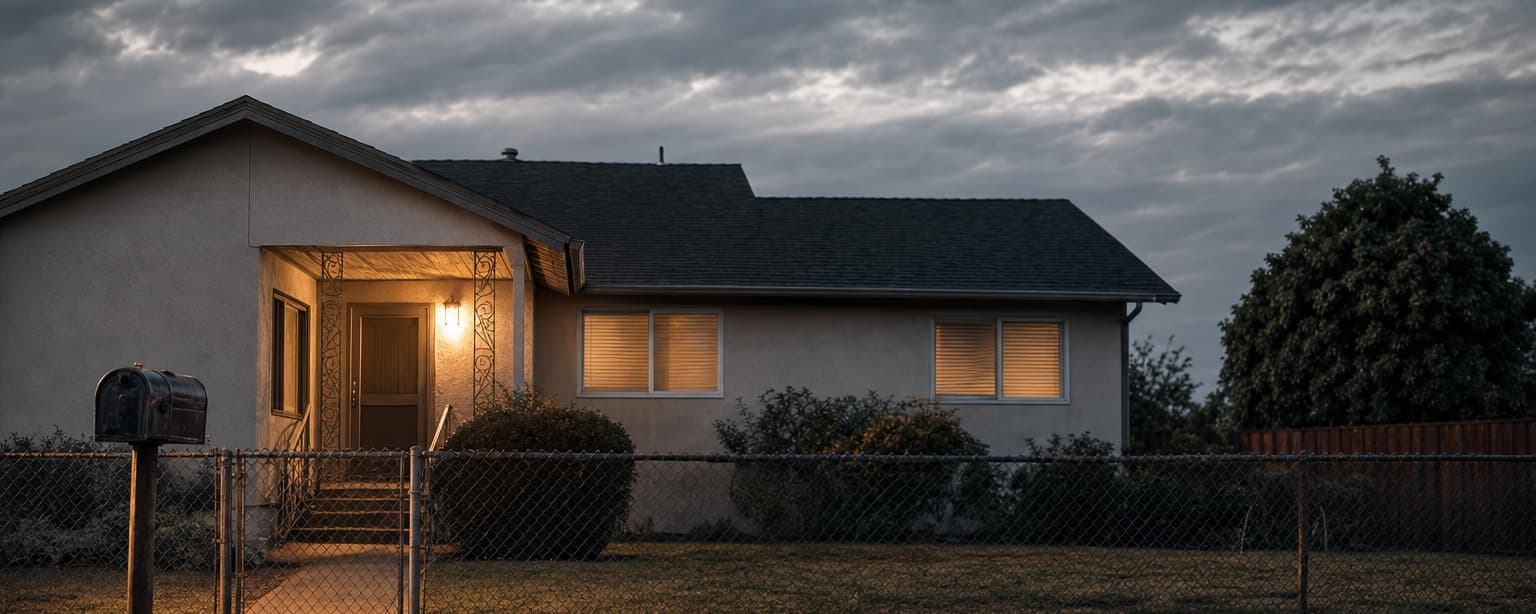
The policy most rental owners have, and the one most of them misread.
The dwelling fire form — DP-1, DP-2 or DP-3 — is what a house gets when the owner does not live in it. The three are not tiers of the same thing, and DP-3 does not do what many owners think it does.
Tell us the situation.
One licensed human replies the same business day — not five agents, not an auto-responder. If the policy you have is already the right one, we will tell you.
We use this to quote and service your insurance, and we do not sell it or pass it to lead networks. Privacy policy.
Send us what you have. We’ll tell you if it’s right.
Your current policy paperwork, a renewal notice, or nothing at all. A licensed agent reads it and replies the same business day.
What dwelling fire actually covers.
DP-1 — basic, named perils
A short list of perils, and usually actual cash value rather than replacement cost.
Without it — The cheapest form, and the one that depreciates a roof to nearly nothing.
DP-2 — broad, named perils
A longer named list, generally on a replacement cost basis.
Without it — Anything not on the list is not covered, and the list is what you must read.
DP-3 — special form
Open perils on the structure: covered unless excluded, which is the stronger position.
Without it — Still excludes far more than owners assume, and covers no liability by default.
Fair rental value
The rent lost while the property is untenantable after a covered loss.
Without it — Not automatic on every form, and frequently set far too low.
Liability — added, never assumed
A dwelling fire policy is a property form and nothing more: liability is an endorsement on it, or a separate policy altogether.
Without it — An owner who thinks they have homeowners-style liability has none.
What clients with dwelling fire ask us.
Is DP-3 the same as homeowners?
No, and the difference costs people money. DP-3 is open-perils on the structure like an HO-3, so the headline reads the same, but it carries no liability unless you add it, its contents coverage is minimal and aimed at the owner’s appliances rather than a tenant’s belongings, and it has no loss-of-use for anyone. It is a property form for a building somebody else lives in. Treating it as "homeowners for a rental" is the single most common mistake in this market.
Does a DP-3 cover short-term rental?
Usually not, and this is the gap that catches the most owners. Most dwelling fire forms are written for a conventional tenancy: a lease of months, one household. Nightly and weekly rental is commonly excluded outright or voided as a change in occupancy and a business use of the premises, and the exclusion is often explicit. Owners running an Airbnb on a DP-3 are frequently uninsured for the exact activity generating the income, and find out at claim.
Why did my insurer switch me to DP-1 at renewal?
Usually vacancy, condition or claims. A property standing empty, an ageing roof, or two claims in three years pushes an owner out of the preferred market and onto a basic form, often without the change being obvious in the renewal paperwork. The perils list shrinks and the settlement basis can drop to actual cash value at the same time. Read the form code at every renewal, because that is where it shows.
What is the actual cash value trap?
Settlement at replacement cost minus depreciation. On a fifteen-year-old roof that can be most of its value, so a $30,000 roof claim settles near $8,000 and the owner funds the rest. It rarely matters at purchase and always matters at claim, which is why the settlement basis deserves more attention than the premium difference that produced it.
Is the liability I add to a DP-3 the same as general liability?
No. The liability form on a dwelling policy is premises liability, which responds to bodily injury or property damage caused by an accident and to nothing else. Our founder held exactly that on a rental in 2018 when a guest sued him in small claims over the review he wrote about her on Airbnb, and the carrier had no coverage for a claim with no injury and no damage in it. A commercial general liability policy adds personal and advertising injury, which names libel and slander. If you rent to the public, that second insuring agreement is the one you are missing.
Commercial insurance is 96% of what we do — it is not a department here, it is the whole business. Not ready to talk? The guides answer the questions this page raises in more depth. Already insured with us and need a certificate or a policy change? Ask the service team rather than starting a quote — it is faster and it goes to the people whose job it is. We also write home and auto, which is usually cheaper alongside the business policy than apart from it.
Handed a lease, a vendor packet or a client contract with insurance requirements? Paste it into the COI Requirements Decoder to see what each one means for your business, or read what the requirements mean.