
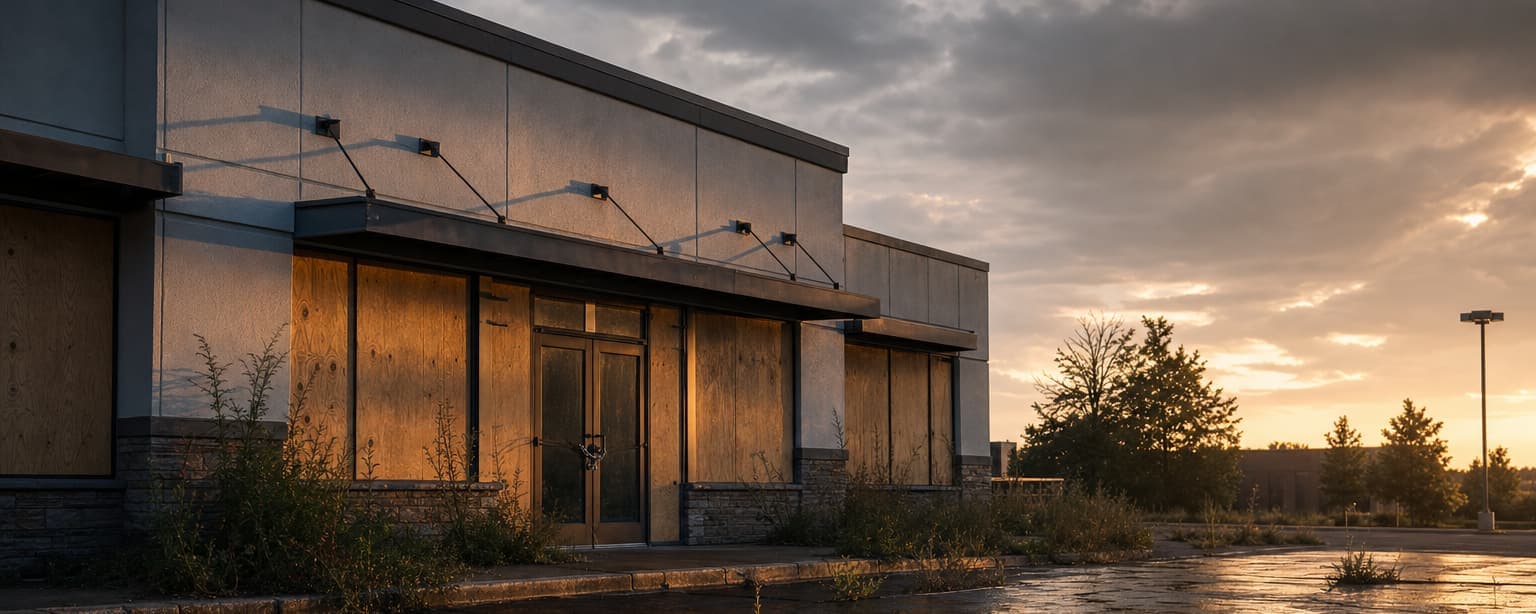
Sixty days after the last tenant left, most of your policy switched off.
A standard property policy suspends the coverages that matter most the moment a building stands empty. We cover it between tenants, in probate, mid-renovation or awaiting sale.
Tell us the situation.
One licensed human replies the same business day — not five agents, not an auto-responder. If the policy you have is already the right one, we will tell you.
We use this to quote and service your insurance, and we do not sell it or pass it to lead networks. Privacy policy.
Send us what you have. We’ll tell you if it’s right.
Your current policy paperwork, a renewal notice, or nothing at all. A licensed agent reads it and replies the same business day.
What vacant property businesses actually need.
Property, without the vacancy cut
A form written for an empty building rather than one that penalises it.
Without it — Vandalism, theft, water and glass are the first coverages a vacancy clause removes.
Vandalism and theft
Break-ins, copper and fixture theft, arson and squatting.
Without it — The dominant loss on an empty building, and the first thing excluded.
Liability for an empty site
Injury to trespassers, contractors and anyone attracted by an open building.
Without it — An unsecured empty building is an attractive nuisance in most states.
Water damage and freeze
Escape of water nobody is present to notice.
Without it — Commonly excluded outright once vacant unless systems are drained.
Renovation exposure
Where the building is empty because work is going on.
Without it — Structural work usually needs builders risk rather than a vacant form.
Businesses like this one, with their own page.
Every one of these is written for that specific operation — the coverages it needs, the questions underwriters ask it, and what it usually gets wrong.
- Vacant Land
Vacant land has no building to insure, which is why owners assume it needs no insurance. What it has is liability: a trespasser hurt on it, a hunter, a child on a dirt bike, a neighbor whose fence a fallen tree took out, a fire that started on your acreage and spread. Vacant land liability is a general liability policy written for a parcel, priced by the acre, and it is among the least expensive policies sold because the underwriter's questions are short: where is it, what is on it, and who can get onto it. We place it for investors holding lots, farmland between uses, hunting land, and parcels waiting for a permit.
What our vacant property clients ask us.
When exactly does a building count as vacant?
The form defines it and the definitions differ, which is why owners get caught. Commercial forms commonly treat a building as vacant when less than a stated percentage, often 31%, of its square footage is used in customary operations, measured after a period of typically 60 days. Note "unoccupied" and "vacant" are not the same: a furnished house between tenants may be unoccupied, an emptied one is vacant, and the coverage consequences differ. Read your own form rather than assuming the usual numbers.
What actually gets cut?
On most commercial forms, vandalism, sprinkler leakage, glass breakage, water damage and theft are excluded outright once the vacancy period passes, and everything still covered is paid at a reduced percentage — 15% less is typical. That combination is what makes vacancy dangerous: the coverages removed are precisely the losses an empty building suffers, and the reduction applies to the fire claim you thought was safe.
We are renovating. Vacant policy or builders risk?
Depends on the work. Cosmetic work in an otherwise idle building sits on a vacant property policy, sometimes with a renovation endorsement. Structural work, additions or anything changing the footprint belongs on builders risk, which is written for a project and covers materials on site and in transit. Getting this wrong is common and expensive: a vacant policy will generally exclude the construction, and a builders risk will not answer for the idle building around it.
How do we get better terms on an empty building?
By reducing the two things underwriters fear: unauthorised entry and undetected water. Boarding or securing at ground level, monitored alarms, working locks and lighting, winterising and draining the water system, cutting the grass so it does not look abandoned, and documented inspections on a schedule you actually keep. Inspection frequency is often a policy condition rather than a discount, so agree an interval you will meet.
Commercial insurance is 96% of what we do — it is not a department here, it is the whole business. Not ready to talk? The guides answer the questions this page raises in more depth. Already insured with us and need a certificate or a policy change? Ask the service team rather than starting a quote — it is faster and it goes to the people whose job it is. We also write home and auto, which is usually cheaper alongside the business policy than apart from it.
Handed a lease, a vendor packet or a client contract with insurance requirements? Paste it into the COI Requirements Decoder to see what each one means for your business, or read what the requirements mean.