
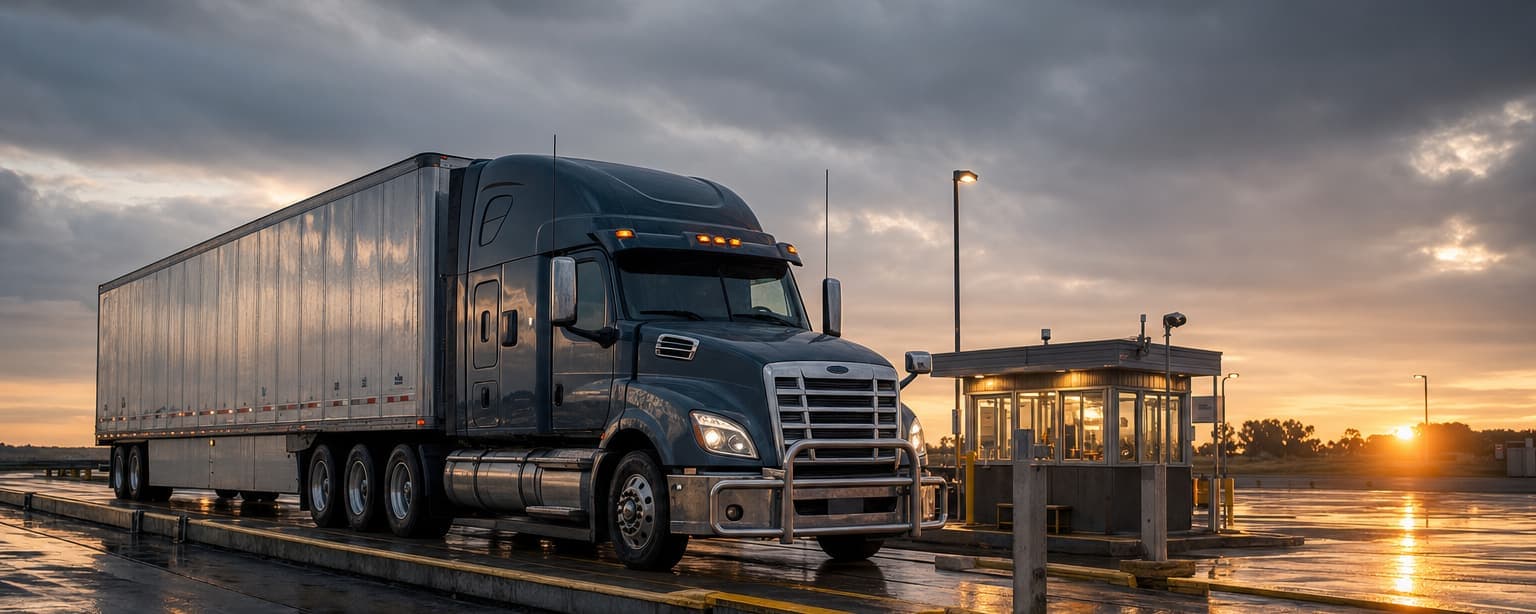
The federal minimum is $750,000. No broker in the country will load you at $750,000.
Primary auto liability is the coverage FMCSA requires before your authority goes active, the line the BMC-91 files against and the MCS-90 endorses. The federal floor has not moved since 1980, and the market moved without it.
Tell us the situation.
One licensed human replies the same business day — not five agents, not an auto-responder. If the policy you have is already the right one, we will tell you.
We use this to quote and service your insurance, and we do not sell it or pass it to lead networks. Privacy policy.
Send us what you have. We’ll tell you if it’s right.
Your current policy paperwork, a renewal notice, or nothing at all. A licensed agent reads it and replies the same business day.
What trucking auto liability actually covers.
Bodily injury and property damage
What you owe other people when one of your trucks causes a loss.
Without it — A single serious injury on an interstate exhausts a $750,000 limit before the case is argued.
The MCS-90 endorsement
A federal endorsement making the insurer pay a public judgment even where the policy would not respond.
Without it — Your authority cannot go active. It is a guarantee to the public, not cover for you: the insurer can and does come back to you for what it paid.
The BMC-91 filing
The insurer telling FMCSA electronically that the policy exists.
Without it — The policy is in force and the authority still shows inactive, because FMCSA reads filings and not certificates.
Trailers and non-owned units
Liability while pulling a trailer you do not own, under an interchange agreement.
Without it — The liability follows the power unit and the gap shows after the accident.
Where trucking auto liability shows up.
- Trucking
The liability form written for a for-hire carrier. The page covers what the MCS-90 promises the public, what the filing does not do, and why a scheduled-auto policy fails a broker packet.

Lori Adams, TRS
Commercial Trucking Insurance Advisor
Twenty-five years in trucking insurance. Knows the filings, the radius rules and the carriers that will actually take the risk.
Transportation Risk Specialist (TRS)
What clients with trucking auto liability ask us.
How much liability does FMCSA actually require?
For general freight in a vehicle rated 10,001 lbs GVWR or more, $750,000, the figure in the schedule at 49 CFR 387.9, set in 1980 and never raised. It goes to $1,000,000 for oil, hazardous waste and hazardous materials listed in 49 CFR 172.101, and to $5,000,000 for hazardous substances in bulk, bulk Division 1.1, 1.2 and 1.3 explosives, poison-gas Zone A materials and highway route controlled radioactive material. Passenger carriers sit under a separate schedule at 387.33. Intrastate-only operations follow their own state rule, which is sometimes lower and sometimes higher.
So why does everyone say $1 million?
Because the federal minimum stopped being the operative number decades ago. Brokers and shippers set their own requirement in the load contract, and $1,000,000 combined single limit is effectively universal. Many require it before they will even see your rate. A carrier who buys $750,000 because that is what the regulation says is legal, filed, and unable to get loaded. Treat the federal figure as the floor for your authority and the broker requirement as the number you actually buy.
What is the difference between this and truckers general liability?
They cover opposite halves of the day. Auto liability responds when the truck causes the loss: in motion, in traffic, backing into a dock. Truckers general liability responds to everything that is not the vehicle in operation: a driver injuring someone on the customer’s premises, damage during loading and unloading, and completed operations. Auto liability is federally required and filed; TGL is required by contract, and the certificate a shipper asks for usually names both. Carrying one and assuming it covers the other is a common and expensive mistake.
Does the MCS-90 cover my truck?
No, and this is the single most misread document in trucking. The MCS-90 is a surety-like guarantee to the public: it obliges your insurer to pay a judgment for bodily injury or property damage to a member of the public up to the filed limit even if the policy itself excludes the loss — an undisclosed driver, a hauled commodity you never declared, an operation outside the policy terms. It does not pay for your truck, your cargo, or you. And when the insurer pays under it, they are entitled to recover that money from you. It exists so an injured member of the public is not left with nothing.
Why is new authority so expensive?
Because underwriters price the first year on the crash data, and carriers in their first year of authority crash more, with no loss history, no CSA scores and no way to tell a careful operator from a careless one, everyone is rated as the class average. Expect to be quoted well above an established fleet, expect a larger deposit, and expect fewer carriers to look at it at all. It comes down materially at the first clean renewal, which is why the worst thing you can do in year one is let coverage lapse and reset the clock.
Commercial insurance is 96% of what we do — it is not a department here, it is the whole business. Not ready to talk? The guides answer the questions this page raises in more depth. Already insured with us and need a certificate or a policy change? Ask the service team rather than starting a quote — it is faster and it goes to the people whose job it is. We also write home and auto, which is usually cheaper alongside the business policy than apart from it.
Handed a lease, a vendor packet or a client contract with insurance requirements? Paste it into the COI Requirements Decoder to see what each one means for your business, or read what the requirements mean.