
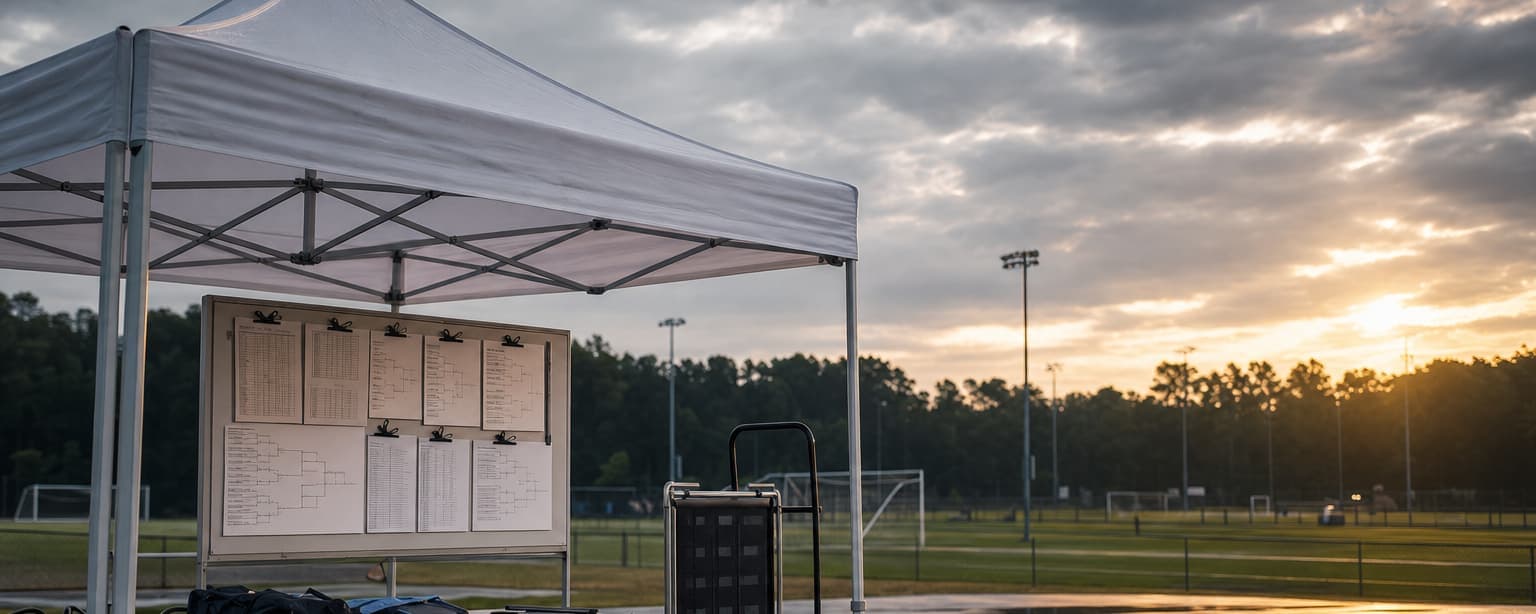
One weekend, a field full of strangers, and somebody else’s facility.
We insure teams, tournaments, races and one-off sporting events, from the facility’s requirements to the participants to the prize you have promised.
Tell us the situation.
One licensed human replies the same business day — not five agents, not an auto-responder. If the policy you have is already the right one, we will tell you.
We use this to quote and service your insurance, and we do not sell it or pass it to lead networks. Privacy policy.
Send us what you have. We’ll tell you if it’s right.
Your current policy paperwork, a renewal notice, or nothing at all. A licensed agent reads it and replies the same business day.
What teams and sporting events businesses actually need.
Event liability
General liability for a single event or a season of them. It is the coverage a venue, park or municipality requires, naming them, before they will confirm the booking.
Without it — The venue, the park district or the city named before you are allowed to use the ground.
Participant accident
Pays the medical costs of a player, a camper or a rider injured while taking part, without anyone having to establish that the organization was at fault.
Without it — Competitors injured in the ordinary course of competing, covered without fault.
Event cancellation
Reimburses the committed costs of an event that cannot go ahead for a reason outside your control, and the exposure peaks before the gates open, because most of the money is spent by then.
Without it — Entries, permits, timing, medical coverage and marketing are committed before race day.
Prize indemnity
Pays the prize when somebody actually wins it, whether a hole in one, a half-court shot or a grand prize, so a promotion can offer a number far larger than its budget.
Without it — A hole in one, a half-court shot or a grand prize you cannot afford to hand over.
General liability
Third-party bodily injury and property damage. It is the line nearly every contract names by default.
Without it — Spectators, parking lots, road closures and volunteers directing all three.
Inland marine & equipment
Tools, equipment and property in transit. It picks up exactly where commercial property stops, which is the moment the item leaves the building.
Without it — Timing systems, barriers, staging and hire equipment on an open course.
Umbrella & excess liability
Extra limit stacked above general liability, auto and employers liability. Usually the cheapest million dollars on the policy.
Without it — Municipal permits and national governing bodies specify limits above primary.
Active assailant
Covers the costs following a violent attack at a premises or event: victim support, counseling, closure, the security review and the crisis response, most of which liability coverage does not reach.
Without it — Mass-participation events in public space are the profile this form addresses.
What the insurance company will ask about your teams and sporting events business
We read the applications the markets use for businesses in this field and pulled out what they actually ask. Have these answers ready and a quote takes a day instead of a week, because nobody has to come back to you for the missing piece.
About the business
- How many years has your race team been in business?
- What exactly does your team do at events - what classes race, what is your role?
- How many events do you plan to hold, and what is your expected total attendance?
How you operate
- Who manages the business day-to-day, and how many years of experience do they have in racing?
- Are spectators allowed in pit areas or on race vehicles during events?
- Will your track or course be closed during testing and practice sessions?
- Do you have any contract requirements from track owners or sponsors?
Safety and controls
- What is your drug policy for employees and drivers, and what happens if someone fails a test?
- For each race vehicle, what is the year, make, model, VIN, current value, engine type, horsepower, max speed, and hull type?
- Who are your race vehicle operators, what are their ages, how many years of experience does each have, and do any have traffic or safety citations?
Your history
- Are you aware of any incidents, accidents, lawsuits, or losses that haven't been reported to your current insurer?
- What is your claims history over the last five years?
Money and people
- How many full-time and part-time employees do you have?
- What is your annual payroll?
- Who owns the business, and how many years of racing experience do they have?
Have these ready
- Your last five years of claims history from your current insurer, including what happened, the damage or injury, and what was done to prevent it from happening again
- A copy of any contracts you have with track owners, event organizers, or sponsors
- Information about your current insurance coverage and provider, including the company name, types of coverage, limits, and annual premium
You answer what you can; a licensed agent fills the rest with you.
What our teams and sporting events clients ask us.
The city wants a certificate for a road race. What will they ask for?
A million or two per occurrence naming the municipality, often the police and parks departments separately, frequently a waiver of subrogation, and increasingly evidence of a medical plan and marshalling. Permits are approved in a sequence, so the certificate is usually needed weeks before the event rather than days. Get the requirement in writing when you apply, not when you are chased.
We are offering a car for a hole in one. How does that work?
Prize indemnity, and it is cheaper than people expect because it is priced on the odds. Conditions are strict and procedural — a minimum distance measured on the day, independent witnesses at tee and green, a registered player list — and almost every failed claim is a condition missed rather than a dispute about the shot. Arrange it before you advertise the prize.
Do participants signing a waiver mean we do not need insurance?
No. A waiver is a useful document and it is not a policy: it can be found unenforceable, it does not bind a minor’s parents in every state, it does nothing about a spectator, and it does not pay anybody’s medical bills. Use both: the waiver to set expectations, the insurance to actually respond.
What does a teams and sporting events insurance application ask for?
The applications for teams and sporting events businesses ask about 4 things above all: how many years has your race team been in business; who manages the business day-to-day, and how many years of experience do they have in racing; what is your drug policy for employees and drivers, and what happens if someone fails a test; are you aware of any incidents, accidents, lawsuits, or losses that haven't been reported to your current insurer. Have your last five years of claims history from your current insurer, including what happened, the damage or injury, and what was done to prevent it from happening again and a copy of any contracts you have with track owners, event organizers, or sponsors ready and a quote takes a day instead of a week.
Commercial insurance is 96% of what we do — it is not a department here, it is the whole business. Not ready to talk? The guides answer the questions this page raises in more depth. Already insured with us and need a certificate or a policy change? Ask the service team rather than starting a quote — it is faster and it goes to the people whose job it is. We also write home and auto, which is usually cheaper alongside the business policy than apart from it.
Handed a lease, a vendor packet or a client contract with insurance requirements? Paste it into the COI Requirements Decoder to see what each one means for your business, or read what the requirements mean.