
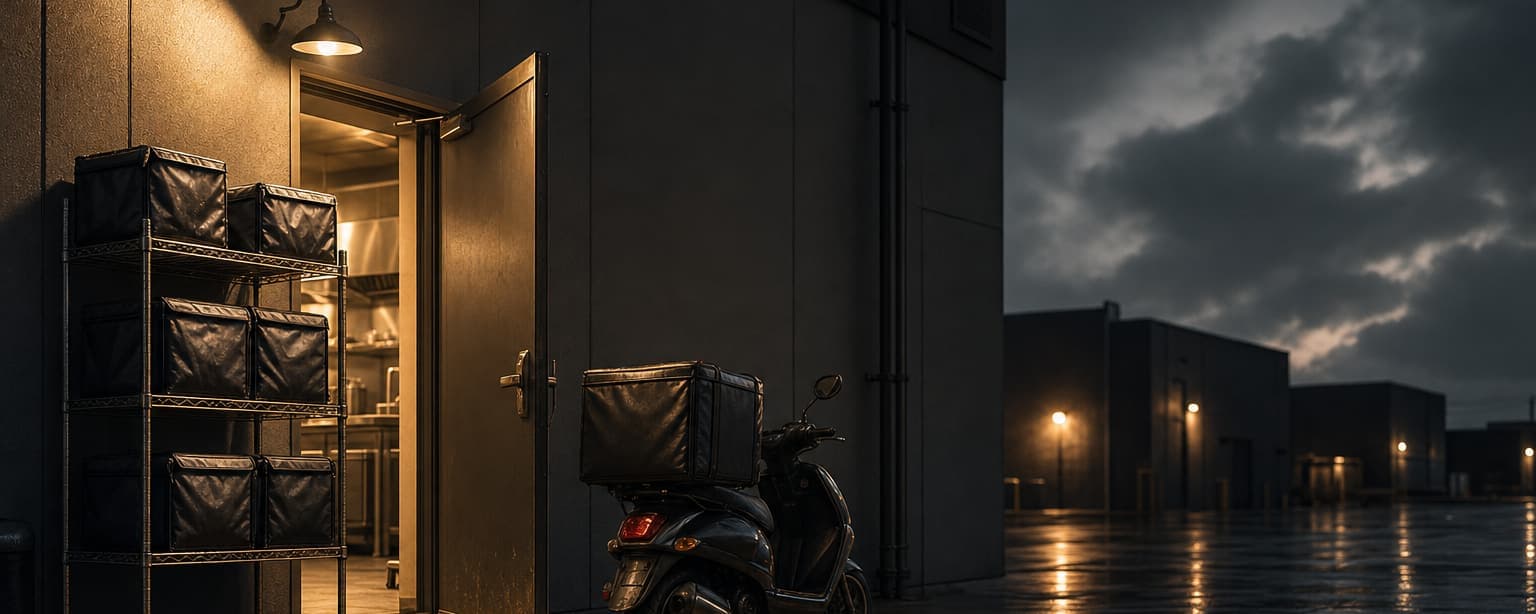
The moment you tell a carrier you deliver, most of them stop quoting.
The moment your staff deliver in their own cars, general liability stops carrying the auto exposure. We place restaurant delivery with the few markets that write it.
Tell us the situation.
One licensed human replies the same business day — not five agents, not an auto-responder. If the policy you have is already the right one, we will tell you.
We use this to quote and service your insurance, and we do not sell it or pass it to lead networks. Privacy policy.
Send us what you have. We’ll tell you if it’s right.
Your current policy paperwork, a renewal notice, or nothing at all. A licensed agent reads it and replies the same business day.
What delivery restaurant businesses actually need.
Hired and non-owned auto
Liability when an employee crashes their own car on a delivery run: the business gets sued, not just the driver.
Without it — The single coverage that makes delivery hard to place at all, and the one most standard carriers will not attach once you disclose it.
General liability
The dining room, the counter, the sidewalk and foodborne illness claims.
Without it — The base policy, but on a delivery account it usually will not carry the auto exposure with it.
Workers compensation
Drivers injured on the road, and kitchen staff burned or cut, on different class codes and often one payroll.
Without it — A driver hurt on a run is a work injury wherever the accident happened, and delivery class codes rate well above kitchen ones.
Employer’s non-ownership liability
The endorsement wording that decides whether your policy responds when the car is the employee’s and the trip was yours.
Without it — A personal auto policy commonly excludes delivery for compensation, which means the driver’s insurer denies and yours is the only one left.
Umbrella
Excess above the auto and general liability limits, which is where a serious road claim actually lands.
Without it — A primary auto limit is exhausted by one injury accident, and delivery accidents involve other people’s cars and other people’s bodies.
Business cyber
Online ordering, stored cards and the customer database that delivery necessarily builds.
Without it — Taking orders online means holding addresses and payment data for everyone who ever ordered.
Crime and social engineering
Till shortages across shifts, and the supplier invoice paid to a changed account number.
Without it — Paying a supplier invoice to a changed account is not theft under a property policy. It sits under social engineering, which you have to request.
Group health and benefits
Drivers who know the routes and stay long enough to be worth insuring.
Without it — Driver turnover raises your auto rate directly: a fleet of six-month drivers is a fleet of unknown risks to an underwriter.
An independent restaurant with four delivery drivers was non-renewed after its carrier reclassified the account on discovering deliveries. Two brokers came back declined, and the shop was days from operating with the auto exposure uninsured.
We placed general liability, property and hired and non-owned auto together in a market that writes delivery deliberately, at a $1M limit with an umbrella above it. The submission went out with a written driver safety program and a signed driver standards handbook for each driver, which is what moved it from a marginal risk to an accepted one. The coverage was bound before the old policy expired.
What the insurance company will ask about your delivery restaurant business
We read the applications the markets use for businesses in this field and pulled out what they actually ask. Have these answers ready and a quote takes a day instead of a week, because nobody has to come back to you for the missing piece.
About the business
- What kind of food and drinks do you serve?
- How many years have you been in business?
- What are your annual sales?
- What are your regular hours of operation?
- Do you deliver alcohol to customers, and if so, how far?
How you operate
- Do you have live entertainment like DJs, bands, or karaoke?
- Do you offer bottle service or drinking games?
- Do you rent out your space for private events?
- If you do table-side or hibachi cooking, what types of cooking are done on premises?
- Are there warning signs posted about hot surfaces where cooking happens?
Safety and controls
- Do you check IDs at the door?
- Are all employees who serve alcohol certified?
- Do you employ bouncers or security staff?
- What is your average customer age range?
- Have you had police calls to your business in the last three years?
Your history
- How long has liquor liability coverage been in place at this business?
- Has liquor liability coverage been cancelled or non-renewed in the past five years?
- Have you ever filed for bankruptcy?
Money and people
- Who owns and manages this business, and what is their restaurant experience?
- Is there anyone else with a financial interest in the business?
Have these ready
- Your active liquor license and active food service permit or license
- Your loss and claims history for the past three to five years from your current insurance company
- A written agreement and certificate of insurance from any security firm you use
- A written agreement and certificate of insurance from any independent contractors or vendors you work with
- Records showing how you track stock rotation and cooler temperatures
You answer what you can; a licensed agent fills the rest with you.
What our delivery restaurant clients ask us.
Why will hardly anyone quote us once we say we deliver?
Because delivery converts a premises risk into a road risk, and road risk is where severity lives. A slip in the dining room is a five-figure claim; a driver running a light in their own car with your logo on the roof is a seven-figure one, with your business named because the trip was for your benefit.
Our drivers use their own cars and have their own insurance. Isn’t that enough?
No, and this is the assumption that causes the uninsured claims. A personal auto policy almost always excludes using the vehicle to carry goods or people for compensation, so the moment your driver is delivering, their own insurer has grounds to deny, leaving your business as the only solvent party in the suit. Even where their policy does pay, it pays their limit, which is usually a state minimum, and the plaintiff comes to you for the rest. And your driver can sue you for not carrying the coverage the business was supposed to have. Their insurance is a layer, not a substitute.
What do you actually give us beyond a policy?
The program the underwriter wants to see, because on a delivery account that is what decides both acceptance and price. We provide our insureds with underwriting-approved sample cell phone and distracted driving policies, a written driver safety program, and driver standards handbooks your employees can sign at hire.
Should we be pulling MVRs on drivers?
Yes, on every driver at hire, and we recommend it strongly enough that it is part of how we present these accounts. Two reasons. The obvious one is that it stops you handing a company errand to somebody with a suspended license or a recent DUI, which is the fact that turns an accident into a negligent hiring claim against you.
We use DoorDash and Uber Eats. Does that change it?
It reduces the exposure but it does not remove it, and the mistake is assuming it does. On a third-party marketplace order collected by their courier, the driver is not yours and the auto exposure largely is not either.
What limit do we need?
Start at $1M and expect to be asked for more, and treat that number as a floor rather than a target. Auto claims are the most severe thing a restaurant does, a single injury accident regularly exceeds a $1M primary, so most delivery accounts sit better with an umbrella above it. Where a franchise agreement, a landlord or a catering client names a limit, theirs decides it: brand requirements in this trade run well above $1M and are non-negotiable. Tell us what your agreement says and we will build to that number rather than to the cheapest compliant one.
What does a delivery restaurant insurance application ask for?
The applications for delivery restaurant businesses ask about 4 things above all: what kind of food and drinks do you serve; do you have live entertainment like djs, bands, or karaoke; do you check ids at the door; how long has liquor liability coverage been in place at this business. Have your active liquor license and active food service permit or license and your loss and claims history for the past three to five years from your current insurance company ready and a quote takes a day instead of a week.
Also in this family
Commercial insurance is 96% of what we do — it is not a department here, it is the whole business. Not ready to talk? The guides answer the questions this page raises in more depth. Already insured with us and need a certificate or a policy change? Ask the service team rather than starting a quote — it is faster and it goes to the people whose job it is. We also write home and auto, which is usually cheaper alongside the business policy than apart from it.
Handed a lease, a vendor packet or a client contract with insurance requirements? Paste it into the COI Requirements Decoder to see what each one means for your business, or read what the requirements mean.