
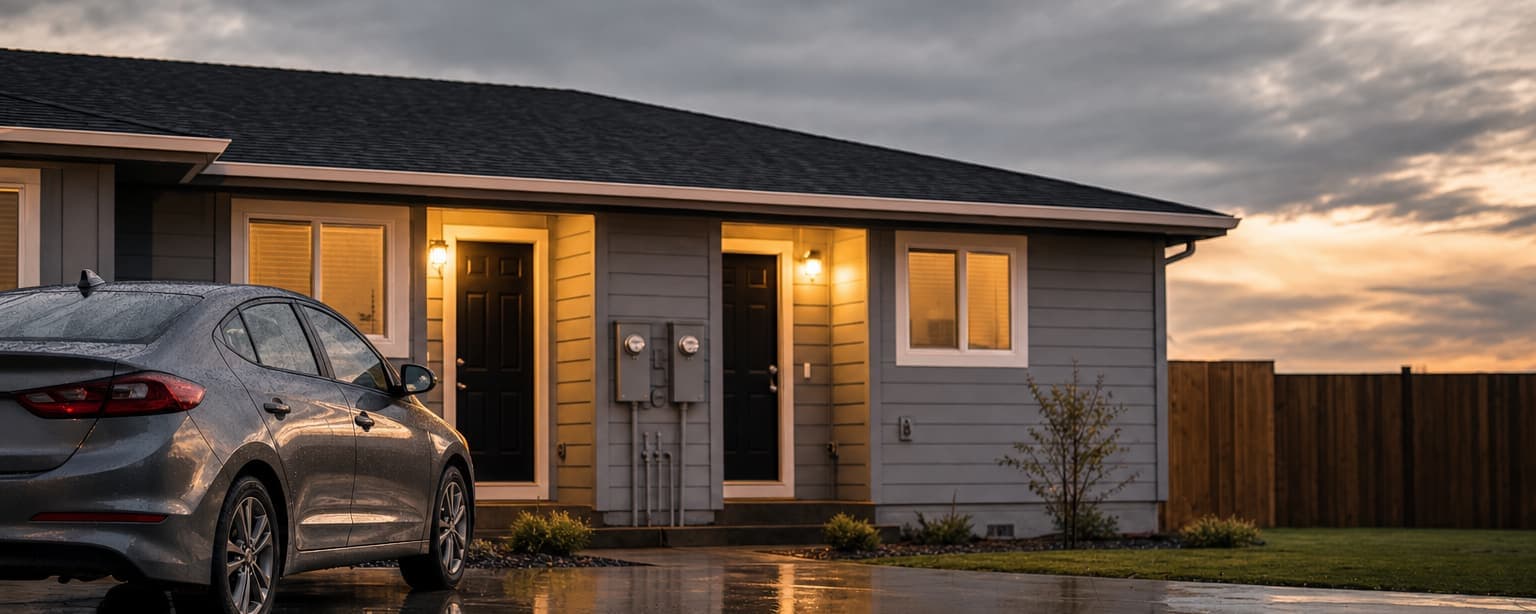
The day a tenant moves in, your homeowners policy stops being the right policy.
A homeowners policy assumes you live there, so it never contemplates lost rent. We cover rental property from a single unit to a portfolio.
Tell us the situation.
One licensed human replies the same business day — not five agents, not an auto-responder. If the policy you have is already the right one, we will tell you.
We use this to quote and service your insurance, and we do not sell it or pass it to lead networks. Privacy policy.
Send us what you have. We’ll tell you if it’s right.
Your current policy paperwork, a renewal notice, or nothing at all. A licensed agent reads it and replies the same business day.
What landlord insurance actually covers.
Dwelling and other structures
The building itself, at replacement cost.
Without it — A homeowners form excludes tenant occupancy, so the whole policy is in question.
Loss of rents
The rent that stops while the property is uninhabitable after a covered loss.
Without it — The mortgage continues through a six-month rebuild and the income does not.
Water and sewer backup
Water that comes back up a drain, sewer or sump, which the base form excludes.
Without it — A basement or ground-floor unit floods from the drain far more often than from the roof, and the claim lands on the owner.
Landlord liability
Injury claims by tenants and their visitors.
Without it — A trip on a stair or a dog bite in a shared yard names the owner, not the tenant.
Where landlord insurance shows up.
- Real Estate Investors
A held property and a let property are different risks on the same asset.
What clients with landlord insurance ask us.
Should I require tenants to carry renters insurance?
Yes, and put it in the lease with a minimum liability limit and proof at renewal. It costs the tenant very little, and it does two things for you: it covers their possessions so they are not looking to your policy for them, and their liability coverage responds first when they cause damage, a kitchen fire or an overflowing bath, instead of your policy taking the claim and the loss history. Ask to be named as an additional interest so you are notified if it lapses.
Does one policy cover several properties?
Once you are past about four units it usually should. A schedule of locations on one policy is simpler to manage, avoids gaps at renewal dates that drift apart, and typically prices better than separate policies. Past roughly ten units, or with any commercial tenancy in the mix, it moves to a commercial package, at which point you also gain the ability to add a blanket limit rather than insuring each building to a fixed number.
Commercial insurance is 96% of what we do — it is not a department here, it is the whole business. Not ready to talk? The guides answer the questions this page raises in more depth. Already insured with us and need a certificate or a policy change? Ask the service team rather than starting a quote — it is faster and it goes to the people whose job it is. We also write home and auto, which is usually cheaper alongside the business policy than apart from it.