
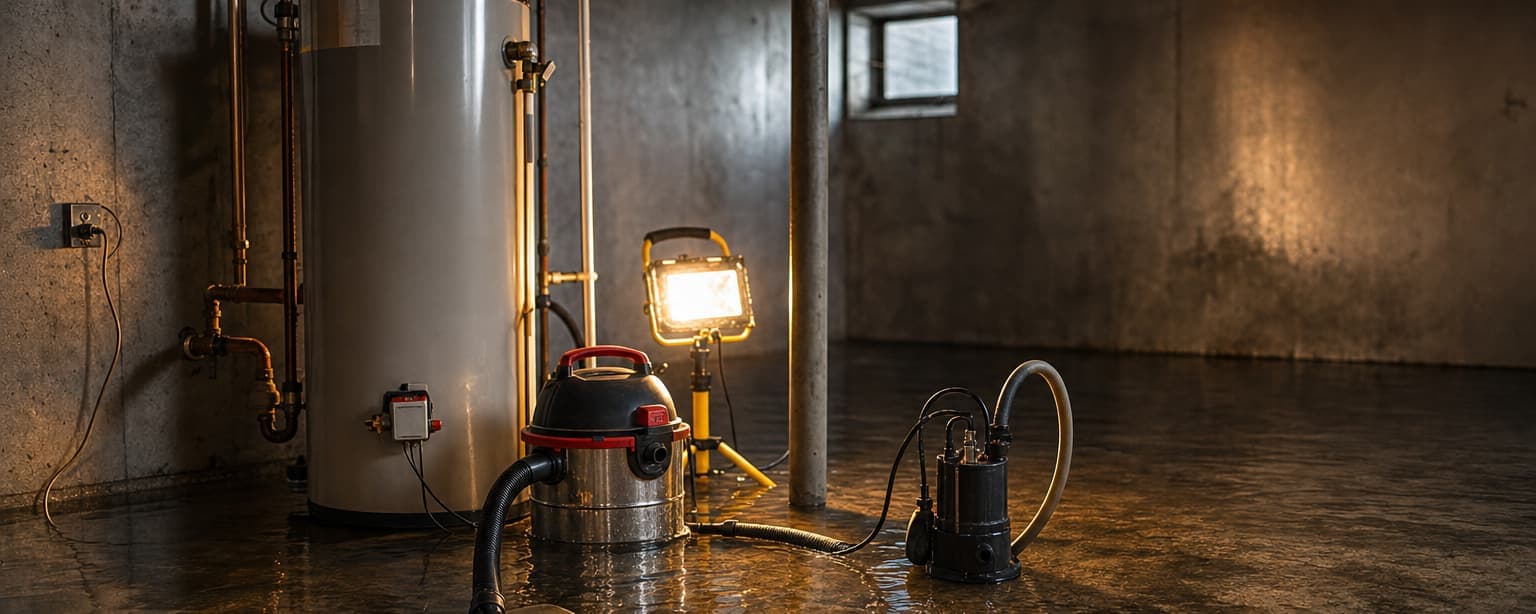
Water that comes back up the drain is excluded by default.
An endorsement for backup of sewers, drains and sump pump failure, excluded from standard property policies, and separate again from flood.
Tell us the situation.
One licensed human replies the same business day — not five agents, not an auto-responder. If the policy you have is already the right one, we will tell you.
We use this to quote and service your insurance, and we do not sell it or pass it to lead networks. Privacy policy.
Send us what you have. We’ll tell you if it’s right.
Your current policy paperwork, a renewal notice, or nothing at all. A licensed agent reads it and replies the same business day.
What water backup actually covers.
Sewer and drain backup
Water backing up through the building’s own drainage.
Without it — Excluded by the standard property form, and a common basement loss.
Sump pump failure and overflow
Loss when the pump fails, loses power or is overwhelmed.
Without it — The failure is mechanical, which puts it outside the property peril.
Resulting damage and clean-up
Damage to the building and contents, plus the clean-up itself.
Without it — Category three water requires professional remediation, not a mop.
Lost rent
Income while affected units cannot be occupied.
Without it — A basement backup in a multifamily building empties units immediately.
What clients with water backup ask us.
Is this the same as flood coverage?
No, and the difference decides which policy pays. Flood is surface water rising and entering the building from outside. Backup is water coming up through the building’s own drains, sewers or sump. A property can suffer either or both in the same storm, and they are covered by two different purchases — the flood policy and this endorsement. Owners who bought one commonly believe they are covered for the other.
Why is backup excluded in the first place?
Because it is frequent, it correlates across a whole neighborhood in one storm, and it is heavily influenced by municipal infrastructure the insurer cannot underwrite. Standard property forms exclude it and sell it back as a scheduled endorsement with its own limit, which is usually far lower than the building limit, so the number to check is the endorsement sublimit rather than the policy limit.
What limit should we carry?
More than the default. Endorsement limits often start around $5,000 or $10,000, which is a fraction of what a finished basement, a lift pit, an electrical room or a set of ground-floor units costs to remediate. Set it against what is actually below the water line in your building — mechanical plant is usually the expensive part, not the flooring — and check whether the limit is per occurrence or annual aggregate.
Does a backwater valve help?
Yes, on both frequency and pricing, and it is one of the few genuinely cheap fixes in property risk. A backwater valve on the main drain stops sewer water re-entering the building, and insurers ask about it in areas with known municipal capacity problems. Same logic as leak detection on supply lines: the device costs a fraction of the deductible, and having it documented is worth mentioning on the submission.
Also in this family
Commercial insurance is 96% of what we do — it is not a department here, it is the whole business. Not ready to talk? The guides answer the questions this page raises in more depth. Already insured with us and need a certificate or a policy change? Ask the service team rather than starting a quote — it is faster and it goes to the people whose job it is. We also write home and auto, which is usually cheaper alongside the business policy than apart from it.
Handed a lease, a vendor packet or a client contract with insurance requirements? Paste it into the COI Requirements Decoder to see what each one means for your business, or read what the requirements mean.