
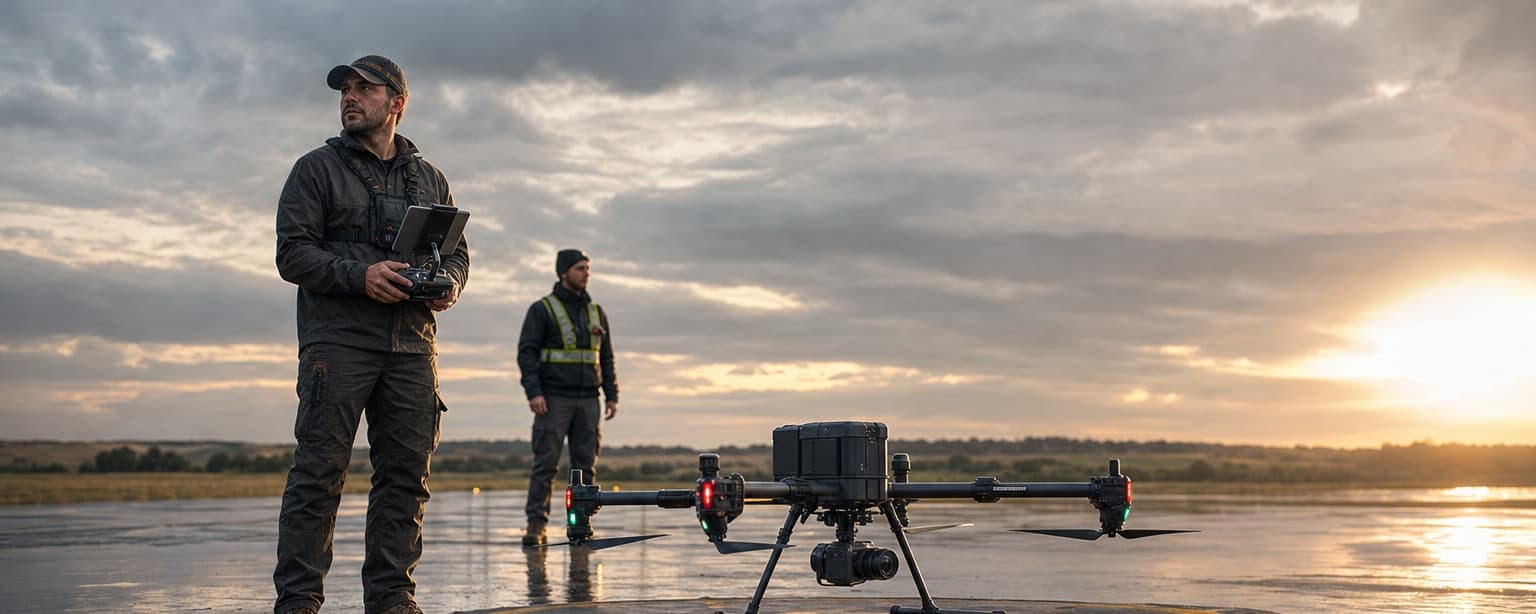
It is aviation, which is why your general liability already excludes it.
A standard policy carves your drone out as aircraft. We put the liability back, add hull coverage for the airframe, and handle the privacy exposure that comes with a camera in the air.
Tell us the situation.
One licensed human replies the same business day — not five agents, not an auto-responder. If the policy you have is already the right one, we will tell you.
We use this to quote and service your insurance, and we do not sell it or pass it to lead networks. Privacy policy.
Send us what you have. We’ll tell you if it’s right.
Your current policy paperwork, a renewal notice, or nothing at all. A licensed agent reads it and replies the same business day.
What drone operator businesses actually need.
Drone liability
Injury and property damage caused by the aircraft.
Without it — General liability excludes aircraft, and a drone is an aircraft.
Hull
Physical damage to the airframe, payload and gimbal.
Without it — A fly-away or a hard landing writes off the equipment.
Invasion of privacy
Claims arising from imagery captured, intentionally or not.
Without it — A camera over private property is the complaint this trade gets.
Professional liability
Errors in survey, mapping, inspection or thermal work relied on by a client.
Without it — A wrong roof report or bad photogrammetry is a financial loss, not damage.
Non-owned and rented aircraft
Drones you hire, borrow, or that a subcontracted pilot flies for you.
Without it — A subcontracted pilot’s incident is still your client’s claim.
What our drone operator clients ask us.
Doesn’t my business policy already cover the drone?
Almost certainly not. Commercial general liability contains an aircraft exclusion, and it does not distinguish by size: a drone is an aircraft for that purpose, so damage or injury it causes falls outside the policy. Some insurers will endorse limited drone liability onto a business policy for incidental use; anyone flying commercially, and anyone whose client asks for evidence, needs it written properly. Photographers and roofers adding aerial work are the two groups most likely to be flying uninsured without realizing.
What do clients typically require?
A $1,000,000 liability limit is the common baseline, with the client named as an additional insured, and evidence of your Part 107 certification. Film productions, utilities, construction sites and public agencies frequently ask for more and may add specific requirements about operating within visual line of sight or holding waivers. Ask for the requirement in writing at booking: a drone policy can usually be bound quickly, but not on the morning of the shoot.
Is hull coverage worth it?
It depends on what you fly and what it carries. On a consumer-grade airframe the premium can approach the replacement cost and self-insuring is reasonable. On an enterprise platform with a thermal or LiDAR payload the numbers are entirely different and hull is straightforward value. Note that hull and liability are separate decisions. You can carry liability alone, and most operators should never do the reverse.
What about privacy complaints?
They are the most common non-damage claim in the trade and they are frequently excluded. A drone over a neighboring property, a wedding overflown, a resident filmed during a roof survey. The complaint is invasion of privacy rather than injury or damage, and general liability’s personal and advertising injury grant is narrower than operators assume. Check whether the policy addresses it explicitly, and keep flight logs, because the defense is usually about where the aircraft actually was.
Is DJI Care Refresh drone insurance?
No, and the difference is the whole point of this page. DJI’s plan is a repair-or-replace service for the aircraft you bought — a fly-away, a crash, water damage — for a fee per replacement and a limited number of replacements a year. It covers the drone. It covers nothing the drone does to anyone else, which is the claim that costs real money: the car it lands on, the window, the person at the wedding. That is unmanned aircraft liability, it is a separate policy, and a client asking for a certificate cannot be given one from a manufacturer’s plan. Keep the plan if you like it for the airframe; it does not replace the liability, and on an enterprise platform with a payload it does not replace hull coverage either.
Is by-the-hour drone insurance from an app enough?
For a hobbyist flying a few times a year, often yes: the on-demand apps sell liability by the flight, and a Sunday in a park does not need an annual policy. For anyone who flies for money it usually is not, for three reasons. The coverage exists only for the window you bought, so the flight you forgot to log is uninsured. The limit is typically capped where a client contract starts — a brokerage, a venue or a production wants a certificate at a fixed annual limit with them named on it, and an hourly policy cannot produce one. And the apps sell liability alone: the aircraft, the gimbal and the camera under it are hull coverage, which is a separate purchase. Once a drone earns more than a few hundred dollars a month, an annual liability-and-hull policy is both cheaper per flight and the only thing a client will accept.
Does my homeowners policy — State Farm, Allstate, whoever — cover my drone?
For a hobby drone, sometimes, and only for the hobby. A homeowners policy may cover the aircraft as personal property, subject to the deductible, and may cover liability for a purely recreational flight — read yours, because some exclude aircraft and radio-controlled models entirely. The moment the flight earns money, delivers footage to a client or is posted on a monetized channel, it is business use and the homeowners policy is out. A personal policy also cannot issue the certificate a client asks for. If you are on this page because someone wanted proof of insurance, the homeowners policy is not the answer, whichever company it is with.
I fly for a YouTube channel or a real-estate video business. Is that commercial?
Yes. Monetized footage is commercial use whether the client is a listing agent or an ad network, and the exposure is the same aircraft exclusion everyone else on this page has, and larger than most channel owners realize, because a drone that comes down on a person or a car is an aviation claim, not a dropped camera. We write the liability and the hull for creators as part of the same policy set as their gear and media coverage, and a channel flying every week for content is exactly the operator a general liability policy was never going to cover.
Commercial insurance is 96% of what we do — it is not a department here, it is the whole business. Not ready to talk? The guides answer the questions this page raises in more depth. Already insured with us and need a certificate or a policy change? Ask the service team rather than starting a quote — it is faster and it goes to the people whose job it is. We also write home and auto, which is usually cheaper alongside the business policy than apart from it.
Handed a lease, a vendor packet or a client contract with insurance requirements? Paste it into the COI Requirements Decoder to see what each one means for your business, or read what the requirements mean.