
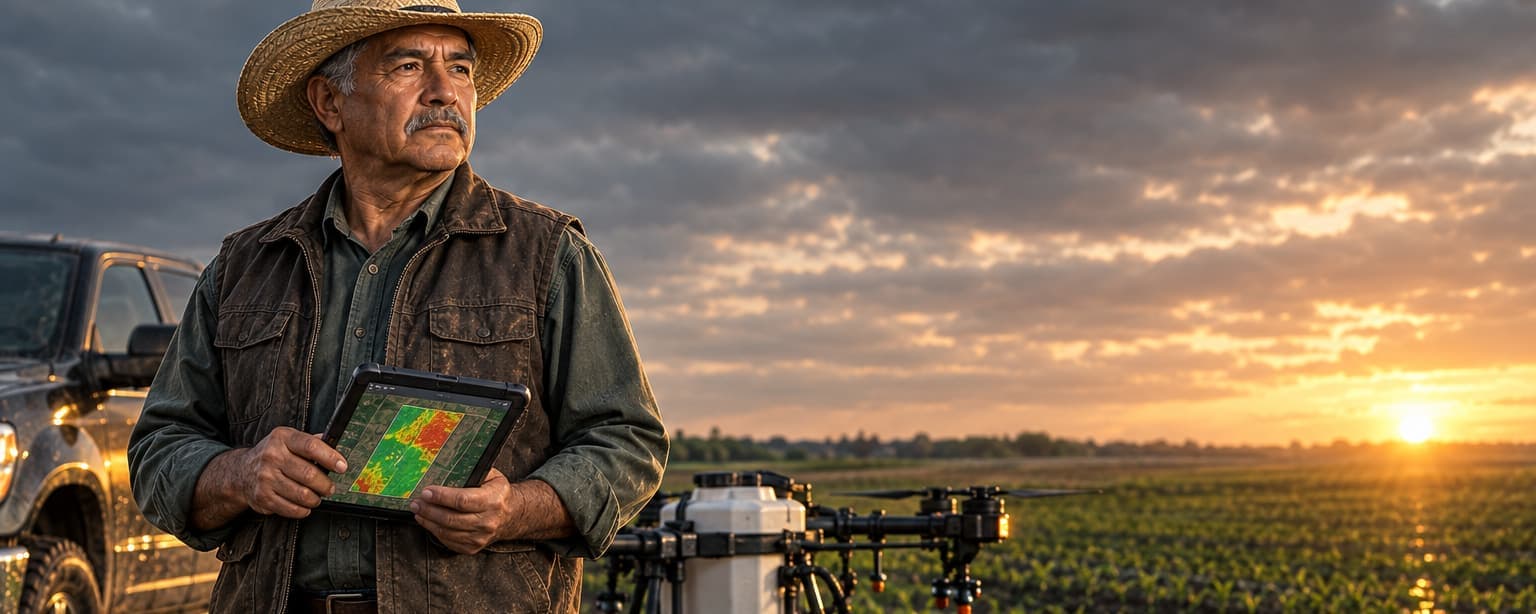
A wrong prescription kills a crop, or drifts onto the neighbor’s.Founded by a software developer who runs an AI app.
We place technology E&O with contingent property damage for agronomy, spray and fertilizer prescription, yield and irrigation, drone and livestock-monitoring apps, and we show where a claim falls between your software policy, the grower’s farm policy and the applicator’s.
Tell us the situation.
One licensed human replies the same business day — not five agents, not an auto-responder. If the policy you have is already the right one, we will tell you.
We use this to quote and service your insurance, and we do not sell it or pass it to lead networks. Privacy policy.
The person placing your tech E&O runs an app with an AI coach of his own.

Kevin Kelsey
Founder | Principal Agent
Boring’s founder, Kevin Kelsey, owns and runs TrainRec, a fitness app with a built-in AI coach, and has placed insurance for AI apps. Insuring his own taught him how an underwriter reads a model. Personal guidance from an AI reads more like the work of a professional than like software, technology E&O forms commonly exclude bodily injury, and not every form will add it back. So whether your app answers money, health, hiring or farming questions, the gap between what it says and what the policy covers gets read by someone who has had to close it for his own product.
Send us what you have. We’ll tell you if it’s right.
Your current policy paperwork, a renewal notice, or nothing at all. A licensed agent reads it and replies the same business day.
What agtech app businesses actually need.
Technology E&O with contingent property damage and bodily injury
Claims that a prescription, model output or alert from your app was wrong and a grower’s crop, a neighbor’s crop or a person was harmed after relying on it. Contingent means the harm is blamed on relying on your output, not on anything your company physically did.
Without it — Tech E&O forms commonly exclude property damage, and a dead crop is property damage to somebody. Ask for the contingent grant by name and check that it covers crops and not just buildings and equipment.
Pollution liability
Drift, overspray and runoff of a chemical onto someone else’s land, which the pollution exclusion on a standard policy removes.
Without it — A software policy and a farm policy can both exclude pollution, so a drift claim can be left without a policy unless pollution coverage is bought on purpose.
Farm and ranch package
The grower’s own policy: dwelling, buildings, machinery, livestock and farm liability on one schedule.
Without it — The farm policy answers the grower, and it may not cover a prescription the grower bought from you or a custom application.
Drone coverage
Liability and physical damage for the aircraft, which general liability and software policies commonly exclude.
Without it — A spray drone is an aircraft, and aircraft are a standard exclusion. If you operate drones, the aircraft needs its own policy.
Cyber & tech E&O
Breach response, ransomware and the notification costs that follow. Technology errors and omissions sits on the same policy and covers the software or service itself failing a client, which is the half most tech companies find out about too late.
Without it — Field boundaries, yield maps, input records and equipment telemetry are business data a grower treats as private, and a leak of one grower’s yield is a claim of its own.
Product liability
Injury or damage caused by a physical device you make or sell, such as a sensor, a controller or a sprayer attachment.
Without it — Software coverage does not follow your software onto hardware you ship, and a device that applies product needs its own policy.
What the regulators actually wrote down.
Federal pesticide law makes it unlawful for any person to use any registered pesticide in a manner inconsistent with its labeling.
7 U.S.C. 136j(a)(2)(G) (FIFRA section 12(a)(2)(G)) · checked 2026-11-01
A pesticide classified for restricted use may be applied for the restricted use only by or under the direct supervision of a certified applicator, or subject to other restrictions the EPA Administrator sets by regulation.
7 U.S.C. 136a(d)(1)(C) (FIFRA section 3(d)(1)(C)) · checked 2026-11-01
FAA rules define an agricultural aircraft operation as operating an aircraft to dispense any economic poison, or any other substance intended for plant nourishment, soil treatment, propagation of plant life or pest control, and bar anyone from conducting one without, or in violation of, an agricultural aircraft operator certificate.
14 CFR 137.3 (definitions) and 137.11(a), Certificate required · checked 2026-11-01
In June 2024 the FAA described drone spraying as part 137 agricultural aircraft operations and told its inspectors an applicant using unmanned aircraft submits FAA Form 8710-3 and the number of the exemption the operator was granted; that notice printed a cancellation date of June 10, 2025, so the current process should be checked with the FAA.
FAA Notice N 8900.704, Part 137 Unmanned Aircraft Systems (UAS) Certification (effective 6/10/24) · checked 2026-11-01
In a real placement an underwriter read an AI product giving personal guidance as closer to a professional service than to software, and technology E&O forms commonly exclude bodily injury, so the same caution applies to a prescription that damages property.
Kevin Kelsey, agency placement experience (underwriter correspondence, insurers not named) · checked 2026-10-29
The claims we actually see.
Ordered by how often we see them, not by how dramatic they are. Each one names the coverage that answers it — and the policy people wrongly assume already does.
Most common
A prescription is wrong and a grower’s crop is damaged or the yield falls
Covered by Technology E&O with contingent property damage
A lost yield is a financial loss and a dead crop is property damage, and the claim usually says both. Tech E&O may answer the first and exclude the second, which is why the contingent grant has to name property damage.
Common
A spray drifts onto a neighbor’s crop, bees or home
Covered by Pollution liability, with the applicator’s policy and the farm policy behind it
The neighbor never used your app and never saw your terms, so a disclaimer does not reach them. Pollution exclusions on the farm policy, the general liability and the tech E&O can leave a drift claim with nothing standing behind it.
Less common, severe
A drone applies the wrong rate or the wrong product, or crashes
Covered by Aviation or drone coverage, plus pollution liability
A spray drone is an aircraft, so a liability policy that excludes aircraft will not respond, and the application itself is an agricultural aircraft operation under FAA rules that has its own certificate requirement.
Common
A livestock-monitoring or irrigation alert fails and animals or equipment are lost
Covered by Technology E&O with contingent property damage, plus the farm policy
Animals and equipment are property, so the claim is excluded by a standard tech E&O form. The farm policy may cover the grower’s loss, and then its insurer looks to you to recover it.
What our agtech app clients ask us.
Does tech E&O cover a crop damaged by my app’s prescription?
Often not, unless the policy says so. Technology E&O is written for financial loss, and most forms exclude property damage, which a dead or damaged crop is. The fix is a contingent property damage grant on the tech E&O, which covers damage someone says came from relying on your app’s output. Ask for it by name, check that crops, livestock and neighboring land are not carved out, and read whether it has its own smaller limit.
What is contingent property damage?
It is damage to something that someone says came from relying on your software’s output, rather than from anything your company physically did. A grower sprays at the rate your app recommended and the field is burned: that is contingent property damage. It sits beside contingent bodily injury, which is the same idea for people, and both are usually added to a tech E&O policy as an endorsement.
The pesticide label is the law. Doesn’t that make the label responsible, not the app?
It makes the label the standard the app’s output is judged against. Federal law makes it unlawful to use a registered pesticide in a manner inconsistent with its labeling (7 U.S.C. 136j(a)(2)(G)), so a prescription that recommends a rate, a timing, a crop or a mixture the label does not allow puts the person who followed it in breach. The app can then be blamed for causing the violation. Label compliance is therefore the first thing an underwriter asks about.
Who answers if my spray prescription drifts onto a neighbor?
Several policies may be asked and each may decline. The grower’s farm policy and the applicator’s policy normally carry a pollution exclusion, and your tech E&O normally excludes property damage. The neighbor sues whoever can be found. Pollution liability bought on purpose by the applicator, with your contract saying who carries it, is what answers drift.
We use drones to spray. What do we need beyond insurance?
FAA rules treat dispensing a pesticide or fertilizer from an aircraft as an agricultural aircraft operation and bar conducting one without an agricultural aircraft operator certificate (14 CFR 137.3 and 137.11). The FAA described the drone process in a June 2024 notice that carried a cancellation date, so confirm current steps with the FAA. States also license commercial pesticide applicators, and federal law limits restricted-use pesticides to certified applicators or those under their direct supervision. An insurer will ask for each of these before it prices the drone.
How is this different from the fitness app page?
The fitness page is about contingent bodily injury to a user who follows a plan. Agtech adds property damage, which tech E&O forms commonly exclude, and the harmed person is often a neighbor, a bystander or a downstream buyer who never used your app and never accepted its terms. The same contingent grant applies and the claimant is further away, and the label and state agency rules are a second standard the output is judged against.
Fitness and health app insurance, where contingent bodily injury starts
The grower has a farm policy. Why can’t it answer?
A farm policy answers the grower’s own losses and liability, and it may not cover advice the grower bought from a software vendor or work done by a custom applicator. When the grower’s insurer pays a loss it can pursue the party that caused it, and that can be you. A claim can therefore arrive twice: once from the grower and once from the grower’s insurer.
If our app only recommends and the grower decides, is that a defense?
It is a good fact and not a full defense. A clear recommendation framing, an agronomist’s sign-off and a label check built into the app make a claim easier to defend, and underwriters ask for them. They do not stop a claim being filed, and the cost of defending it arrives regardless. An app that gives a specific prescription for a specific field can read to an underwriter more like an agronomist than like software.
What will the underwriter ask an agtech app?
Whether the app suggests or decides a prescription, whether a certified crop adviser or agronomist reviews it, whether it checks the label for crop, rate, timing, buffers and restrictions, which AI model or vendor produces the output, whether it controls equipment such as a sprayer or a drone, how many acres and growers use it, how forecasts and field data are validated, whether you operate aircraft or apply product yourselves, which states and countries, your contract’s limits and indemnities, and prior claims. Your answers decide whether the form reads you as software or as an agronomy service.
Does AI-generated output change the coverage?
It can. A model that invents a rate, confuses two products or misreads a label is producing wrong output, and some 2026 forms exclude or limit generative AI claims. Ask whether the tech E&O and the contingent grant cover claims from AI output, and what a pollution or farm policy says about it.
A distributor or equipment maker wants us to indemnify them. What should we check?
Read what the indemnity covers, then check that your insurance covers the same thing. Agtech contracts with distributors and equipment makers often ask you to defend and hold harmless against claims arising from your software, and a crop or drift claim is one of them. If your tech E&O excludes property damage, you have promised something no policy stands behind. Send us the agreement before signing.
Do we need cyber insurance too?
Probably. Field boundaries, yield maps, input records and telemetry from equipment are information a grower treats as private, and a breach exposes it. Cyber coverage is built for the response and for the privacy claim, and tech E&O is not.
Our app was built fast with AI coding tools. Does that matter?
It changes the questions. A prescription engine written quickly and tested thinly is what an underwriter probes when the output is a rate someone sprays. Say who reviews the model and how a bad recommendation would be caught before a grower sprays it.
We sell to farmers in other countries. Does our insurance follow?
Not automatically. Many tech E&O policies only defend claims brought in the US or Canada, and pesticide rules and label standards differ in every country. Check where claims may be brought before you sell abroad.
Which NAICS codes does this page cover?
Agtech software usually files under 513210 Software Publishers, 541511 Custom Computer Programming Services, 541512 Computer Systems Design Services or 518210 Computing Infrastructure Providers, Data Processing, Web Hosting, and Related Services. Research and consulting companies use 541715 Research and Development in the Physical, Engineering, and Life Sciences (except Nanotechnology and Biotechnology) and 541690 Other Scientific and Technical Consulting Services. Businesses that apply or make the equipment use 115112 Soil Preparation, Planting, and Cultivating, 115116 Farm Management Services and 333111 Farm Machinery and Equipment Manufacturing. Tell us the code on your paperwork and whether your company applies anything or only sends a recommendation.
Where does this sit among insurance for AI apps?
Agtech is one of the industries where software output moves something physical. Others handle money, health or hiring, each with its own exposure and its own gap between policies. The hub lists every industry we have written up.
Also in this family
Guides on agtech app.
- Bodily Injury vs Contingent Bodily InjuryGeneral liability pays for injuries you cause by accident, and E&O pays for money lost to your mistakes. An injury caused by a mistake in your app, software or advice falls between them, and contingent bodily injury on the E&O is how that gap is closed.
- Insurance for an App Launching WorldwideAn app store launch puts your app in front of users in dozens of countries on the first day. Your tech E&O may only defend claims filed in the US or Canada, and your cyber policy has to handle European privacy rules, where health and fitness readings are a special category of data.
- Vibe-Coded App InsuranceA vibe-coded app carries the same liability as any other, and the documented failures are security ones: open databases, exposed keys and an agent that deleted data. Here is which policy answers which failure, what the AI tool providers say about who is responsible, and what to check before you buy.
Commercial insurance is 96% of what we do — it is not a department here, it is the whole business. Not ready to talk? The guides answer the questions this page raises in more depth. Already insured with us and need a certificate or a policy change? Ask the service team rather than starting a quote — it is faster and it goes to the people whose job it is. We also write home and auto, which is usually cheaper alongside the business policy than apart from it.
Handed a lease, a vendor packet or a client contract with insurance requirements? Paste it into the COI Requirements Decoder to see what each one means for your business, or read what the requirements mean.