
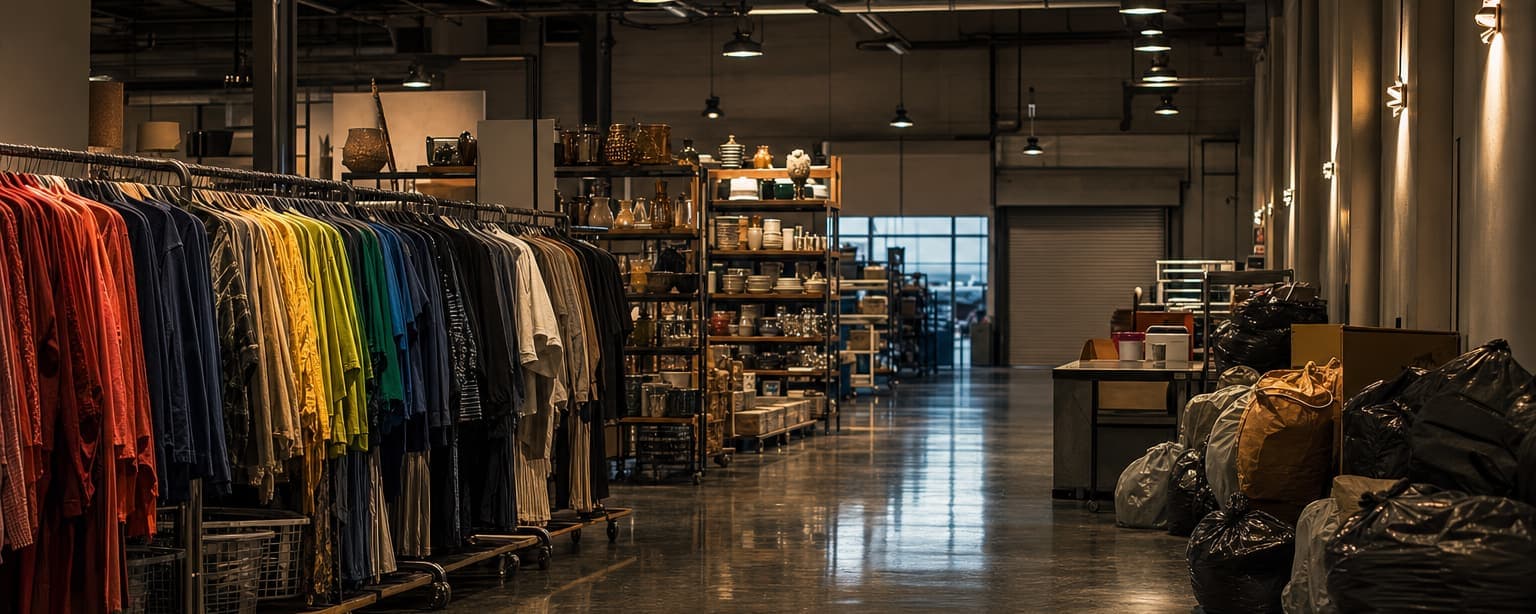
You are a retailer that sells goods nobody tested, staffed by people you do not pay.
A nonprofit policy alone does not cover the trading operation. We add product liability on donated goods, volunteer injury, and the donation door itself.
Tell us the situation.
One licensed human replies the same business day — not five agents, not an auto-responder. If the policy you have is already the right one, we will tell you.
We use this to quote and service your insurance, and we do not sell it or pass it to lead networks. Privacy policy.
Send us what you have. We’ll tell you if it’s right.
Your current policy paperwork, a renewal notice, or nothing at all. A licensed agent reads it and replies the same business day.
What thrift store businesses actually need.
Product liability on donated goods
Injury caused by something you sold — electrical goods, furniture, toys, equipment — with no manufacturer in reach.
Without it — Selling a second-hand item makes you its supplier, and the maker is usually untraceable or long gone.
General liability and property
The shop floor, the stockroom and the donation area, plus injury to customers and donors.
Without it — Cluttered floors, heavy furniture and public access are the everyday claim.
Workers compensation, including volunteers
Paid staff and the volunteers who sort, lift and move stock, elected where the state permits.
Without it — Lifting and sorting injuries are frequent, and most of the labor is volunteer.
Crime and fidelity
Till theft and cash handling losses by staff or volunteers.
Without it — Cash businesses run by rotating volunteers have almost no segregation of duties.
Business cyber
Card terminals and any customer or donor records the shop keeps.
Without it — Card data in a small retail operation with no security staff is the standard target.
Hired and non-owned auto
Volunteers collecting donations and delivering furniture in their own vehicles.
Without it — Collection and delivery is constant in charity retail, and personal policies exclude it.
What our thrift store clients ask us.
Are we really liable for a second-hand item we were given?
Yes. Selling an item puts you in its chain of supply, and the injured buyer sues whoever they can reach, which is you, because the manufacturer of a twenty-year-old heater is untraceable, dissolved or overseas. Donated status does not change it and neither does a low price. The practical controls are the ones underwriters ask about: testing or refusing electrical goods, checking that upholstered furniture carries its fire labeling, refusing recalled items, cots, car seats and helmets, and keeping a written policy on what you will not accept. Those reduce both the claim and the premium.
Our nonprofit already has a policy. Does it cover the shop?
Usually not properly. A retail operation is a different class with a different rating basis — sales rather than headcount — and a nonprofit package written for a charity’s programs will not silently extend product liability to goods sold over a counter. The shop needs to be scheduled as its own location with its own exposure, and if you have several shops each needs to be on the schedule. This is one of the more common gaps we find, and it is normally found at claim time rather than at renewal.
Also in this family
Commercial insurance is 96% of what we do — it is not a department here, it is the whole business. Not ready to talk? The guides answer the questions this page raises in more depth. Already insured with us and need a certificate or a policy change? Ask the service team rather than starting a quote — it is faster and it goes to the people whose job it is. We also write home and auto, which is usually cheaper alongside the business policy than apart from it.
Handed a lease, a vendor packet or a client contract with insurance requirements? Paste it into the COI Requirements Decoder to see what each one means for your business, or read what the requirements mean.