
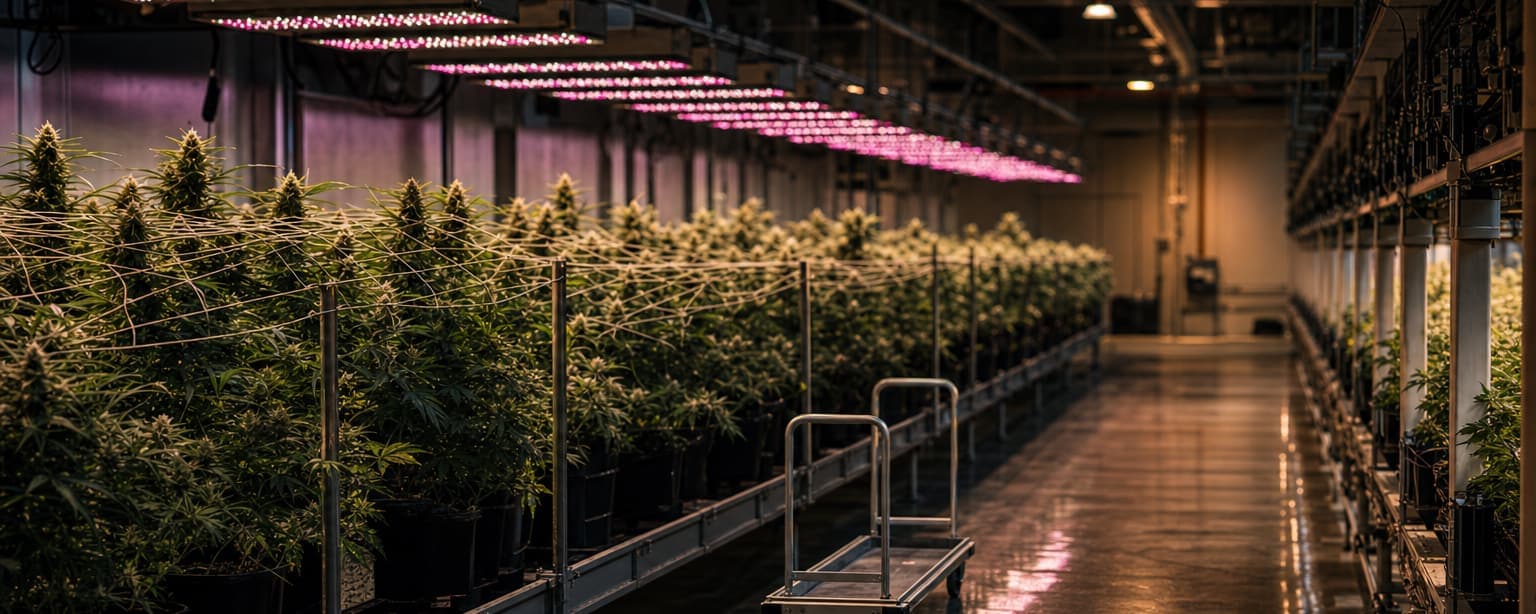
Federally legal for some of what you sell, and not for the rest.
We place licensed cannabis operators, from cultivation to manufacturing to retail, in the surplus lines market. The federal position decides what can be written, and that position moved this year.
Tell us the situation.
One licensed human replies the same business day — not five agents, not an auto-responder. If the policy you have is already the right one, we will tell you.
We use this to quote and service your insurance, and we do not sell it or pass it to lead networks. Privacy policy.
Send us what you have. We’ll tell you if it’s right.
Your current policy paperwork, a renewal notice, or nothing at all. A licensed agent reads it and replies the same business day.
What cannabis business businesses actually need.
General and product liability
Injury from the product, and the ordinary premises exposures.
Without it — Edibles, vapes, potency and labeling claims are the live product exposure.
Property, written for a grow
Buildings, lighting, HVAC, extraction equipment and the fit-out.
Without it — The electrical and humidity load in a grow is not a standard property risk.
Crop and plants
Living plants and harvested product, which standard property excludes.
Without it — There is no federal crop program for cannabis as there is for hemp.
Crime, sized for cash
Theft of cash and product, with limits set for a business banks will not fully serve.
Without it — Restricted banking means unusual amounts of cash on premises.
Product recall
State-mandated recalls for pesticide, mould, heavy metal or potency failures.
Without it — Recall is excluded from liability and states order them regularly.
Directors and officers
Board and investor exposure in a heavily regulated, capital-hungry sector.
Without it — Licensing, disclosure and compliance claims land on individuals.
What our cannabis business clients ask us.
Where does federal law actually stand right now?
Split, as of August 2026, and the split is the whole insurance story. On 22 April 2026 FDA-approved marijuana products AND marijuana subject to a qualifying state medical license moved from Schedule I to Schedule III, effective immediately. Everything else — adult-use product, and medical outside a licensed state program — remains Schedule I.
Why is cannabis insurance always surplus lines?
Because admitted carriers file their rates and forms with a state regulator and are backed by the state guaranty fund, and most will not take on a risk that is federally controlled. Surplus lines carriers do not file rates or forms, which is exactly what lets them write a class nobody has filed a rate for. It means no guaranty fund behind the policy, so the carrier’s own financial strength rating matters more here than almost anywhere else, and it means the wording varies between quotes that look alike.
Does the April rescheduling make this easier to insure?
At the margin, and mostly for state-licensed medical operators. Moving to Schedule III removes some of the reasoning carriers and banks have used to decline the class, and it has a large tax consequence too, since Section 280E applies to Schedule I and II substances. What it has not done is make adult-use cannabis federally lawful — that product is still Schedule I — so most of the market still places in surplus lines. Expect the position to keep moving; do not assume a quote from six months ago reflects today’s appetite.
What does a policy typically exclude?
Read for three things specifically. Federal seizure and forfeiture is commonly excluded outright, which matters more than it sounds when the product is still federally controlled. Health-claim and efficacy exposure is often carved out. And vape and inhalation products draw their own exclusions or sublimits following the lung-injury litigation. None of these are unusual in this market; all of them are worth finding before you bind rather than at a claim.
How is the crop covered?
Under a specific crop or plants grant, not by the property policy, and usually with the value stepped by growth stage: a seedling and a plant at harvest are not insured for the same amount. There is no federal crop insurance program for cannabis, unlike hemp, so this is a private placement. Expect questions about the grow environment, redundancy on HVAC and power, security, and whether the operation is indoor, greenhouse or outdoor, because those change both the price and the market.
Commercial insurance is 96% of what we do — it is not a department here, it is the whole business. Not ready to talk? The guides answer the questions this page raises in more depth. Already insured with us and need a certificate or a policy change? Ask the service team rather than starting a quote — it is faster and it goes to the people whose job it is. We also write home and auto, which is usually cheaper alongside the business policy than apart from it.
Handed a lease, a vendor packet or a client contract with insurance requirements? Paste it into the COI Requirements Decoder to see what each one means for your business, or read what the requirements mean.