
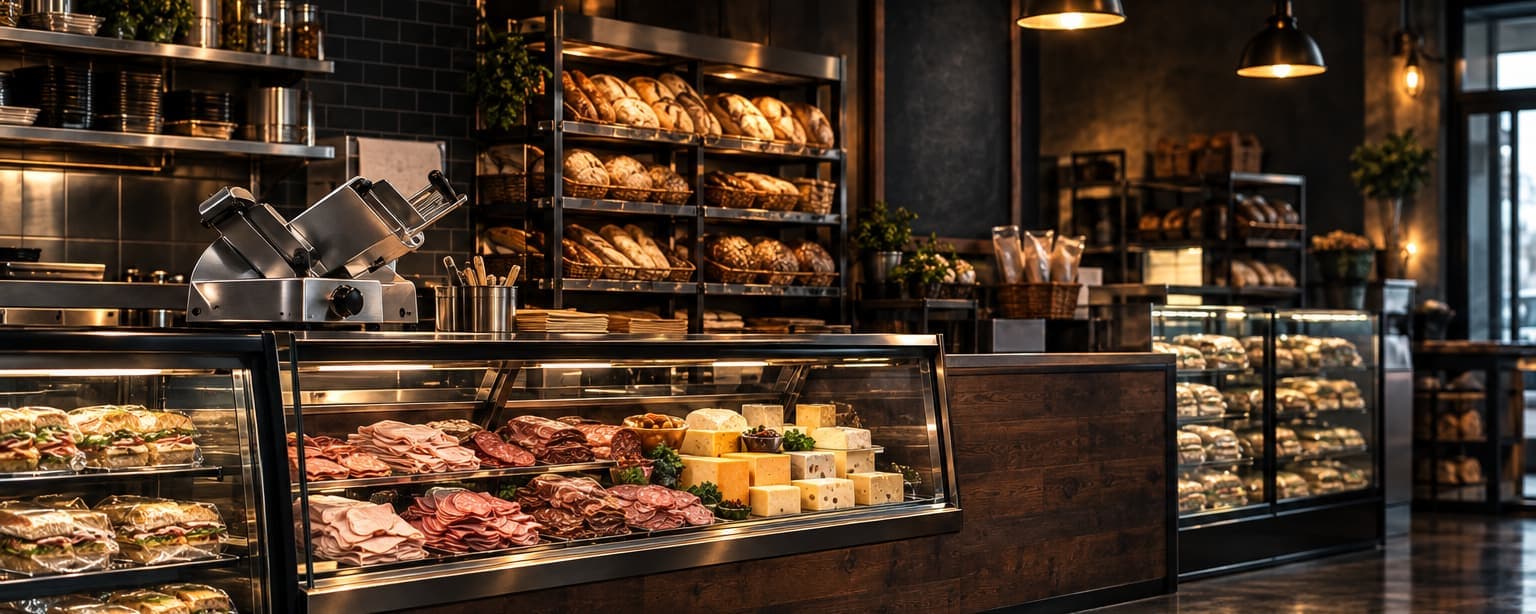
Half retail, half restaurant, with a slicer and a delivery car. The policy has to be all four.
A deli sells across a counter, cooks a little, caters a lot and increasingly delivers. Carriers rate it as a limited-cooking restaurant, which keeps the price below a full kitchen, but the deli-specific claims are their own: a slicer injury to an employee, a cold case that fails over a weekend, a catering tray that makes an office sick, a delivery driver in their own car. The policy is a restaurant package with the slicer, the spoilage and the delivery pieces filled in, plus liquor liability where beer and wine are sold and workers compensation for the counter staff. We place it for corner delis, kosher and Italian delis, bagel shops and sandwich shops with or without seating.
Tell us the situation.
One licensed human replies the same business day — not five agents, not an auto-responder. If the policy you have is already the right one, we will tell you.
We use this to quote and service your insurance, and we do not sell it or pass it to lead networks. Privacy policy.
Send us what you have. We’ll tell you if it’s right.
Your current policy paperwork, a renewal notice, or nothing at all. A licensed agent reads it and replies the same business day.
What deli businesses actually need.
General liability
Customer injury in the store, and illness claims from food sold across the counter or catered.
Without it — A foodborne illness claim from a catering order can name every guest at the event.
Property and equipment
The cases, slicers, ovens, refrigeration, the build-out and inventory.
Without it — A deli's equipment is worth more than its lease deposit, and a fire in the kitchen takes it all.
Spoilage and equipment breakdown
Product lost when refrigeration fails or power goes out, and the repair of the compressor that failed.
Without it — A weekend outage is the whole cold case, and standard property does not pay for what melted.
Hired and non-owned auto
Liability when employees deliver in their own cars or a catering order is driven in a rented van.
Without it — The employee's personal policy pays first and may deny business use; the deli is sued next.
Liquor liability
Where beer and wine are sold for on- or off-premises consumption.
Without it — Off-premises sales are a lower rate than a bar, but a sale to a minor is the same lawsuit.
Workers compensation
Counter, kitchen and delivery staff injuries.
Without it — The slicer is the injury a deli actually has, and it happens to the new hire in the first month.
The claims we actually see.
Ordered by how often we see them, not by how dramatic they are. Each one names the coverage that answers it — and the policy people wrongly assume already does.
Most common
A customer slip on a wet floor or at the entrance
Covered by General liability
Mop schedules, mats and a camera over the door are the defense. Carriers ask about all three.
Common
An employee cut on the slicer
Covered by Workers compensation
Guards removed for cleaning and a rushed lunch service cause most of them. The training record is what the claim adjuster asks for.
Common
A delivery accident in an employee's car
Covered by Hired and non-owned auto, after the driver's own policy
Carriers ask the minimum driver age, whether you check motor vehicle records and whether you require proof of personal auto insurance. Delivering alcohol raises the rate again.
Less common, severe
A foodborne illness outbreak from a catering order
Covered by General liability
A cold-chain failure on a tray of chicken salad at an office party produces dozens of claimants at once. Temperature logs and delivery times are the defense.
What the policy will not cover.
Pick a procedure to see what the exclusion actually means and whether it can be placed somewhere else.
The policy covers a deli as a limited-cooking food business with a counter, a small kitchen, catering and delivery. Change the cooking or the sales mix and the rating changes with it.
Where a deli policy stops
Full cooking without fire suppression
Fryers and open flame move a deli into the full-restaurant class and require an inspected suppression hood.
Can it be placed? Yes, once the hood is installed and inspected.
Third-party delivery apps
Drivers from an app are the app's responsibility on the road, but a food claim still comes back to the kitchen.
Can it be placed? Not needed for the driving; the food claim is already covered.
Wholesale or manufacturing
Making product for other stores under your label is a manufacturer's products exposure.
Can it be placed? Yes, with a products endorsement once volumes are known.
Bar service
Serving spirits by the drink is a bar class, not a deli with beer and wine.
Can it be placed? Yes, on a bar or tavern policy.
What the insurance company will ask about your deli business
We read 1 application the markets use for this kind of business and pulled out what they actually ask. Have these answers ready and a quote takes a day instead of a week, because nobody has to come back to you for the missing piece.
About the business
- What type of restaurant are you (quick service, upscale, delivery-only, etc.)?
- How many years have you been in business?
- Are you a sole owner, partnership, LLC, or corporation?
- Do you own any other restaurant businesses?
- Have you previously owned restaurants that are now closed or sold?
How you operate
- Do you make deliveries, and if so to homes, other businesses, or both?
- Who delivers your food - your own employees, drivers using their own cars, third-party delivery services, or some combination?
- What is the minimum age for your drivers?
- How far do you deliver from your location?
- Do you deliver alcohol?
Safety and controls
- Do you have a driver training program in place?
- If employees use their own vehicles for deliveries, how do you verify they have personal auto insurance?
- Do you use GPS, cameras, or other monitoring systems to track and coach your drivers?
- Do you have hold harmless agreements and insurance certificates from any contractors or vendors you work with?
Your history
- What was your total sales last year, and how much of that came from delivery and alcohol?
- Do you currently have delivery insurance, and if so what are your coverage limits and when does it expire?
Money and people
- How many employees do you have at each location?
- Do you own or do your employees use their own vehicles for delivery?
Have these ready
- Your restaurant's current insurance information, including coverage limits, deductible, and when it expires
- List of all your restaurant locations with their addresses
- Information about who delivers for you and what vehicles they use
- Years of restaurant management experience you and your manager have
You answer what you can; a licensed agent fills the rest with you.
What our deli clients ask us.
How much does deli insurance cost?
A deli without seating, fryers or alcohol is one of the cheaper food businesses to insure; the package is rated on sales, square footage and equipment value. Adding delivery in employee cars, beer and wine, or catering with alcohol raises it. Workers compensation is rated on payroll and is usually the larger line once there are more than a couple of staff.
What does a delicatessen insurance application ask for?
The delivery restaurant applications we work from ask: the type of operation and years in business, sales broken down into eat-in, carry-out, delivery and alcohol, whether you deliver and who drives (employees, their own cars, company vehicles or a third-party app), how far you deliver and whether you deliver alcohol, the minimum driver age and whether you check driving records and personal auto insurance, hours, staff per location, and your last five years of claims.
Is a deli insured as a restaurant or a store?
As a restaurant, usually in the limited-cooking class that also holds sandwich shops and bagel stores, with a retail component for packaged goods. Carriers ask what share of sales is prepared food, and a deli that is mostly a grocery with a counter is rated closer to a market.
Does the policy cover our catering and the food truck we run at events?
Catering is covered once it is on the application, with the sales figure rated in and liquor added if you pour. A truck or trailer is a separate vehicle and premises and needs its own coverage.
Commercial insurance is 96% of what we do — it is not a department here, it is the whole business. Not ready to talk? The guides answer the questions this page raises in more depth. Already insured with us and need a certificate or a policy change? Ask the service team rather than starting a quote — it is faster and it goes to the people whose job it is. We also write home and auto, which is usually cheaper alongside the business policy than apart from it.
Handed a lease, a vendor packet or a client contract with insurance requirements? Paste it into the COI Requirements Decoder to see what each one means for your business, or read what the requirements mean.