
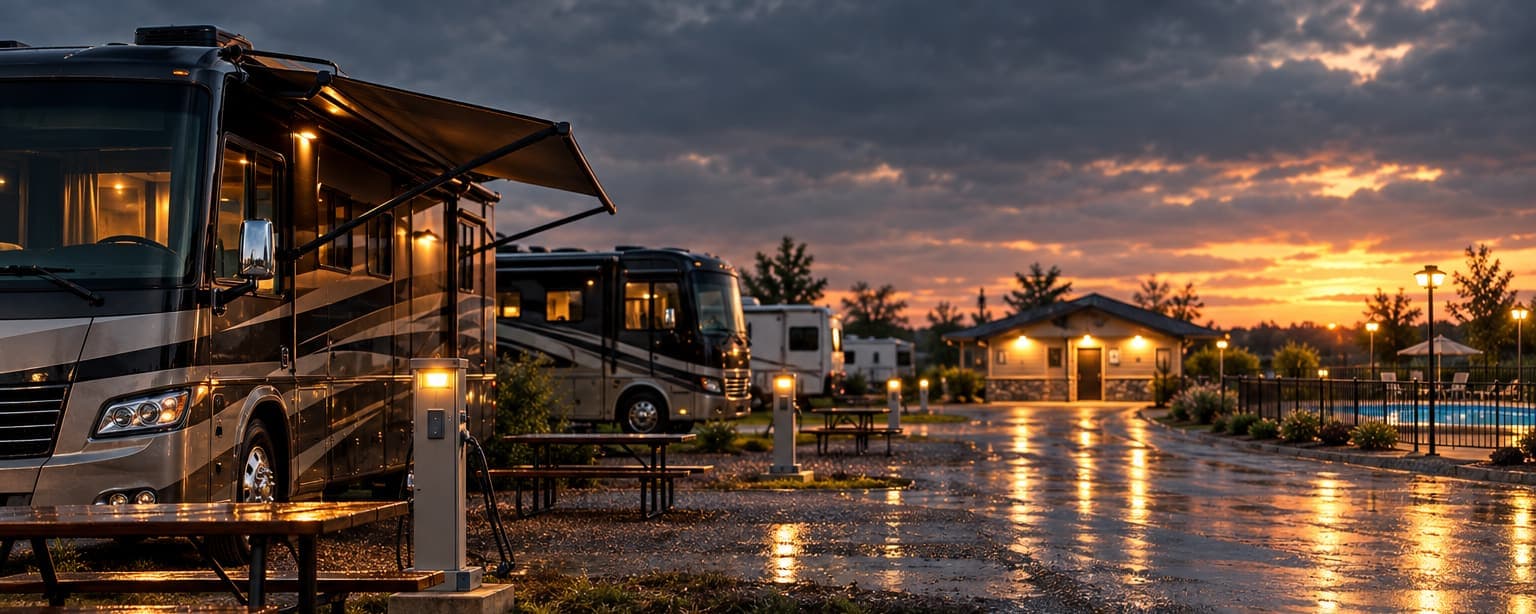
Guests bring their own homes. You still own the water, the power, the pool and the ground under them.
An RV park is a hospitality business where the guests supply the bedrooms and the park supplies everything that can go wrong around them: electrical pedestals, water and sewer hookups, roads, a pool, a playground, a camp store, propane, and weather. The insurance is a package built for that: property for what the park owns, liability for what happens to guests, and the pieces that campgrounds specifically need, from the pool to the propane to the guest's rig damaged by the park's tree. We place RV parks, campgrounds and seasonal resorts, and the application walks through every amenity because each is rated.
Tell us the situation.
One licensed human replies the same business day — not five agents, not an auto-responder. If the policy you have is already the right one, we will tell you.
We use this to quote and service your insurance, and we do not sell it or pass it to lead networks. Privacy policy.
Send us what you have. We’ll tell you if it’s right.
Your current policy paperwork, a renewal notice, or nothing at all. A licensed agent reads it and replies the same business day.
What RV park businesses actually need.
General liability
Injury and property damage to guests and visitors: falls, the pool, the playground, a pedestal fault, a tree limb on a rig.
Without it — A guest injured at the pool is the park's claim, and a family with a hurt child does not read the waiver.
Property
The office and store, bathhouses, cabins, pavilions, the pool and its equipment, the electrical and water systems, at replacement cost, with the business income lost if a covered loss closes the park in season.
Without it — A storm that takes the bathhouse and the power distribution closes the park until both are rebuilt.
Liquor liability
For parks with a store or a bar that sells alcohol: injury caused by a guest you served.
Without it — General liability excludes it for anyone selling alcohol.
Propane and fuel sales
Liability arising from filling tanks and selling fuel, and the equipment.
Without it — Propane is excluded or surcharged on many general liability forms.
Rented equipment and watercraft
Golf carts, kayaks, bikes and boats rented to guests.
Without it — A rented golf cart is the most common source of serious campground injuries and it needs to be on the policy by name.
Workers compensation
Seasonal staff and workampers hurt on the job.
Without it — Required from the first employee, and a workamper paid in site rent is an employee in most states.
The claims we actually see.
Ordered by how often we see them, not by how dramatic they are. Each one names the coverage that answers it — and the policy people wrongly assume already does.
Most common
A guest falls on a wet bathhouse floor, a step or a walkway
Covered by General liability
Lighting, handrails and non-slip surfaces are the cheap fixes; the application asks about them.
Common
A tree or limb falls on a guest's RV
Covered by General liability, when the park was negligent about the tree
An annual arborist walk and a log of removed hazards turn a covered claim into a defended one, and a healthy tree in a storm is usually not the park's fault.
Less common, severe
A pool incident, including a drowning
Covered by General liability, umbrella
Fencing, self-closing gates, posted rules and a no-lifeguard notice are conditions on most policies.
Common
An electrical pedestal fault damages a rig or starts a fire
Covered by General liability
Old pedestals and undersized service are the campground claim underwriters ask about most. Inspection records and upgrade dates matter.
What the policy will not cover.
Pick a procedure to see what the exclusion actually means and whether it can be placed somewhere else.
Every amenity is rated, and a few change the class entirely.
What the campground application asks about
Water: pools, lakes, rivers and waterfront
Swimming, boating and waterfront access are rated on supervision, signage and fencing, and some carriers decline natural swimming areas.
Can it be placed? Yes, with the safety measures documented.
Long-term and permanent residents
A park where most sites are occupied year-round is habitational, not hospitality, and rated as such.
Can it be placed? Yes, on a habitational form for the resident share.
Amusements: zip lines, jumping pillows, mini golf, animals
Each is a separate rate and some are excluded outright.
Can it be placed? Yes, listed individually.
Events and festivals
Hosting rallies or concerts adds a special event exposure.
Can it be placed? Yes, per event or on a schedule.
What the insurance company will ask about your RV park business
We read the applications the markets use for businesses in this field and pulled out what they actually ask. Have these answers ready and a quote takes a day instead of a week, because nobody has to come back to you for the missing piece.
About the business
- What is your business name and website?
- What type of business structure do you have (individual owner, corporation, partnership, or other)?
- How many employees do you have?
- What is your annual gross revenue?
- Is this a new business or established?
How you operate
- What specific activities and services does your business offer (for example: lodging, dining, recreation, tours)?
- Does any part of your operation run from a residential property? If yes, what portion and how many employees work there?
- Do you use rental vehicles or do employees use their own vehicles for business purposes?
- Do you hire subcontractors? If yes, do you require them to carry insurance?
- Do you have written safety procedures, including emergency evacuation and fire safety?
Safety and controls
- Do you use liability waiver forms for your guests or customers?
- Do you have a written safety program with emergency procedures and fire safety measures in place?
- What is the distance to the nearest fire department and fire hydrant?
Your history
- Has your business or any previous owner ever had an insurance claim or loss?
- Has your current or previous insurance been cancelled or non-renewed in the last five years? If yes, why?
- Do you have any known incidents or events that could lead to a future claim?
Money and people
- What was your premium and insurance company name last year?
- What are your desired coverage limits for liability?
- What is your annual payroll?
Have these ready
- Your loss runs (claims history) from your current or most recent insurance company for the last five years
- Certificates of insurance from any subcontractors or independent contractors you use
- Your written safety program and emergency evacuation procedures
- Any liability waiver forms you use with customers or guests
You answer what you can; a licensed agent fills the rest with you.
What our RV park clients ask us.
How much does RV park insurance cost?
It is priced on the number of sites and the annual revenue, then on the amenities: a pool, waterfront, rentals, propane, a store with alcohol and cabins each add their own rate, and the property values and the storm exposure set the other half. A small dry campground pays a modest premium; a resort with a pool, a lake and cabins pays for each.
Are guests' RVs covered by the park's insurance?
Not for their own losses. A guest's rig is insured by the guest, and the park's liability policy responds only when the park caused the damage, such as a tree the park should have removed or a pedestal it should have repaired. The registration form should say so.
What does an RV park insurance application ask for?
The applications we work from ask the number of sites by type, the season and occupancy, the share of long-term residents, every amenity (pool, waterfront, playground, rentals, store, alcohol, propane, cabins, events), the electrical system and its inspection history, the tree maintenance program, staff and workampers, the property values, and five years of claims. The amenity list is the rating.
Do workampers need workers compensation?
In most states yes: a person who works in exchange for a site is being paid in kind and is an employee, and an injury to one without coverage is the park's liability plus a penalty. The application asks how staff are compensated for that reason.
Commercial insurance is 96% of what we do — it is not a department here, it is the whole business. Not ready to talk? The guides answer the questions this page raises in more depth. Already insured with us and need a certificate or a policy change? Ask the service team rather than starting a quote — it is faster and it goes to the people whose job it is. We also write home and auto, which is usually cheaper alongside the business policy than apart from it.
Handed a lease, a vendor packet or a client contract with insurance requirements? Paste it into the COI Requirements Decoder to see what each one means for your business, or read what the requirements mean.