
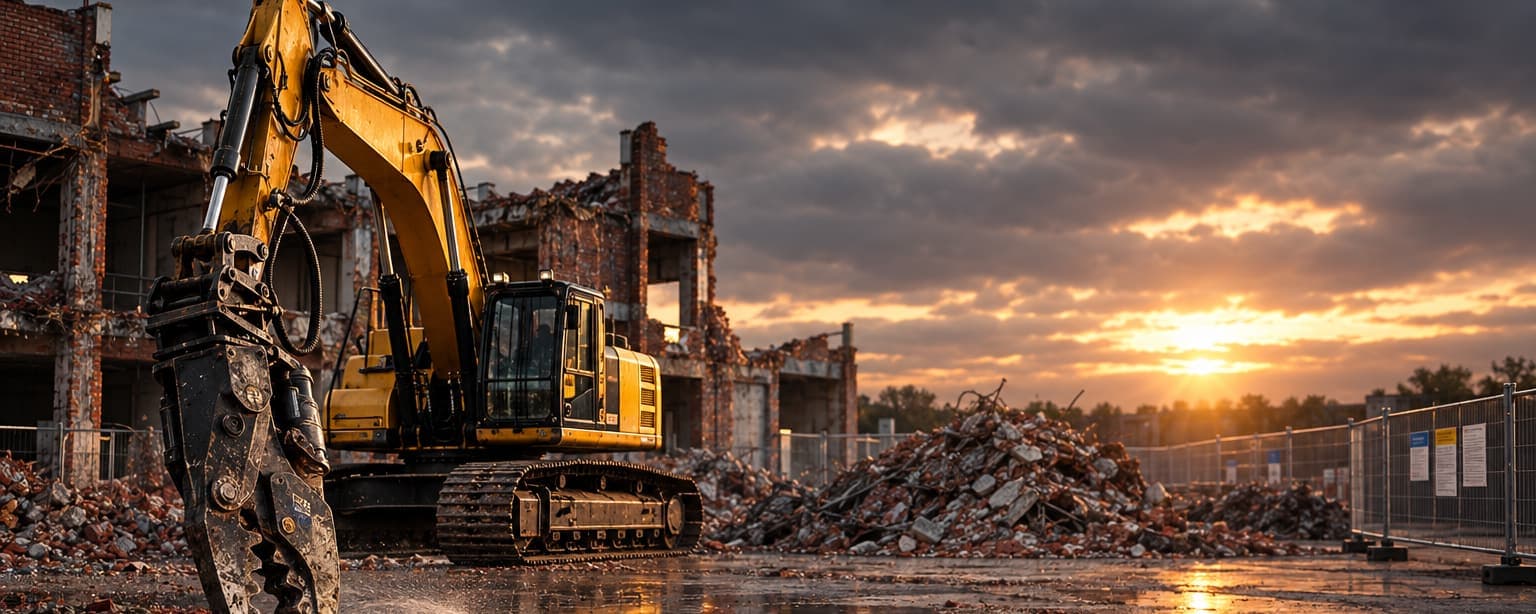
The building you are paid to take down is not the risk. The one sharing a wall with it is.
A demolition contractor is priced on what surrounds the job: the shared wall, the sidewalk, the gas main, the tenant still in the other half of the building. Standard contractor policies exclude or restrict demolition, so the work is placed with markets that ask exactly how you shore, disconnect and document before the first bite. The policy is general liability rated on payroll and on the share of work with occupied or adjacent structures, pollution liability for the asbestos and lead you disturb, equipment for the excavator and shear, and workers compensation for a trade with a high injury rate. We place it for interior strip-outs, whole-building takedowns and selective demolition, and we read the contracts before quoting because they usually name the limits.
Tell us the situation.
One licensed human replies the same business day — not five agents, not an auto-responder. If the policy you have is already the right one, we will tell you.
We use this to quote and service your insurance, and we do not sell it or pass it to lead networks. Privacy policy.
Send us what you have. We’ll tell you if it’s right.
Your current policy paperwork, a renewal notice, or nothing at all. A licensed agent reads it and replies the same business day.
What demolition contractor businesses actually need.
General liability
Damage to adjacent structures, utilities and the public, and injury to anyone who is not your employee.
Without it — A collapse into the neighbor's wall or a struck gas line is the claim this trade exists to pay for, and a standard contractor form excludes demolition.
Contractors pollution liability
Release of asbestos, lead, silica dust or PCBs during the work, including cleanup and third-party claims.
Without it — General liability excludes pollution, and a demolition site disturbs more of it than any other trade.
Equipment
Excavators, shears, breakers, loaders and attachments, owned or rented, on site and in transit.
Without it — A hydraulic shear is worth more than the truck that carries it, and rental agreements make you responsible for a rented machine.
Workers compensation
Injuries to your crew: falls, struck-by, crush and silica exposure.
Without it — Required from the first employee, and the rate for demolition is among the highest in construction.
Commercial auto
Dump trucks, lowboys and pickups hauling debris and equipment.
Without it — A loaded dump truck is rated as a heavy vehicle whatever the pickup fleet looks like.
Umbrella
Limits above the primary policies, which contracts on commercial and public work routinely require.
Without it — A municipal or general contractor requirement of five or ten million cannot be met by the primary policy alone.
The claims we actually see.
Ordered by how often we see them, not by how dramatic they are. Each one names the coverage that answers it — and the policy people wrongly assume already does.
Most common
Damage to an adjacent building or a shared wall
Covered by General liability
The defense is the pre-demolition survey with photographs. The application asks whether you document neighboring structures before work starts.
Common
A struck gas, water or electrical line
Covered by General liability, and pollution if fuel or gas is released
Utility locates and a written shutdown confirmation are what an underwriter wants to see, and what a court wants to see afterward.
Less common, severe
An asbestos or lead release
Covered by Contractors pollution liability
Without the pollution policy the claim is uninsured, and the abatement survey you were handed is the first thing the plaintiff reads.
Less common, severe
A crew member crushed or struck during a takedown
Covered by Workers compensation
Serious injuries drive the experience rating for years. The engineered demolition plan and exclusion zones are the controls that are priced.

Joe Gorman
Co-Founder | President of Commercial Lines
Came up in construction, on site and in the office, then moved into sales. Went out on a limb to become Boring’s first dedicated salesperson when the agency had no sales team at all, and now leads it. Landscaping is the class he writes most: grounds maintenance, tree work, irrigation and the spray operations that push an account out of preferred appetite.
What the policy will not cover.
Pick a procedure to see what the exclusion actually means and whether it can be placed somewhere else.
The policy covers mechanical and manual demolition as described on the application. Certain methods and certain sites are priced separately or refused.
Where a demolition policy stops
Blasting and explosives
Implosion and blasting are excluded on nearly every demolition form and need a specialist policy for the blaster.
Can it be placed? Yes, through a blasting specialist market, usually for the subcontractor doing the shot.
Asbestos abatement as a service
Removing asbestos on purpose is an abatement contractor's license and policy; disturbing it during demolition is what your pollution policy covers.
Can it be placed? Yes, with an abatement license and its own policy.
Salvage sold as product
Reclaimed beams and brick sold to the public create a product liability exposure the contractor form does not contemplate.
Can it be placed? Yes, with products coverage disclosed and rated.
Work over a certain height or in occupied buildings
Many markets cap building height and require occupied-building work to be scheduled and priced separately.
Can it be placed? Yes, once described on the application.
What the insurance company will ask about your demolition contractor business
We read 1 application the markets use for this kind of business and pulled out what they actually ask. Have these answers ready and a quote takes a day instead of a week, because nobody has to come back to you for the missing piece.
About the business
- What type of blasting work do you do, and where do you do it?
- How many full-time and part-time employees do you have?
- What is your annual payroll?
- How far from your main location do you typically work?
- Are you a member of any blasting trade associations?
How you operate
- Do all your blasters have experience with the types of shots you perform?
- Do you keep blasting logs current for every job?
- What percentage of your work is in undeveloped areas versus urban areas?
- How many shots did you perform in the past 12 months, and how many do you expect in the next 12 months?
- What types of rock do you blast (heavy rock, soft rock, fragmented rock)?
Safety and controls
- Do you use blasting mats when shooting in developed areas?
- Do you perform pre-blast surveys within 250 feet of the blast site?
- Do you use an independent surveyor for pre-blast surveys?
- Do you require the surveyor to carry insurance and name you as additionally insured?
- Do you require surveyor to carry professional liability insurance?
Money and people
- What are your estimated annual blasting-related receipts for the next 12 months?
- How long have you been under current management?
- How many years of experience does your management have?
Your history
- What is your business structure (individual, corporation, partnership, joint venture, other)?
- Has your business operated under any other names?
- Do you have any claims over $5,000 from the past?
- Who supplies your explosives?
Have these ready
- Your blasting safety program and hiring practices
- Your current financial statement
- Your last five years of claims history from your current insurer, called loss runs
- Sample contracts or hold harmless agreements you use with customers
- Information about your business (brochures or similar)
You answer what you can; a licensed agent fills the rest with you.
What our demolition contractor clients ask us.
How much does demolition contractor insurance cost?
General liability for a small demolition contractor is typically priced in the mid four figures a year and rises with payroll, the share of work near occupied or adjacent structures, and the limits your contracts demand. Pollution liability adds a few thousand. Workers compensation is often the largest line because the classification rate is high, and equipment is priced on its value.
What does a demolition contractor insurance application ask for?
The application we work from asks your revenue including salvage, your payroll, whether you use subcontractors and for what, whether you own or rent cranes and the boom heights, what share of your work is in unoccupied versus partially occupied buildings, whether you or anyone else performs blasting on your jobs, how you identify asbestos, lead and PCBs, whether you photograph and assess neighboring structures before starting, whether utilities are shut down and shared walls shored, and your project list for five years.
Does my general contractor policy cover demolition?
Usually only incidental demolition as part of a larger job, and often not even that. Standard contractor forms carry a demolition exclusion or a height and method restriction. A contractor whose demolition work is more than a small share of revenue needs the class written on purpose.
Do I need pollution insurance if I never do abatement?
Yes. The pollution policy is for what you disturb, not what you remove on purpose. Old buildings contain asbestos, lead paint and PCB ballasts, and a release during demolition is excluded from general liability. Excavation contractors face the same gap with fuel and buried tanks.
Commercial insurance is 96% of what we do — it is not a department here, it is the whole business. Not ready to talk? The guides answer the questions this page raises in more depth. Already insured with us and need a certificate or a policy change? Ask the service team rather than starting a quote — it is faster and it goes to the people whose job it is. We also write home and auto, which is usually cheaper alongside the business policy than apart from it.
Handed a lease, a vendor packet or a client contract with insurance requirements? Paste it into the COI Requirements Decoder to see what each one means for your business, or read what the requirements mean.