
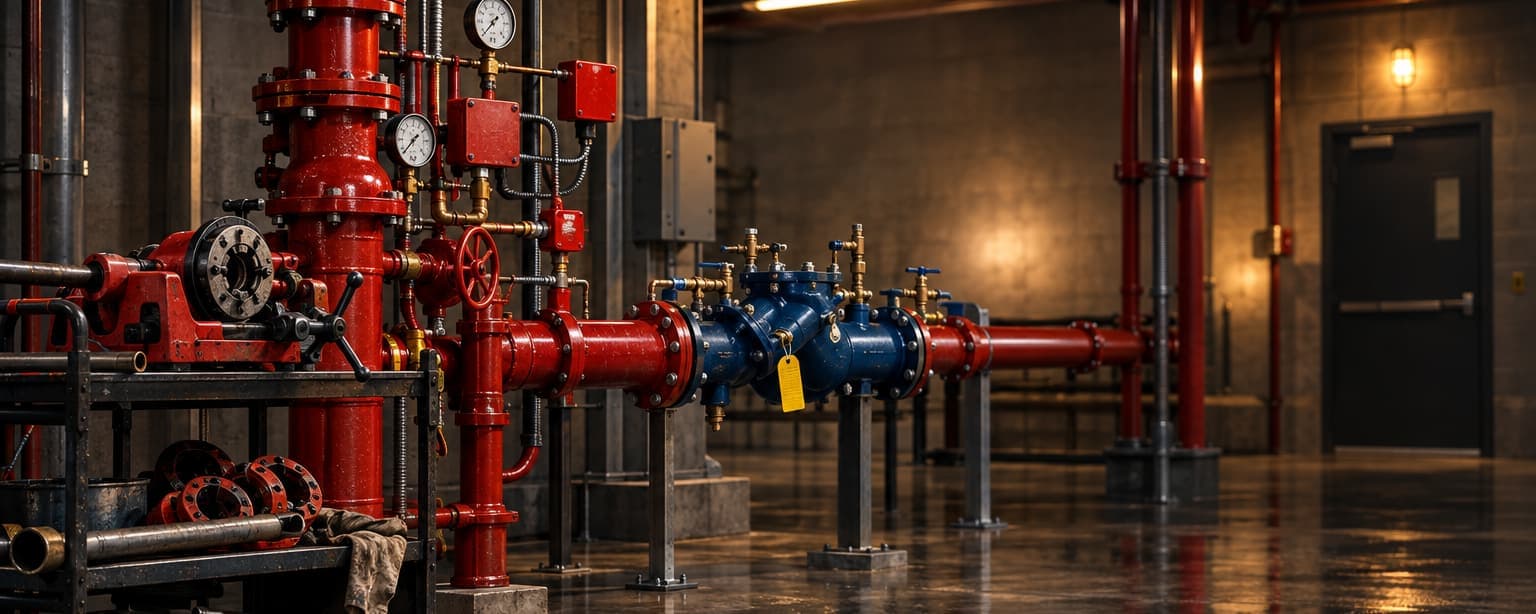
You install a system that is supposed to work once, years from now, and the policy is written for the day it does not.
A fire sprinkler contractor installs, inspects and tests systems that are judged on the day of a fire. Two claims define the class: the system that failed to suppress, and the system that discharged when there was no fire and flooded three floors. Both arrive long after the invoice is paid, which is why the completed-operations part of general liability matters more here than in almost any other trade, and why inspection and testing work carries a professional liability exposure a plumber does not have. We place general liability with the completed-operations tail intact, professional liability for design and inspection, tools and equipment, and workers compensation, for installers, inspection companies and contractors who do both.
Tell us the situation.
One licensed human replies the same business day — not five agents, not an auto-responder. If the policy you have is already the right one, we will tell you.
We use this to quote and service your insurance, and we do not sell it or pass it to lead networks. Privacy policy.
Send us what you have. We’ll tell you if it’s right.
Your current policy paperwork, a renewal notice, or nothing at all. A licensed agent reads it and replies the same business day.
What fire sprinkler contractor businesses actually need.
General liability with completed operations
Injury and property damage from your work, including work finished years ago.
Without it — A discharge or a failure to suppress happens after the job closes; a policy that excludes completed operations covers only the installation week.
Professional liability
Claims that your design, hydraulic calculation or inspection report was wrong.
Without it — General liability excludes professional services. An inspection tag that said the system was fine is a professional opinion.
Tools and equipment
Pipe threaders, groovers, lifts and hand tools on site and in the van.
Without it — A threader and a scissor lift are an expensive theft from a job site, and a rented lift is your responsibility under the rental agreement.
Workers compensation
Injuries to fitters and inspectors: falls from lifts and ladders, overhead lifting, cuts and burns.
Without it — Required from the first employee; overhead work carries a higher rate than ground-level plumbing.
Commercial auto
Vans and trucks carrying pipe, fittings and tools.
Without it — Personal auto excludes business use, and a pipe rack on the roof settles the argument.
Contractors pollution liability
Antifreeze, corrosion inhibitors and stagnant-water releases during draining and testing.
Without it — A drained system into a storm drain is a pollution claim, and general liability excludes it.
The claims we actually see.
Ordered by how often we see them, not by how dramatic they are. Each one names the coverage that answers it — and the policy people wrongly assume already does.
Most common
A water discharge with no fire: a broken head, a frozen pipe, a failed fitting
Covered by General liability, completed operations
CPVC installed without the cure time or tested with air alone is the recurring cause, and the application asks about both in detail.
Rare, catastrophic
A fire the system did not control
Covered by General liability and professional liability, depending on whether the cause is workmanship or design
The building owner's insurer pays the fire and then comes after the contractor and the inspector. Job files and signed acceptance forms are the defense.
Common
An inspection report that missed a closed valve or a corroded pipe
Covered by Professional liability
Inspection and testing under the national standard is a duty to report, and a report that was wrong is sued as advice, not as work.
Common
A fitter falls from a lift
Covered by Workers compensation
Overhead work on lifts is the injury pattern for the trade. Fall protection and lift training are the controls an underwriter asks about.

Joe Gorman
Co-Founder | President of Commercial Lines
Came up in construction, on site and in the office, then moved into sales. Went out on a limb to become Boring’s first dedicated salesperson when the agency had no sales team at all, and now leads it. Landscaping is the class he writes most: grounds maintenance, tree work, irrigation and the spray operations that push an account out of preferred appetite.
What the policy will not cover.
Pick a procedure to see what the exclusion actually means and whether it can be placed somewhere else.
The policy is written for water-based fire protection systems installed and serviced by your crews. Other suppression work and other trades are priced separately or refused.
What a sprinkler contractor policy does not do
Design without a licensed engineer
Some markets exclude design liability unless a licensed engineer stamps the drawings; the application asks whether you design or install to others' designs.
Can it be placed? Yes, with the engineer relationship disclosed.
Clean agent, foam and kitchen hood systems
Gaseous and chemical suppression carry different failure modes and are often a separate classification.
Can it be placed? Yes, as a scheduled operation.
Alarm monitoring
Monitoring a system for a fee is a failure-to-respond exposure priced like an alarm company, not an installer.
Can it be placed? Yes, with a monitoring endorsement or a separate policy.
Work you did not do
Inspecting a system means reporting on it, not guaranteeing it; a claim for a defect you documented and the owner ignored is defended on the report.
Can it be placed? Not needed if the report is on file.
What the insurance company will ask about your fire sprinkler contractor business
We read 1 application the markets use for this kind of business and pulled out what they actually ask. Have these answers ready and a quote takes a day instead of a week, because nobody has to come back to you for the missing piece.
About the business
- Your company name, address, phone number, and main contact
- When did you start this business?
- How many people do you employ total?
- What professional associations or unions are you part of?
How you operate
- What types of sprinkler systems do you design and install (new construction, retrofits, repairs)?
- What percentage of your work is new systems versus fixing or upgrading existing ones?
- What types of piping do you use (steel, CPVC, copper, or other)?
- Do you do any work besides fire sprinklers, like plumbing, HVAC, excavation, or other trades?
- Which trades do you hire as subcontractors?
Safety and controls
- What type of testing do you do on new CPVC systems (water only, air only, or both)?
- How long does CPVC pipe take to cure, and do you adjust cure times based on temperature and humidity?
- Do you test water supply to make sure there's enough for the systems you design?
- Do you require all systems to be tested before you sign off, whether new, retrofit, or repair?
- Do you protect building surfaces and property during retrofit and repair work, and do you document this?
Your history
- How many years have you designed sprinkler systems?
- Do you design all systems in line with NFPA 13, NFPA 13-R, and NFPA 13-D standards?
- Do you do your own system design work or use outside designers?
- Have you had any professional liability claims from systems you designed? If yes, explain
- In the last five years, have you been cited or prosecuted for releasing substances like chemicals into sewers, water, air, or land?
Money and people
- What is your total gross sales?
- How much of your sales come from wrap-up insurance projects, and how much excluding those?
- What percentage of your revenue comes from each type of building (institutional, commercial, residential, manufacturing)?
- What is your federal tax ID number?
Have these ready
- Your CPVC training program name and certification credentials
- A list of all subcontractors and their certificates of insurance
- Copy of any alarm monitoring agreement if you provide that service
- Documentation showing water supply testing records for systems you've designed
- Your loss runs (claims history from your current insurer for the last five years)
You answer what you can; a licensed agent fills the rest with you.
What our fire sprinkler contractor clients ask us.
How much does fire sprinkler contractor insurance cost?
General liability for a small sprinkler contractor is priced on payroll and revenue and typically lands in the mid four figures a year, with the completed-operations exposure a large part of it. Professional liability for design and inspection adds a few thousand. Workers compensation for overhead work is often the largest line, and the CPVC share of your work moves the liability rate.
What does a fire sprinkler contractor insurance application ask for?
The application we work from asks what share of your work is new CPVC systems versus repairs, whether you design or install to others' designs, what other fire safety services you provide, your customer mix across residential, commercial and institutional work, what you subcontract, your CPVC training and certification, whether you test with water, air or both, your cure times and whether you adjust them for temperature, whether you test water supply before installing, how long you keep job files, and whether customers sign an acceptance of the system.
Does my plumbing policy cover sprinkler work?
Often not without a specific classification, and rarely with the professional liability that inspection and testing need. Plumbing and sprinkler fitting share tools and pipe, but the failure-to-suppress claim and the inspection duty make sprinkler work a class of its own.
Why do inspections need professional liability?
Because an inspection produces an opinion, and when a system fails the building owner's insurer asks who last said it was fine. General liability covers damage from your work, not from your report. Professional liability defends the report, and a written scope for each inspection limits what you are answering for.
Also in this family
Commercial insurance is 96% of what we do — it is not a department here, it is the whole business. Not ready to talk? The guides answer the questions this page raises in more depth. Already insured with us and need a certificate or a policy change? Ask the service team rather than starting a quote — it is faster and it goes to the people whose job it is. We also write home and auto, which is usually cheaper alongside the business policy than apart from it.
Handed a lease, a vendor packet or a client contract with insurance requirements? Paste it into the COI Requirements Decoder to see what each one means for your business, or read what the requirements mean.