
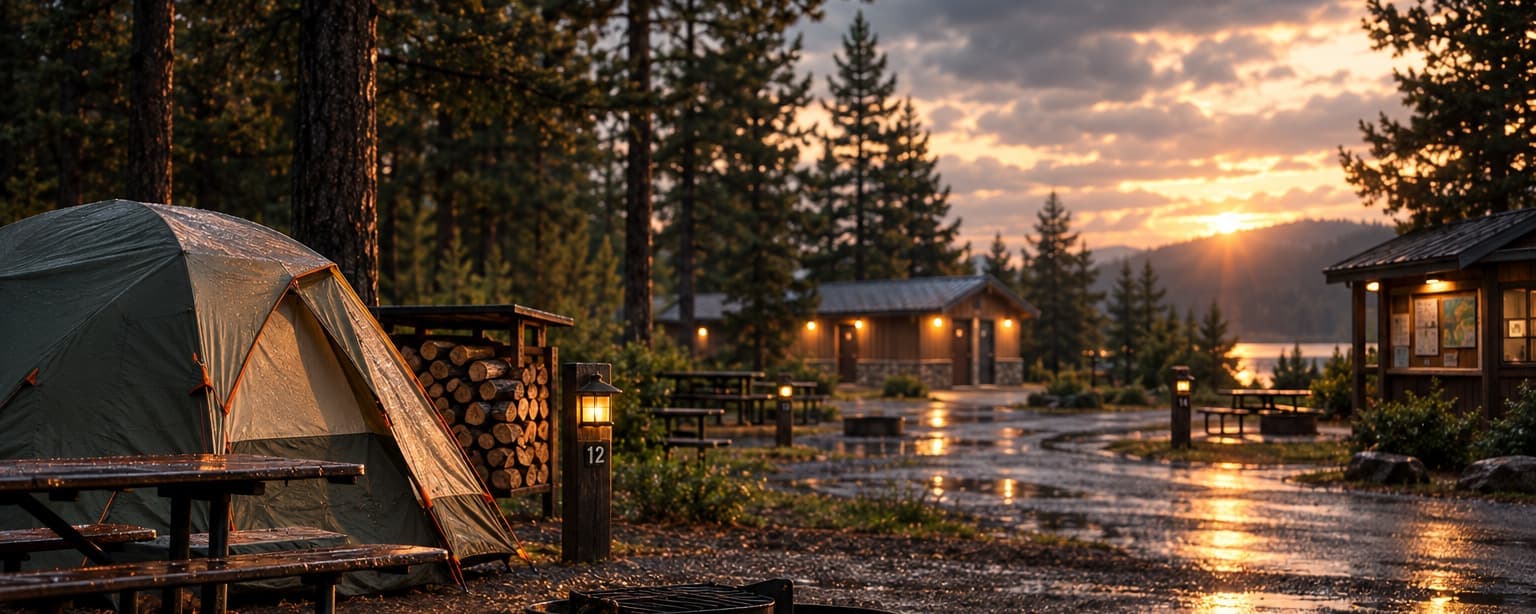
The land is the product and the weather is the tenant. The policy is written for what the land does to guests, not what guests do to it.
A campground rents ground, a fire ring and a bathhouse to people who arrive with tents, dogs and children and stay through whatever the weather does. The claims follow: a tree limb on a tent, a slip in the shower block, a child at the swimming hole, a fire that leaves the ring, a dog that bites the next site over. The property is spread out, mostly outdoors and seasonal, so the policy is a liability policy first, with property for the office, the cabins and the bathhouse, and pieces for the camp store, the boat rental and the propane fill. Campgrounds with RV sites overlap with RV parks and are placed the same way; add rental cabins, a pool or a lake and the liability rate moves. We place it for family campgrounds, membership parks, glamping sites and seasonal operations.
Tell us the situation.
One licensed human replies the same business day — not five agents, not an auto-responder. If the policy you have is already the right one, we will tell you.
We use this to quote and service your insurance, and we do not sell it or pass it to lead networks. Privacy policy.
Send us what you have. We’ll tell you if it’s right.
Your current policy paperwork, a renewal notice, or nothing at all. A licensed agent reads it and replies the same business day.
What campground businesses actually need.
General liability
Guest injury anywhere on the grounds: trails, sites, the bathhouse, the playground, the water.
Without it — The single biggest exposure a campground has, and the one every county permit and lender asks to see.
Property
The office, bathhouses, cabins, pavilions, docks, the camp store inventory and equipment.
Without it — A wildfire, a windstorm or a flood takes out the structures that make the land rentable, and the season with them.
Business income
Lost revenue while a covered loss keeps the campground closed through its season.
Without it — A campground earns in three or four months. A June fire is a year without income.
Liquor and camp store liability
Firewood, propane, food and, where sold, beer and wine from the store.
Without it — A propane fill station and a firewood pile are products and premises exposures the general liability form needs to know about.
Watercraft and rental equipment
Canoes, kayaks, paddle boats and bikes rented to guests.
Without it — Rented watercraft are excluded from standard liability unless listed.
Workers compensation
Seasonal staff, camp hosts and maintenance crews, including tree work.
Without it — Chainsaws, mowers and ladders in a seasonal crew are the injuries campgrounds actually have.
The claims we actually see.
Ordered by how often we see them, not by how dramatic they are. Each one names the coverage that answers it — and the policy people wrongly assume already does.
Most common
A slip or fall in the bathhouse or on a trail
Covered by General liability
Wet concrete and uneven ground are the two campground surfaces. Carriers ask about lighting, non-slip flooring and how often trails are inspected.
Common
A tree or limb falls on a site
Covered by General liability
A dead tree over an occupied site is negligence once you knew about it. An arborist's inspection each spring is the defense and an underwriting question.
Rare, catastrophic
A drowning or near-drowning
Covered by General liability
Pools and swimming areas without lifeguards are rated hard. Signage, depth markers and fencing are asked about specifically.
Less common, severe
A campfire spreads
Covered by General liability for neighboring property; your own property policy for your structures
A guest's fire that reaches the next county is a liability claim against the campground that allowed the fire. Burn bans and ring rules matter and are asked about.
What the policy will not cover.
Pick a procedure to see what the exclusion actually means and whether it can be placed somewhere else.
The policy covers the campground as a lodging business: the grounds, the structures, the guests and the staff. Things the guests bring and activities beyond camping are added or excluded by name.
Where a campground policy stops
Guests' own property
A tent, an RV or a car damaged by a storm is the guest's own insurance, unless your negligence caused it.
Can it be placed? Not needed; the guest's policy responds.
Amusement activities
Zip lines, climbing walls, inflatables and ATV trails are excluded from a lodging form and rated as attractions.
Can it be placed? Yes, with each activity disclosed and often a separate policy.
Long-term and seasonal residents
A site rented by the year is a landlord relationship, with eviction and habitability exposure a lodging form does not contemplate.
Can it be placed? Yes, once the resident sites are counted separately.
Flood and wildfire on the property policy
Both are excluded or sublimited on standard property forms, and campgrounds sit on rivers and in woods.
Can it be placed? Flood through the federal program or a private policy; wildfire depends on the location.
What the insurance company will ask about your campground business
We read the applications the markets use for businesses in this field and pulled out what they actually ask. Have these answers ready and a quote takes a day instead of a week, because nobody has to come back to you for the missing piece.
About the business
- What is your business name and website?
- What type of business structure do you have (individual owner, corporation, partnership, or other)?
- How many employees do you have?
- What is your annual gross revenue?
- Is this a new business or established?
How you operate
- What specific activities and services does your business offer (for example: lodging, dining, recreation, tours)?
- Does any part of your operation run from a residential property? If yes, what portion and how many employees work there?
- Do you use rental vehicles or do employees use their own vehicles for business purposes?
- Do you hire subcontractors? If yes, do you require them to carry insurance?
- Do you have written safety procedures, including emergency evacuation and fire safety?
Safety and controls
- Do you use liability waiver forms for your guests or customers?
- Do you have a written safety program with emergency procedures and fire safety measures in place?
- What is the distance to the nearest fire department and fire hydrant?
Your history
- Has your business or any previous owner ever had an insurance claim or loss?
- Has your current or previous insurance been cancelled or non-renewed in the last five years? If yes, why?
- Do you have any known incidents or events that could lead to a future claim?
Money and people
- What was your premium and insurance company name last year?
- What are your desired coverage limits for liability?
- What is your annual payroll?
Have these ready
- Your loss runs (claims history) from your current or most recent insurance company for the last five years
- Certificates of insurance from any subcontractors or independent contractors you use
- Your written safety program and emergency evacuation procedures
- Any liability waiver forms you use with customers or guests
You answer what you can; a licensed agent fills the rest with you.
What our campground clients ask us.
How much does campground insurance cost?
Liability is rated on the number of sites and the attractions: a tent-and-cabin campground with a bathhouse is at the low end, and a pool, a lake with rentals, a store selling alcohol or a zip line each raise it. Property is rated on the structures. A small seasonal campground can see a low four-figure annual price; a large resort campground with amenities is a different conversation.
What does a campground insurance application ask for?
The question bank has hotel and RV-park forms but no tent campground form yet. Applications for this class typically ask: the number of tent, RV and cabin sites and the season length, whether there is a pool, lake, river or beach and whether it is guarded, playgrounds and activities, rentals of boats or bikes, whether alcohol is sold, propane sales, campfire rules and burn-ban procedures, tree inspection, security and after-hours staffing, long-term residents, and any claims in the last five years.
Is a campground insured the same way as an RV park?
Mostly, and many operations are both. The RV side adds electrical pedestals, sewer hookups and heavier vehicles on the roads; the tent side adds fire rings, more foot traffic on trails and guests sleeping under trees. The application asks for both site counts and rates each.
Does the policy cover a guest hurt by another guest's dog?
The dog's owner is liable first, under their own homeowners or renters policy if they have one. The campground is named when the claim argues it should have enforced its own leash rules. Your liability policy defends that argument, and having and enforcing a written pet policy is what wins it.
Commercial insurance is 96% of what we do — it is not a department here, it is the whole business. Not ready to talk? The guides answer the questions this page raises in more depth. Already insured with us and need a certificate or a policy change? Ask the service team rather than starting a quote — it is faster and it goes to the people whose job it is. We also write home and auto, which is usually cheaper alongside the business policy than apart from it.
Handed a lease, a vendor packet or a client contract with insurance requirements? Paste it into the COI Requirements Decoder to see what each one means for your business, or read what the requirements mean.