
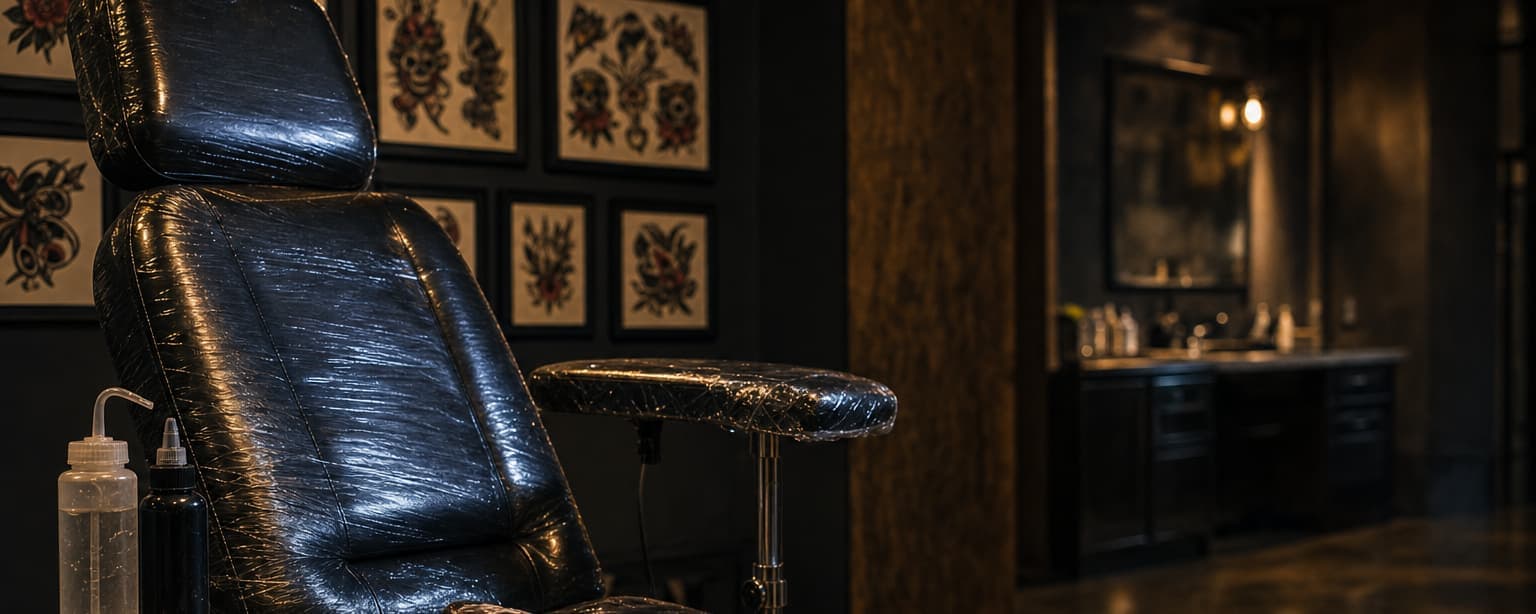
It is a permanent procedure that breaks the skin, and both halves matter.
The artist-versus-shop question decides who is actually insured, and most studios get it wrong. We cover that, infection and reaction claims, and dissatisfaction with permanent work.
Tell us the situation.
One licensed human replies the same business day — not five agents, not an auto-responder. If the policy you have is already the right one, we will tell you.
We use this to quote and service your insurance, and we do not sell it or pass it to lead networks. Privacy policy.
Send us what you have. We’ll tell you if it’s right.
Your current policy paperwork, a renewal notice, or nothing at all. A licensed agent reads it and replies the same business day.
What tattoo shop businesses actually need.
Professional liability
Infection, allergic reaction, scarring, and claims about the work itself.
Without it — General liability answers a slip, not the procedure.
Communicable disease
Bloodborne pathogen transmission claims.
Without it — Routinely excluded, and the most serious allegation in the trade.
General liability and property
Premises injury, plus equipment, stock and the fit-out.
Without it — A retail studio with the public in it and expensive kit behind the counter.
Products
Inks, pigments, jewelry and aftercare products.
Without it — A reaction to a pigment involves you in the chain of supply.
Artist coverage
Whether the policy covers employed artists, contractors or chair renters.
Without it — A chair renter without their own policy leaves the shop exposed.
Crime and social engineering
Cash deposits and ink and equipment stock, and a refund sent to somebody who was never a client.
Without it — A deposit refunded to a caller who was never a client is not burglary, so property does not answer it. The coverage for it is social engineering, requested by name.
Group health and benefits
Artists who bring their own following to your shop.
Without it — Artists are mobile and their clients follow them. What keeps them is the studio being a better place to work than the one down the road.
What our tattoo shop clients ask us.
Are our artists covered by the shop policy?
Only if the policy says so, and in most studios the artists are independent contractors renting a chair, which means they are separate businesses and need their own professional liability. The shop should require it and collect certificates annually, naming the studio as an additional insured. Otherwise a client suing over one artist’s work sues the studio, which is the name they know and the entity with assets, and the studio defends it alone.
What is the communicable disease exclusion?
A common exclusion removing claims of disease transmission, which for a trade whose defining feature is breaking the skin removes the most serious allegation there is. Check whether your policy excludes it and whether it can be bought back, because a hepatitis or HIV transmission allegation is exactly the claim that needs a defense funded. Insurers will ask about autoclave use and logging, single-use needles, sharps disposal and bloodborne pathogen training.
What about a client who simply does not like the tattoo?
It is a real claim type and it is why professional liability matters more here than in most trades: the work is permanent, so dissatisfaction cannot be resolved by redoing it. Claims turn on consent and documentation: a signed consent form showing the design, placement, size and spelling, with the client’s approval recorded before work starts. Studios that photograph the approved stencil in place are in a much stronger position than those relying on memory.
Does tattooing minors affect our coverage?
Yes, and it can void it. State law sets minimum ages and parental consent rules, and working outside them is both a licensing violation and generally a coverage problem. Insurers write on the basis that you comply with the applicable regulations. Piercing studios that serve minors with parental consent should confirm the position explicitly rather than assuming, and keep the consent records.
Commercial insurance is 96% of what we do — it is not a department here, it is the whole business. Not ready to talk? The guides answer the questions this page raises in more depth. Already insured with us and need a certificate or a policy change? Ask the service team rather than starting a quote — it is faster and it goes to the people whose job it is. We also write home and auto, which is usually cheaper alongside the business policy than apart from it.
Handed a lease, a vendor packet or a client contract with insurance requirements? Paste it into the COI Requirements Decoder to see what each one means for your business, or read what the requirements mean.