
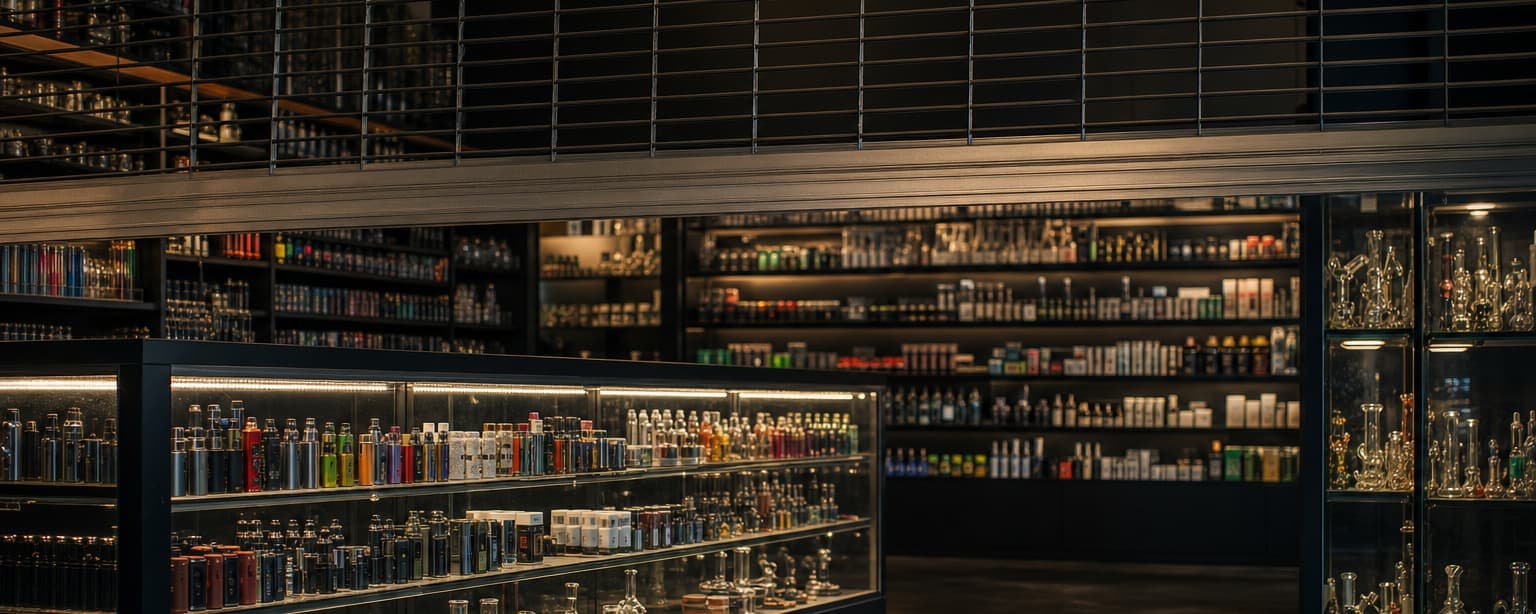
A retail policy is the easy part. The product on your shelves is the problem.
Your inventory is high value and easy to carry, and you did not make any of it. We cover the theft, fire and product liability, ahead of the federal deadline this category faces on 11 December 2026.
Tell us the situation.
One licensed human replies the same business day — not five agents, not an auto-responder. If the policy you have is already the right one, we will tell you.
We use this to quote and service your insurance, and we do not sell it or pass it to lead networks. Privacy policy.
Send us what you have. We’ll tell you if it’s right.
Your current policy paperwork, a renewal notice, or nothing at all. A licensed agent reads it and replies the same business day.
What smoke shop businesses actually need.
Product liability
Claims from product sold: vapes, cartridges, edibles, cannabinoid products.
Without it — A retailer sits in the chain of supply even having made nothing.
Property and inventory
Fit-out, display cases and stock, which is high value per square foot and portable.
Without it — Small, valuable, easily resold inventory is a burglary target.
Crime and theft
Burglary, robbery and employee theft.
Without it — Frequency here is higher than ordinary retail and insurers price it that way.
General liability
Customer injury on the sales floor.
Without it — The ordinary retail exposure, and the easiest part to place.
Compliance conditions
The warranty that you sell only what is lawful where you sell it.
Without it — Breaching it can void the policy for unrelated claims too.
Group health and benefits
Counter staff who know the age-verification rules cold.
Without it — A new hire who fails one ID check can cost you the license. Retention is a compliance control here, not just an HR one.
What smoke, vape and tobacco shops we placed in 2025 and 2026 actually paid.
These are annual premiums from policies we bound, effective January 2025 to June 2026. We show the median and the middle half of what clients paid, never the cheapest or the most expensive, and only for lines where at least five shops stand behind the figure.
- Commercial property, written on its own
- $1,390median a year
- Middle half: $1,110 to $1,650
- 9 policies from 9 shops
- General liability, written without property
- $1,220median a year
- Middle half: $950 to $1,500
- 10 policies from 9 shops
Payroll moves workers compensation more than anything else, and the services you provide, your limits and your claims history move the rest, so treat these as a sense of scale rather than a quote. Source: Boring Insurance bound policies, cancelled policies and test records excluded, refreshed 2026-10-04.
What our smoke shop clients ask us.
Does our insurance change on 11 December 2026?
Your exposure does, sharply, if delta-8, delta-10, HHC or THCA products are a meaningful share of revenue. From that date the federal definition of hemp caps finished products at 0.4mg of total THC per container, counting THCA, and bans cannabinoids synthesized outside the plant. Products containing cannabinoids the plant cannot produce naturally are caught a month earlier, on 12 November. Two things follow. Stock that becomes unsellable is not an insured loss anywhere, so that is a trading problem rather than a claim. And most policies in this class carry a condition that you comply with applicable law, so continuing to sell after the date can put the whole policy at risk, including the slip-and-fall at the counter.
Why is this class hard to place at all?
Three reasons that stack. The inventory is small, valuable and easily resold, which drives theft frequency. Vape and inhalation products carry their own liability history and are commonly excluded or sublimited. And the cannabinoid side sits in a legal category that has moved twice in eighteen months. Most placements land in surplus lines, so the wording varies between quotes that look alike and the carrier’s financial strength matters more than usual.
Could we be cancelled just for stocking delta-8?
Yes, and it is the likeliest way this hurts you. The products liability is placeable. There are markets that will take intoxicating hemp, which surprises most retailers. The general liability is the fragile part: preferred carriers non-renew or cancel on discovering a business sells these products, on the class of product rather than on any claim history.
We only resell. Are we liable for the products?
Yes. Product liability follows the chain of supply, and a retailer is frequently the most reachable defendant, particularly where the manufacturer is a small brand, an overseas supplier or a business that has since closed, which describes a lot of this category. Get named as an additional insured on your suppliers’ policies, collect certificates annually, and carry your own limits regardless of what the distributor promises.
What do underwriters ask about age verification?
A great deal, because a sale to a minor is both a licensing problem and a liability one. Expect questions about ID scanning rather than visual checks, staff training records, whether the point-of-sale system enforces the prompt, and how failed checks are logged. Documented electronic verification is one of the few operational things in this class that visibly improves the terms.
What do smoke, vape and tobacco shops pay for insurance?
From policies we bound effective January 2025 to June 2026. Commercial property, written on its own: smoke, vape and tobacco shops we placed paid a median of $1,390 a year, with the middle half between $1,110 and $1,650 (9 policies from 9 shops). General liability, written without property: smoke, vape and tobacco shops we placed paid a median of $1,220 a year, with the middle half between $950 and $1,500 (10 policies from 9 shops). Payroll, services, limits and claims history move the figure, so treat it as scale rather than a quote.
Commercial insurance is 96% of what we do — it is not a department here, it is the whole business. Not ready to talk? The guides answer the questions this page raises in more depth. Already insured with us and need a certificate or a policy change? Ask the service team rather than starting a quote — it is faster and it goes to the people whose job it is. We also write home and auto, which is usually cheaper alongside the business policy than apart from it.
Handed a lease, a vendor packet or a client contract with insurance requirements? Paste it into the COI Requirements Decoder to see what each one means for your business, or read what the requirements mean.