
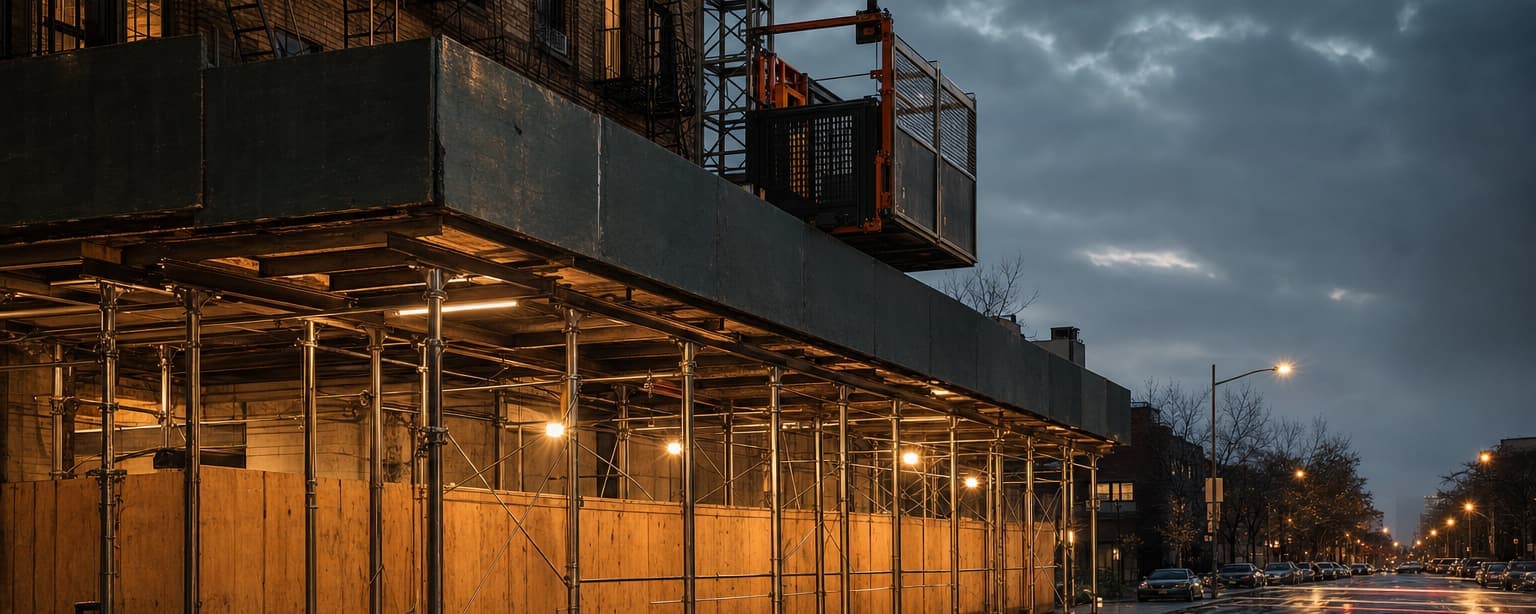
One state has a law that makes you liable whether or not you did anything wrong. You work in it.
We cover contractors working in New York: Labor Law 240 and 241 exposure, action over claims, and the five-borough problem that empties the market of carriers willing to write you.
Tell us the situation.
One licensed human replies the same business day — not five agents, not an auto-responder. If the policy you have is already the right one, we will tell you.
We use this to quote and service your insurance, and we do not sell it or pass it to lead networks. Privacy policy.
Send us what you have. We’ll tell you if it’s right.
Your current policy paperwork, a renewal notice, or nothing at all. A licensed agent reads it and replies the same business day.
What New York contractor businesses actually need.
General liability WITH Labor Law 240/241 coverage
Liability for gravity-related injury claims brought under the Labor Law, rather than a policy that excludes them.
Without it — Many New York forms exclude Labor Law claims outright, or above a stated height, or in the five boroughs. The exclusion is the product.
Action over / employer’s liability
The claim that comes back to you when your injured employee sues the general contractor and the GC seeks indemnity.
Without it — General liability commonly excludes bodily injury to an employee of an insured: the exact route these claims take.
Workers compensation
Injury and illness on site, at New York construction class rates.
Without it — Required, expensive here, and the trigger event for the Labor Law suit that follows.
Excess and umbrella
Layers above the primary, and the limits general contractors, owners and lenders demand before you set foot on the site.
Without it — A strict-liability fall claim exhausts a $1M primary routinely, and GC requirements of $5M and above are ordinary here.
Contractual and additional insured
Owner, general contractor, construction manager and lender named as required, with primary and non-contributory wording and waiver of subrogation.
Without it — The wrong endorsement form is the commonest reason a New York certificate is rejected at onboarding.
Contractors equipment and installation floater
Tools, equipment and materials on site or in transit, including materials installed but not yet accepted.
Without it — Urban sites lose tools and materials constantly, and property policies do not follow them there.
Group health and benefits
Field staff in a market where labor is scarce and expensive.
Without it — New York labor costs are the highest in the country, so replacing a crew member costs more here than anywhere else.
The claims we actually see.
Ordered by how often we see them, not by how dramatic they are. Each one names the coverage that answers it — and the policy people wrongly assume already does.
Most common
A worker falls from height, or is struck by something falling
Covered by General liability with Labor Law 240/241 coverage
The claim New York policies are written to exclude. A form with a Labor Law or height exclusion leaves the single most likely serious claim on your job uninsured.
Most common
Your injured employee sues the general contractor, who comes to you
Covered by Action over / employer’s liability
Workers comp is the exclusive remedy against YOU, so the worker sues everyone else, and your contract obliges you to indemnify them. Many general liability forms exclude injury to an employee of an insured, which is precisely this claim.
Common
A subcontractor’s worker is hurt on your job
Covered by Your liability, and their certificate
An uninsured sub, or one whose own policy carries a Labor Law exclusion, becomes your claim. Collecting a certificate is not the same as reading the exclusions on it.
Common
Damage to an adjoining building or the street
Covered by General liability, and site-specific requirements
Dense urban work means neighbors on both sides, below and above. City permitting and site safety requirements add obligations most out-of-state contractors have not met before.
Common
A worker is injured and the comp claim runs for years
Covered by Workers compensation
New York construction comp is expensive on its own terms, and the injury that generates the comp claim is usually the same event that generates the Labor Law suit.

Joe Gorman
Co-Founder | President of Commercial Lines
Came up in construction, on site and in the office, then moved into sales. Went out on a limb to become Boring’s first dedicated salesperson when the agency had no sales team at all, and now leads it. Landscaping is the class he writes most: grounds maintenance, tree work, irrigation and the spray operations that push an account out of preferred appetite.
A subcontractor working in Brooklyn was renewed by their previous broker into a policy that carried a New York Labor Law exclusion and a height exclusion. Nobody had told them, and the general contractor on their next job would not accept the certificate, which is how they found out, with the crew already scheduled.
We marked up the expiring policy against the contract they had signed, showed them the two exclusions and the indemnity they had promised with nothing behind it, and re-placed the account with a market that writes Labor Law and action over coverage, at the limits the GC required and with the additional insured forms their onboarding portal actually accepts. The certificate cleared and the crew started on schedule.
What our New York contractor clients ask us.
What are Labor Law 240 and 241, in plain terms?
They are two sections of the New York Labor Law that govern construction safety, and New York is the only state with anything quite like the first.
Why is it so hard to get coverage in the five boroughs?
Because the two things that drive the loss stack on top of each other there. The Labor Law applies statewide, but the Bronx, Brooklyn, Manhattan, Queens and Staten Island combine it with the densest construction in the country, the most litigious venues, higher verdicts, more adjoining-property exposure, and a regulatory and permitting regime with obligations that generate their own claims. Carriers responded by leaving, and the ones that stayed manage the exposure by drawing lines rather than by pricing every risk.
What is action over coverage and why does everyone in New York talk about it?
It is coverage for the claim that comes back at you sideways. Your employee is injured, workers compensation is the exclusive remedy against you as their employer, so they sue the parties who are not: the owner, the general contractor, the construction manager. Those parties turn to the contract you signed, which obliges you to indemnify them, so the claim lands on you having gone around the comp bar entirely. Many general liability forms exclude bodily injury to an employee of an insured, which describes this claim exactly. Check for it by name.
How much more does full Labor Law coverage cost?
Materially more, and the honest answer is that the range is wide and driven by what you actually do. Market commentary commonly puts the difference at something like 25% to 100% over a comparable policy without the coverage, and we would treat that as an indication rather than a quote: the real number depends on your trade, how high you work, whether you do residential or commercial, your subcontractor practices, your payroll and your loss history.
We are based out of state and taking a job in New York. What changes?
More than most contractors expect, and the time to find out is before you mobilize. Your existing policy may simply not cover the work — out-of-state forms frequently carry a New York exclusion — and your workers compensation has to be valid for work performed in New York, which is a separate question from having a policy. The general contractor’s requirements will be heavier than you are used to, and the certificate gets rejected on wording rather than on the number. Send us the contract before you sign.
Does a certificate from my subcontractor protect me?
Only as far as what is behind it, and in New York the gap between the certificate and the policy is where the losses live. A certificate is a summary; it does not show exclusions. A subcontractor can hand you a perfectly genuine certificate showing $1M in general liability on a policy that excludes Labor Law claims, excludes work above thirty feet, or excludes the borough you are both standing in, and when their worker falls, that policy answers nothing and the claim comes to you.
Commercial insurance is 96% of what we do — it is not a department here, it is the whole business. Not ready to talk? The guides answer the questions this page raises in more depth. Already insured with us and need a certificate or a policy change? Ask the service team rather than starting a quote — it is faster and it goes to the people whose job it is. We also write home and auto, which is usually cheaper alongside the business policy than apart from it.
Handed a lease, a vendor packet or a client contract with insurance requirements? Paste it into the COI Requirements Decoder to see what each one means for your business, or read what the requirements mean.