
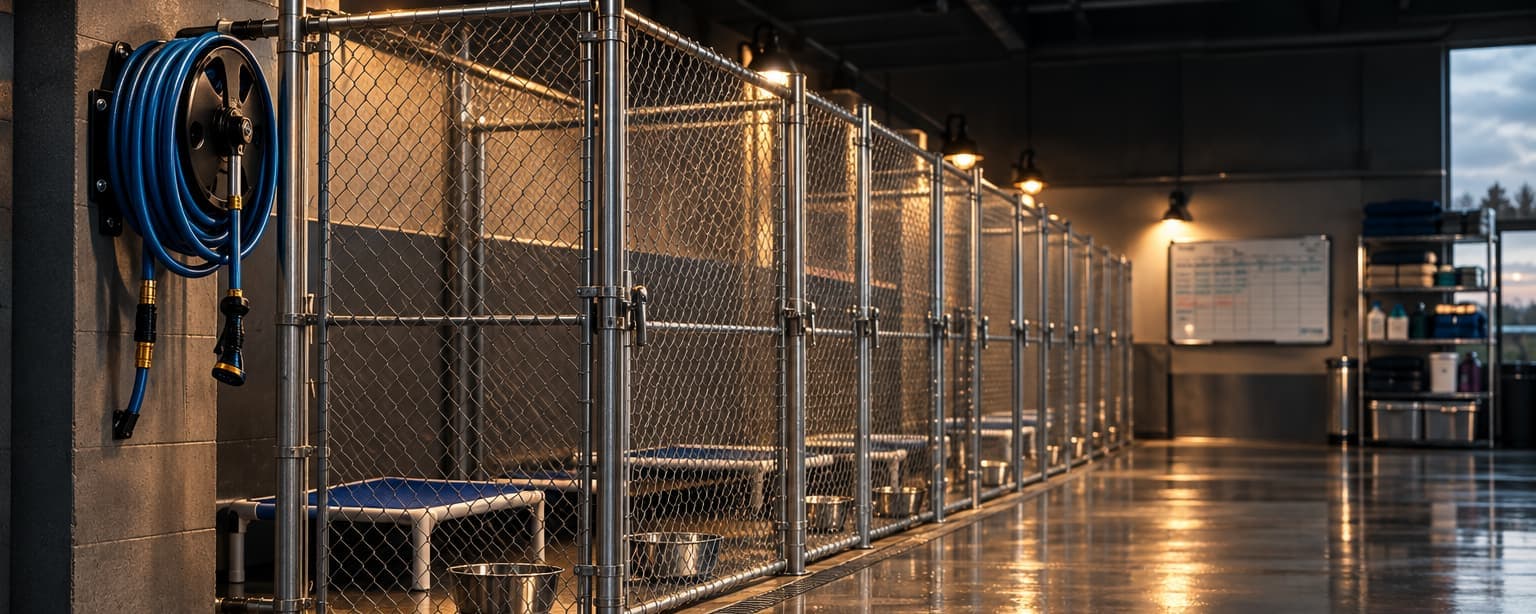
The dogs in your care are not your property and not your customers, which is why the ordinary policy pays nothing when one is hurt.
A boarding kennel holds animals that belong to other people, and the claim a kennel actually gets is about one of those animals: injured in a fight, sick after a stay, escaped through a gate, or dead in a kennel fire. A standard general liability policy treats those animals as property in your care and excludes them. Kennel insurance adds animal bailee coverage for exactly that, alongside liability for bites and for people on the premises, property for the building and runs, and workers compensation for staff who handle dogs all day. We place it for boarding kennels, daycare, cattery and boarding combinations, and kennels that also groom or train.
Tell us the situation.
One licensed human replies the same business day — not five agents, not an auto-responder. If the policy you have is already the right one, we will tell you.
We use this to quote and service your insurance, and we do not sell it or pass it to lead networks. Privacy policy.
Send us what you have. We’ll tell you if it’s right.
Your current policy paperwork, a renewal notice, or nothing at all. A licensed agent reads it and replies the same business day.
What kennel businesses actually need.
Animal bailee
Injury, illness, death or escape of an animal in your care, custody or control, including veterinary bills and the value of the animal.
Without it — The single exclusion in general liability that matters most to a kennel; without it, every injured boarder is paid out of your pocket.
General liability
A bite to a visitor or an employee of another business, a customer who slips on a hosed floor, damage to a neighbor's property by an escaped dog.
Without it — A bite to a person is the headline claim in the industry, and the medical bills follow the kennel that had custody.
Commercial property
The building, runs, fencing, kennels, HVAC and equipment, and business income while you are closed.
Without it — A kennel fire is a total loss with animals inside; the property policy rebuilds and the income coverage keeps the payroll going.
Workers compensation
Bites, scratches, lifting injuries and slips to staff.
Without it — Required from the first employee, and the kennel worker bitten breaking up a fight is the routine claim.
Professional liability for grooming and training
For kennels that also groom or train: claims that the service itself harmed the animal, such as a clipper burn or an injury during training.
Without it — Animal bailee covers the animal while boarded; a claim about how the grooming was done is a professional claim.
Hired and non-owned auto
Pickup and drop-off of animals in a van or a staff member's car.
Without it — A dog loose in a moving vehicle is an accident waiting for a claim, and the personal auto policy excludes business use.
The claims we actually see.
Ordered by how often we see them, not by how dramatic they are. Each one names the coverage that answers it — and the policy people wrongly assume already does.
Most common
A dog injured or killed in a fight with another boarder
Covered by Animal bailee
Group play is where fights happen. Temperament screening, staff-to-dog ratios and constant supervision in common areas are what the application asks about and what carriers price.
Common
A dog escapes and is hit by a car or lost
Covered by Animal bailee for the animal; general liability for damage it does
Double-gated entries and fenced yards are the difference between a story and a claim.
Common
Illness spreads through the kennel
Covered by Animal bailee, often with a disease sublimit
Kennel cough and parvovirus move through a building in days. Vaccination requirements at check-in, isolation runs and cleaning logs are the defense and the underwriting question.
Rare, catastrophic
A fire at night with animals inside
Covered by Property, business income and animal bailee together
Smoke and heat detectors in every area, monitored alarms and no old wiring are the questions on the form; an unattended kennel overnight is the exposure carriers ask about most.
What the policy will not cover.
Pick a procedure to see what the exclusion actually means and whether it can be placed somewhere else.
The policy covers the animals you take in under the conditions you told the carrier about, and the people and property around them. Certain animals and certain practices are rated separately or refused.
Where a kennel policy stops
Breeds or animals the carrier excludes
Some carriers exclude specific breeds, exotic animals or intact males in group play; taking them in anyway leaves those animals uncovered.
Can it be placed? Yes, on a form that accepts them, at a price.
Boarding without vaccination records
A policy conditioned on current vaccinations does not respond to a disease outbreak among dogs you admitted without them.
Can it be placed? Yes, by enforcing the check-in requirement.
Breeding and sales
Selling puppies or breeding on the premises is a different business with its own product and warranty claims.
Can it be placed? Yes, once disclosed.
Veterinary treatment
Administering medication is usually fine; diagnosing or treating an animal is veterinary practice, excluded and unlicensed.
Can it be placed? No, without a veterinarian and a veterinary policy.
What the insurance company will ask about your kennel business
We read 1 application the markets use for this kind of business and pulled out what they actually ask. Have these answers ready and a quote takes a day instead of a week, because nobody has to come back to you for the missing piece.
About the business
- What services do you provide (boarding, day care, grooming, training, or other)?
- How long have you been in business and at your current location?
- How many employees do you have?
- Do you sell any products under your own label?
How you operate
- How many pets do you have on site on an average day?
- How many kennels or compartments do you have?
- Are all pets monitored in common areas?
- Are all play yards and play areas fenced?
- If you transport animals, are they tethered or caged during transport?
Safety and controls
- Do you have functioning fire extinguishers on site?
- Do you have functioning smoke and heat detectors in all areas?
- For any building built before 1978, does it have aluminum wiring or knob and tube wiring?
Your history
- Have you had any property or liability losses in the past three years?
- Has your insurance coverage been canceled or non-renewed in the past three years?
Money and people
- What coverage limits do you want for pet liability (starting at $100,000 per incident)?
- What coverage limit do you want for pets themselves ($1,000 to $10,000)?
Have these ready
- Description of what your business does and how you operate
- Your loss history for the past three years (claims you or your current insurer know about)
- Information about anyone else with a financial interest in your business
You answer what you can; a licensed agent fills the rest with you.
What our kennel clients ask us.
How much does kennel insurance cost?
A small boarding kennel usually pays in the low thousands a year for general liability with animal bailee, plus property on the building and workers compensation on payroll. The number of runs, group play, overnight staffing, the building's age and wiring, and whether you also groom or transport all move the price. Claims in the last three years move it most.
What is animal bailee coverage and do I need it?
Animal bailee pays when an animal in your care is injured, becomes ill, escapes or dies, including the vet bill and the animal's value. General liability excludes property in your care, custody or control, and to an insurer a boarded dog is property. Every kennel needs it, and it is the first thing to check on any quote that looks cheap.
What does a kennel insurance application ask for?
The application we work from asks which services you offer (boarding, daycare, grooming, training), how long you have operated and at this location, how many pets you keep on an average day and how many runs, whether pets are always monitored in common areas and every play yard is fenced, how animals are restrained in transport, whether you have working extinguishers and smoke and heat detectors throughout, the wiring in an older building, three years of losses, and your business structure. It wants loss runs and the building and contents values.
Does the policy cover training classes at the kennel?
Boarding and training are rated separately even under one roof. A training injury, a bite during a class, or a client who says the training made the dog worse is a professional claim, and the kennel policy needs the training added or a separate trainer policy beside it.
Commercial insurance is 96% of what we do — it is not a department here, it is the whole business. Not ready to talk? The guides answer the questions this page raises in more depth. Already insured with us and need a certificate or a policy change? Ask the service team rather than starting a quote — it is faster and it goes to the people whose job it is. We also write home and auto, which is usually cheaper alongside the business policy than apart from it.
Handed a lease, a vendor packet or a client contract with insurance requirements? Paste it into the COI Requirements Decoder to see what each one means for your business, or read what the requirements mean.