
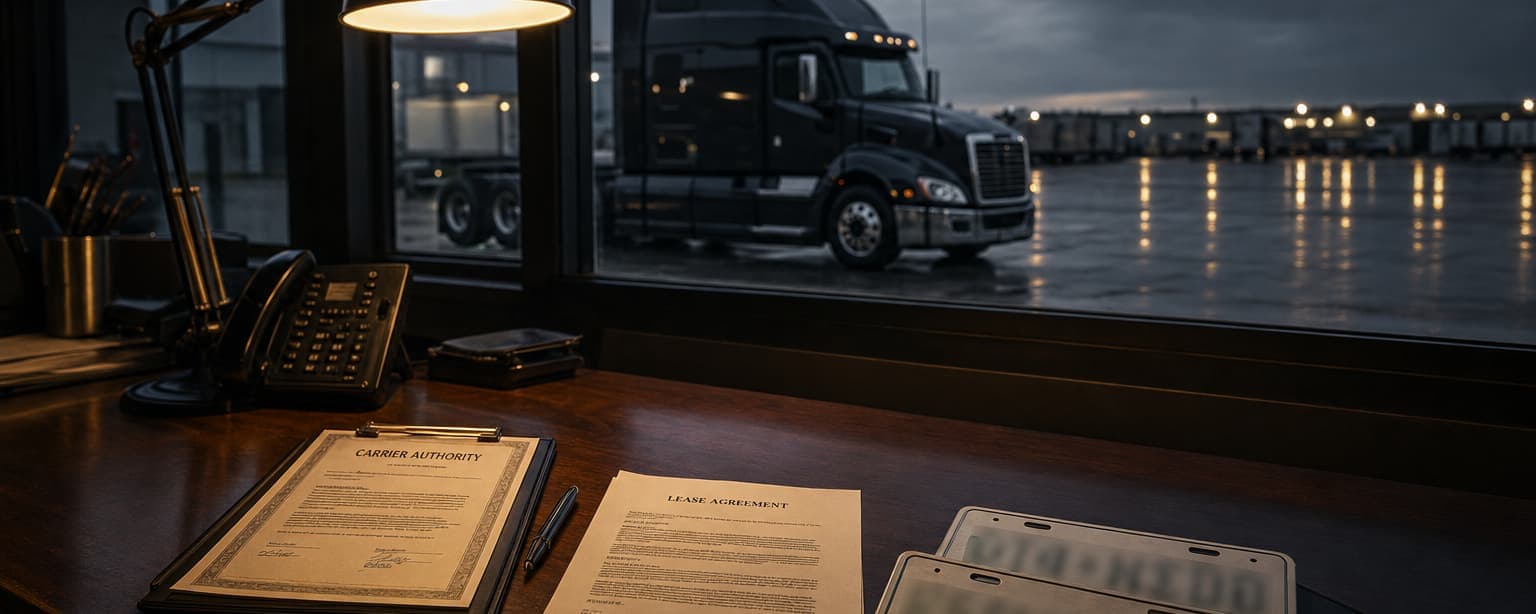
What are the biggest insurance mistakes trucking companies make?
Nine, and most of them are paperwork rather than driving: putting leased owner-operators on the company policy, hiring without a motor vehicle record, running trucks and drivers that are not on the schedule, listing the wrong garaging address, pulling trailers you do not own with no coverage for them, reporting claims late, running related companies under separate DOT numbers, using a shared or borrowed address as the principal place of business, and treating hours-of-service as a roadside problem rather than a pricing one. Each one is cheap to fix before a loss and expensive after, and every one of them is something the underwriter can check from public records before quoting.
Tell us the situation.
One licensed human replies the same business day — not five agents, not an auto-responder. If the policy you have is already the right one, we will tell you.
We use this to quote and service your insurance, and we do not sell it or pass it to lead networks. Privacy policy.

Lori Adams, TRS
Commercial Trucking Insurance Advisor
Twenty-five years in trucking insurance. Knows the filings, the radius rules and the carriers that will actually take the risk.
Transportation Risk Specialist (TRS)
Send us what you have. We’ll tell you if it’s right.
Your current policy paperwork, a renewal notice, or nothing at all. A licensed agent reads it and replies the same business day.
The detail
A lease between a motor carrier and an owner-operator must specify who is responsible for providing and paying for insurance, and where the carrier charges the owner-operator back for coverage the lease must name the amount: the regulation gives "bobtail insurance" as its own example of such a charge.
The lease must give the carrier "exclusive possession, control, and use of the equipment for the duration of the lease", which is why a leased truck under dispatch is the carrier’s liability, and why the owner-operator’s own policy is written for the time outside dispatch.
FMCSA’s Truck Leasing Task Force reported to Congress in January 2025 that "motor carriers may overcharge drivers for insurance coverage and/or mislead drivers about the level of insurance coverage on a vehicle."
A motor carrier must obtain a motor vehicle record covering the preceding three years, from every state that licensed the driver in that period, within 30 days of the date the driver’s employment begins, and place it in the driver qualification file.
Before a driver first performs a safety-sensitive function, the employer must run a full pre-employment query of the Drug and Alcohol Clearinghouse, and must query every driver at least once a year after that.
A recordkeeping violation carries a civil penalty of up to $1,584 per day, to a maximum of $15,846 per violation; a falsified record carries up to $15,846; operating without the required financial responsibility carries up to $21,114 per day.
49 CFR Part 386, Appendix B, paragraphs (a)(1), (a)(2) and (d), as adjusted for 2025 (90 FR 22863)
The ISO business auto and motor carrier forms both say that "the symbols entered next to a coverage on the Declarations designate the only ‘autos’ that are covered ‘autos’" — a scheduled policy covers the listed units and nothing else.
On a scheduled policy a newly acquired truck is a covered auto only if the policy already covers every truck you own, or it replaces one that was covered, AND you tell the insurer within 30 days of acquiring it; miss the 30 days and the truck was never covered.
ISO CA 00 01 10 13 and CA 00 20 10 13, Section I.B (newly acquired autos, symbol 7)
The MCS-90 endorsement pays a member of the public for a judgment "regardless of whether or not each motor vehicle is specifically described in the policy", and then requires the insured to reimburse the insurer for any payment it would not have owed under the policy itself.
The Ninth Circuit held that an MCS-90 insurer that paid a judgment on a truck the policy did not list was entitled to recover the full payment from the motor carrier under the endorsement’s reimbursement clause.
Harco National Insurance Co. v. Bobac Trucking, Inc., 107 F.3d 733 (9th Cir. 1997)
FMCSA’s public roadside inspection data identifies the vehicle inspected by VIN and license plate; the published inspection file states that "due to privacy restrictions driver information is not included."
Commercial auto rating territory, radius class and zone are all determined from the street address where the vehicle is principally garaged, not from the mailing or business address.
Kentucky Automobile Insurance Plan, Commercial Manual (AIPSO, 2016), Rules 72.C.1, 73.B and 74.B.4
In California, "concealment, whether intentional or unintentional, entitles the injured party to rescind insurance" — a wrong garaging address does not need to be a lie to void the policy.
The motor carrier form excludes damage to a trailer in your possession under a trailer interchange agreement unless trailer interchange coverage is bought back, and that coverage pays "all sums you legally must pay as damages" for the trailer. It is liability for someone else’s trailer, not physical damage on your own.
ISO CA 00 20 10 13, Section III (Trailer Interchange Coverage) and Section IV.B.2.a
The intermodal interchange agreement will not accept a scheduled-only auto policy — "we cannot accept just a ‘ALL OWNED AUTO’ or a ‘SCHEDULED ONLY’ auto policy" — and the equipment providers’ trailer interchange requirements run from $15,000 to $35,000 per unit, most of them at $20,000 to $25,000.
IANA, UIIA Insurance Requirements and Form 5B (rev. 05/14/2026)
Both ISO auto forms open their duties clause with "we have no duty to provide coverage under this policy unless there has been full compliance with the following duties": prompt notice of how, when and where the accident happened, the names and addresses of the injured and of witnesses, and permitting the insurer to inspect the vehicle before it is repaired or disposed of.
In New York an insurer may not deny a liability claim for late notice unless it was prejudiced by the delay, and the insurer carries the burden of proving prejudice where notice arrived within two years of the deadline.
On workers compensation claims, NCCI found the median cost of a claim reported in the fourth week or later was $19,900 against $17,300 for claims reported the day of injury, with attorney involvement rising from 12.8% to 31.7%, a workers compensation study, not a commercial auto one, and NCCI itself cautions that the relationship is correlation rather than proven cause.
FMCSA may consolidate two carriers’ records "for all purposes" where one is operating as a continuation of another, weighing thirteen factors that include shared addresses, phone numbers and e-mail, common equipment, continuity of insurance, the same drivers and the same facilities.
An applicant for operating authority must disclose any relationship with another carrier, broker or forwarder in the preceding three years, and a false answer is a ground for revocation.
GAO identified 1,136 carriers registered in 2010 with the characteristics of a "chameleon" — a new registration by an operator that previously held one — and found them three times as likely to be involved in a severe crash (18% against 6%), though not more likely to be placed out of service.
U.S. Government Accountability Office, GAO-12-364 (March 2012)
A principal place of business cannot be a post office box, a commercial mail receiving agency, or the office of a consultant, service agent or attorney; a single-location carrier, including one run from a residence, cannot designate anywhere but that location.
The MCS-150 must be updated before a carrier begins operating and every 24 months thereafter on a schedule set by the USDOT number, and FMCSA may deactivate the USDOT number of a carrier that fails to file it.
A property-carrying driver may drive no more than 11 hours after 10 consecutive hours off duty, within a 14-hour window, with a 30-minute break after 8 hours of driving, and no more than 60 hours in 7 days or 70 hours in 8.
Hours-of-service compliance is one of the seven safety categories FMCSA scores over a 24-month window, and the intervention threshold for it in general freight, the 65th percentile, is the lowest of any category, so the same violation rate triggers attention there before it would anywhere else.
FMCSA, Safety Measurement System Methodology, version 3.2 (June 2026)
At the 2025 International Roadcheck, hours-of-service violations were 32.4% of all driver out-of-service orders and false logs another 10%, the two largest categories.
Carriers over the hours-of-service intervention threshold had 6.24 crashes per 100 power units against 2.09 for carriers with no alert, from FMCSA’s own 2012 analysis of University of Michigan research, and the data is that old.
FMCSA response to Wells Fargo Securities on CSA effectiveness (March 2012)
In the 2014 Cranbury, New Jersey crash the NTSB found the truck driver was within every hours-of-service limit and had been awake for more than 28 hours: the limits cap driving, not fatigue.
What this means for you
- 1. Owner-operators on the company policy with physical damage. A leased owner-operator sits under your authority and your liability while under dispatch, and that is where the carrier’s policy should stop. Put their tractor’s physical damage on your schedule and you are paying to insure a truck you do not own, rating your fleet on equipment you do not control, and, when they leave, carrying a claim history that was never yours. The lease already has to say who pays for what (§376.12(j)); the answer that works is that the owner-operator carries their own non-trucking liability and their own physical damage, and you carry the liability while they are working for you.
- 2. Hiring without a motor vehicle record. The regulation gives you 30 days to pull the three-year record and a year to review it again, and a driver you never ran is a driver the underwriter will run for you, at renewal or after the loss. The price of a bad record on the policy is measured in points on a rate; the price of no record is a driver qualification file that fails an audit and a claim where the first question is whether you knew. Run the MVR and the Clearinghouse query before the first dispatch, not after the first inspection.
- 3. Trucks and drivers that are not on the schedule. Most trucking policies cover the units listed and nothing else — the form says so in one sentence — and the 30-day window for a new truck is a condition, not a courtesy. Inspection records are public and searchable by DOT number, so a unit that was never scheduled is found the first time it is pulled over. Because the MCS-90 makes your insurer pay a member of the public anyway and then collect from you, an unscheduled truck is not an uninsured truck; it is a truck you insured yourself without knowing it.
- 4. The wrong garaging address. Territory, radius and zone are all rated from the street address where the truck actually sleeps, so an address chosen for the price is a misstatement of the thing the price is built on. In California it does not have to be deliberate to void the policy; in New York it cannot void the compulsory liability but it can void everything else. Use the yard, keep proof of it, and tell your agent when it moves.
- 5. Non-owned trailers with no coverage. Your physical damage follows equipment you own. A trailer you pull under an interchange agreement is excluded on the motor carrier form until you buy trailer interchange back, and a trailer you pull on a handshake is not covered by anything. The intermodal pools will not accept a scheduled-only policy at all, and their per-trailer requirement runs $15,000 to $35,000. Decide which trailers you pull that you do not own, and buy the form that matches how you came to be pulling them.
- 6. Reporting the claim late. The duties clause is a condition of coverage — "no duty to provide coverage" until they are met — and the duties are specific: how, when, where, who was hurt, who saw it, and let the insurer look at the truck before it is fixed. Most states now make the insurer show it was prejudiced by the delay, but the states that do not still exist, and prejudice is easy to show once the truck has been repaired and the ELD data has cycled. Report the day it happens. The dashcam and ELD retention clocks are already running.
- 7. Related companies under separate DOT numbers. Insurers write the operation, not the entity, so a second company at the same yard with the same trucks and drivers gets asked onto the same policy. That is underwriting practice, not a rule. What IS a rule is that FMCSA can fold two carriers into one record for all purposes on exactly those facts: a shared address, common equipment, continuity of insurance, the same drivers. A new DOT number starts with no safety history; it does not lose the old one if the old one can be tied to it.
- 8. A shared or borrowed address as the principal place of business. The principal place of business is where your records are and where the audit happens. FMCSA says in so many words that it cannot be a P.O. box, a mail drop or your consultant’s office, and that a carrier run from a home designates the home. The registration deadlines run on mail to that address, and the MCS-150 that carries it is a file-or-deactivate obligation every two years. Give the address where somebody will open the letter.
- 9. Treating hours-of-service as a roadside problem. Hours violations are the biggest single category of driver out-of-service orders, the hours category has the lowest intervention threshold of any FMCSA safety score, and carriers over that threshold crash at three times the rate. That combination is why an underwriter reads your hours percentile before your loss runs. The 11-hour, 14-hour and 70-hour limits are a floor: the NTSB’s Cranbury investigation found the driver inside every one of them and awake for 28 hours.
- 10. Arguing the violation instead of showing what changed. Few things turn a placeable account into a declined one faster, and it is almost always well intentioned. A carrier with a serious violation on the record builds the submission around why the citation was wrong. The officer was mistaken, it is under appeal, the driver was blamed unfairly. An underwriter is not an appeals board and has no view on whether it was fair. They are pricing one thing, which is the chance it happens again, and a submission that argues the past says nothing about that. The version that gets written says what changed. The driver is gone, or was retrained and here is the certificate. The cameras went in on this date. The pre-trip process was rewritten and here it is. Dispute it with the agency if it is wrong, by all means, and separately. In the submission, the violation is the setup and the mitigation is the answer, and leaving the answer out reads as nothing having been done.
Go deeper on any of these
- The driver qualification file, as a checklist
- Cancelled for a truck that showed up on an inspection
- Why your MCS-150 has to match before you can get a quote
- How to get your loss runs
- What to do when a policy is cancelled mid-term
- New authority priced as long-haul when you are not
- What a National Indemnity quote tells you
- Combined single limit vs split limits
- Does running an ELD actually earn a discount?
- Amazon Relay’s requirements, line by line
Related questions
- What should a leased owner-operator carry themselves?
Non-trucking liability for the time outside your dispatch, and physical damage on their own tractor. Your policy carries the liability while they are working for you, and the lease spells out who pays for what. The mistake is putting their truck on your physical damage schedule, which rates your fleet on equipment you do not control and leaves you holding their claims history after they leave.
- Bobtail and non-trucking liability, explained
- What has to be in the driver qualification file before a driver’s first dispatch?
The application, the three-year motor vehicle record from every state that licensed them, the Clearinghouse pre-employment query, the road test or its CDL equivalent and the medical certification, and then a fresh MVR and a documented review every year. The file is retained for the whole employment plus three years, and it is the first thing an auditor and the second thing an underwriter asks for.
- The driver qualification file checklist
- How does the insurer find a truck I never scheduled?
From your inspection history, which is public and indexed by DOT number and VIN. Every roadside inspection records the unit, so a truck that has been inspected and was never on the schedule is a truck the underwriter can see was working. The data does not name the driver, FMCSA withholds that for privacy, but the truck is enough.
- Cancelled for a truck that showed up on a DOT inspection
- Is a wrong garaging address really fraud?
It does not have to be. California’s insurance code lets an insurer rescind for concealment "whether intentional or unintentional", and the garaging address is the fact the territory, radius and zone are rated from. New York will not let an insurer retroactively void the compulsory liability, but physical damage and cargo have no such protection. The safe answer is the yard where the truck actually sleeps, with something on paper that proves it.
- Why carriers ask for proof of garaging
- What is the difference between trailer interchange and non-owned trailer coverage?
Trailer interchange responds to a trailer in your possession under a written interchange agreement, and it is legal-liability coverage for the owner’s trailer rather than physical damage on your own. Non-owned trailer physical damage is the broader form for trailers you rent or borrow without an interchange agreement. The intermodal pools require the first and will not accept a scheduled-only policy at all.
- Trailer interchange and non-owned trailer coverage
- How long do I have to report a truck accident to my insurer?
The policy says "prompt", and it is written as a condition of coverage rather than a request. Most states now require the insurer to prove the delay actually hurt its position before it can deny the claim, but a handful still do not, and the proof gets easy once the truck has been repaired without inspection. The practical answer is the same day, with the ELD and camera data preserved before it cycles.
- When a policy is cancelled mid-term
- Why does my insurer want my other company on the same policy?
Because it is insuring the trucks, the drivers and the yard, and if a second entity shares all three it is the same risk with a second name on it. Insurers underwrite that way rather than following a regulation, but FMCSA’s own consolidation rule uses the same facts, shared address and common equipment and continuity of insurance among them, to treat two carriers as one. A separate DOT number does not separate the operation.
- How a new authority gets rated
- What is a chameleon carrier?
A carrier that registers under a new name and DOT number to shed the safety record, out-of-service order or unpaid judgments of an old one. FMCSA screens new applicants for it, requires disclosure of any related carrier in the previous three years on the application, and can consolidate the two records for all purposes when the facts line up. A 2012 GAO review found the pattern three times as common in severe crashes as among ordinary new carriers. Two real companies at one address are not a chameleon, but they will be asked the question, and the answer should be ready.
- Why your FMCSA profile has to match
- Can I use my accountant’s or my agent’s address as my principal place of business?
No. FMCSA’s guidance names a consultant, service agent or attorney’s office, a P.O. box and a mail drop as addresses that do not qualify, and says a carrier with one location, a home included, must designate that location. The principal place of business is where the records live and where the audit happens, and the registration notices that can suspend your authority go there by mail.
- MCS-150 and MOTUS: why a quote stalls
- Do insurers actually look at hours-of-service scores?
Yes, before they look at your loss runs. The hours category carries the lowest intervention threshold of any FMCSA safety score, so it is the first one to light up, and FMCSA’s own research found carriers over that threshold crashing at three times the rate of carriers with no alert. An operation that treats the 11 and 14 hour limits as a roadside risk rather than a pricing input is paying for it on every renewal.
- Does your ELD affect your insurance?
- What do you check before you quote a trucking account?
All nine of these, mostly from the DOT number: the power units and drivers on the FMCSA profile against the schedule, the inspection history against both, the out-of-service rates and hours percentile, the other carriers at the same address, the date of the last MCS-150, and then the loss runs and the MVRs. It is the same list the underwriter runs, done first, so the submission answers the questions before they are asked.
- Trucking insurance from Boring
Need this handled?
Reading about it and having it handled are different jobs, and the second one is ours. We place the accounts other brokers decline — claims history, a cancellation, an unusual operation, a business nobody wants to underwrite twice — and we will tell you when the policy you already have is the right one. Tell us the situation and a licensed human replies the same business day.
Written by the licensed brokers at Boring Insurance. Last updated 2026-09-02. See all guides.