
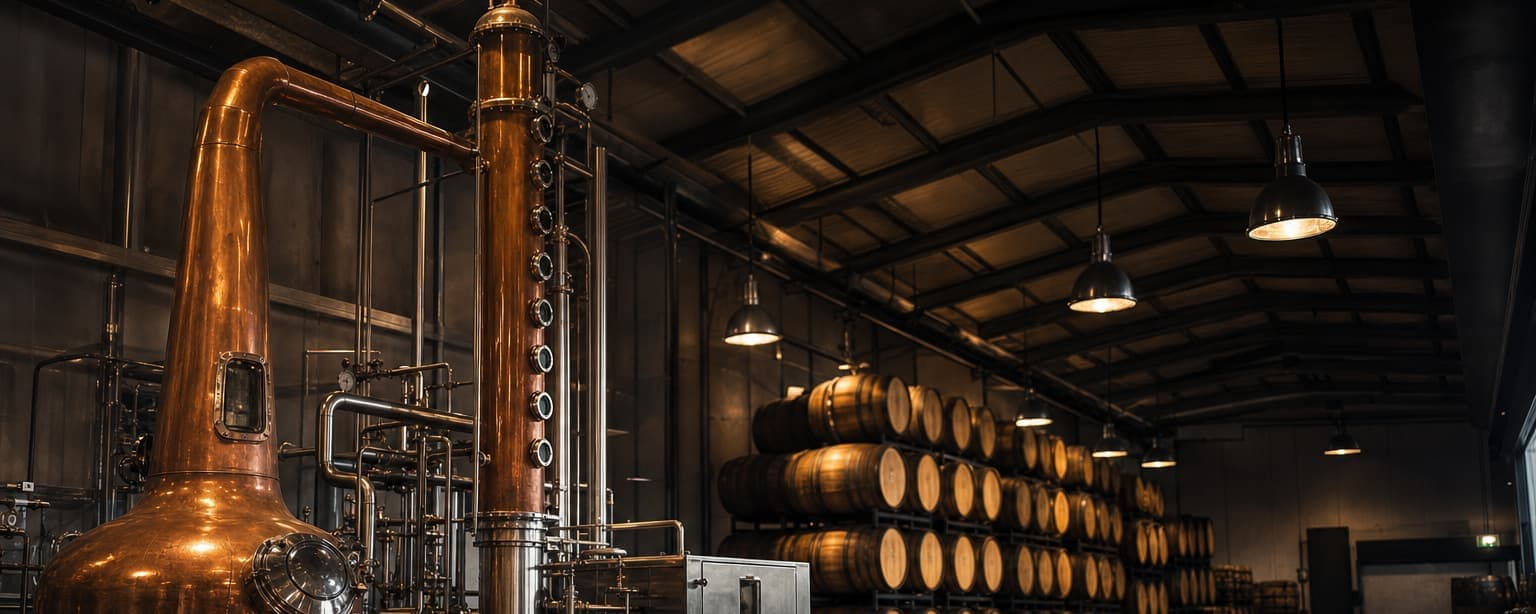
Barrels appreciate in the rickhouse and the limit usually does not.
Your inventory gains value every year it sits, and a total loss can trigger federal excise tax on it. We cover distilleries, including the high-proof fire load.
Tell us the situation.
One licensed human replies the same business day — not five agents, not an auto-responder. If the policy you have is already the right one, we will tell you.
We use this to quote and service your insurance, and we do not sell it or pass it to lead networks. Privacy policy.
Send us what you have. We’ll tell you if it’s right.
Your current policy paperwork, a renewal notice, or nothing at all. A licensed agent reads it and replies the same business day.
What distillery businesses actually need.
General liability
The tasting room, the tour and the still house, and every visitor you let past the door.
Without it — Tours walk the public through the highest fire load on the site, which underwriters price accordingly.
Workers compensation
Still operators, barrel handlers and tasting-room staff, rated separately on one payroll.
Without it — Barrel handling and high-proof vapor are the injuries here, and both are severe rather than frequent.
Ageing inventory
Barrels in the rickhouse, valued for what they are worth now rather than at fill.
Without it — Spirit set at production cost is underinsured by multiples after a few years.
Fire and high-proof exposure
Property coverage written knowing what the fire load in a still house actually is.
Without it — A standard commercial form is not priced or worded for it, and insurers are selective.
Federal excise tax exposure
Tax that can become payable on spirit lost outside an approved allowance.
Without it — A tax bill on inventory that no longer exists, on top of the inventory loss.
Liquor liability
Tasting room and distribution alike.
Without it — Excluded from general liability for anyone in the trade.
Equipment breakdown
Stills, boilers, chillers and controls, and the batch lost when they stop.
Without it — Pressure equipment failure is excluded by property policies as an internal cause.
Crime and social engineering
Stock and materials walking out, and a supplier payment redirected by a convincing email.
Without it — Invoice fraud is the everyday version, and it is excluded from cyber because the transfer was authorized rather than hacked.
Group health and benefits
The people who run high-proof spirit through your still safely.
Without it — Distilling carries the highest fire load in food and beverage, and safe operation is learned rather than taught. Keeping the crew is a fire control.
What our distillery clients ask us.
How should we value barrels in storage?
On a basis that tracks what they are actually worth as they age, agreed with the insurer in advance, not at cost to produce, which is what a default policy does and which understates a mature barrel by multiples. Get the valuation basis written into the policy rather than relying on a claims-time argument, and revisit the limit annually as the warehouse fills. Nothing in the sector is underinsured more often.
What is the excise tax exposure?
Spirits in bond carry federal excise tax that becomes payable on product lost outside an approved allowance. A fire can therefore produce a tax liability on inventory that no longer exists, on top of losing the inventory. Some policies can be extended to it and many are silent, which is not the same as covered — ask the question explicitly.
Why is distillery property coverage hard to place?
High-proof spirit is a serious fire load, concentrated, and a rickhouse concentrates it further. Many insurers simply decline the class. Placement usually depends on the specifics: sprinklers, separation between still house and storage, barrel storage construction, spill containment, and whether the tasting room is attached. Those details are the difference between a market and no market, so gather them before going out.
Commercial insurance is 96% of what we do — it is not a department here, it is the whole business. Not ready to talk? The guides answer the questions this page raises in more depth. Already insured with us and need a certificate or a policy change? Ask the service team rather than starting a quote — it is faster and it goes to the people whose job it is. We also write home and auto, which is usually cheaper alongside the business policy than apart from it.
Handed a lease, a vendor packet or a client contract with insurance requirements? Paste it into the COI Requirements Decoder to see what each one means for your business, or read what the requirements mean.