
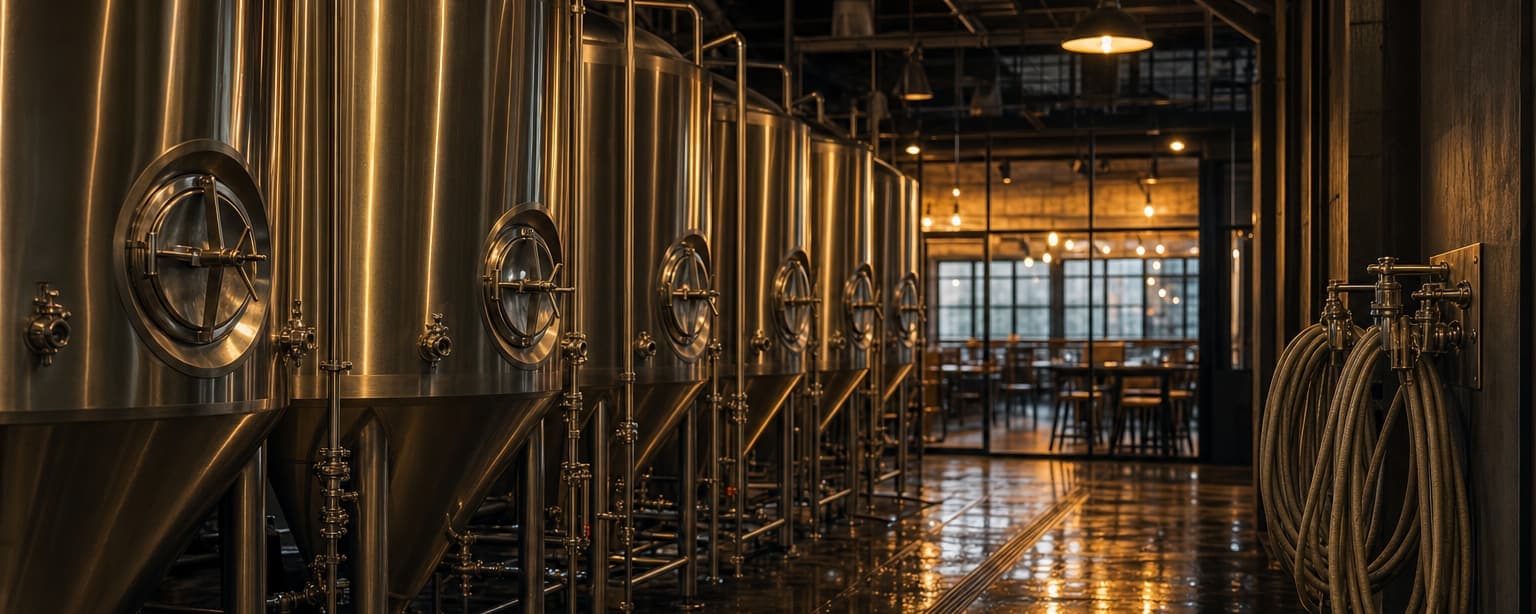
You are a manufacturer, a bar and a landlord, and the policy has to know.
Production, tasting room and distribution sit on one site, with liquor liability over all of it. We insure breweries and brewpubs as the single operation they are.
Tell us the situation.
One licensed human replies the same business day — not five agents, not an auto-responder. If the policy you have is already the right one, we will tell you.
We use this to quote and service your insurance, and we do not sell it or pass it to lead networks. Privacy policy.
Send us what you have. We’ll tell you if it’s right.
Your current policy paperwork, a renewal notice, or nothing at all. A licensed agent reads it and replies the same business day.
What craft brewery businesses actually need.
General liability
The taproom, the tour and the brewhouse floor, and everyone who comes through a door you control.
Without it — A public taproom is a retail exposure attached to a plant, and it is rated as both.
Workers compensation
Brewers, cellar staff and taproom crew, on separate class codes and one payroll.
Without it — Confined spaces, caustic cleaning and CO₂ make this a heavier comp risk than the taproom suggests.
Liquor liability
Claims arising from serving or supplying alcohol, in the taproom and downstream.
Without it — General liability excludes it outright for anyone in the alcohol business.
Product liability and recall
Contamination, over-carbonation, foreign material, and the cost of pulling the batch.
Without it — A bad batch already distributed is a recall, not a liability claim.
Equipment breakdown
Glycol, refrigeration, boilers and controls, plus the spoiled batch when they fail.
Without it — A glycol failure over a weekend ruins tanks of beer, and property excludes the cause.
Tanks and stock in process
Beer in fermentation valued as product rather than as raw ingredients.
Without it — A tank of finished beer is worth many times the malt it started as.
Taproom general liability
Slips, assaults and the ordinary exposures of a public room.
Without it — A production policy alone does not contemplate the public on site.
Crime and social engineering
Stock and materials walking out, and a supplier payment redirected by a convincing email.
Without it — Invoice fraud is the everyday version, and it is excluded from cyber because the transfer was authorized rather than hacked.
Group health and benefits
Brewers and cellar staff who know your yeast and your schedule.
Without it — Brewing knowledge is specific to your system. A cellar hand leaving mid-season costs you consistency in the tank.
What our craft brewery clients ask us.
Does general liability cover the taproom?
For an ordinary slip, yes. For anything alcohol-related, no. General liability carries a liquor liability exclusion, and for a business that manufactures or serves alcohol it applies broadly. Liquor liability is a separate purchase and dram shop statutes in many states extend it beyond the premises to what an over-served customer does afterwards.
How is beer in tank valued?
It should be valued as work in progress at its cost to produce, and frequently is not. A policy set up around ingredients values a tank of finished beer at the price of the malt. Set the stock limit against your peak, not your average: a brewery is fullest before its busiest season, which is exactly when a refrigeration failure costs the most.
We self-distribute. Does that change anything?
Yes, twice. You add commercial auto with product in the vehicle, and you add a distribution exposure to the liquor liability, because supplying a retailer is not the same act as serving a customer, and some forms are written for one and not the other. Tell us the split between taproom, self-distribution and wholesale, because those three revenues rate differently.
Guides on craft brewery.
Commercial insurance is 96% of what we do — it is not a department here, it is the whole business. Not ready to talk? The guides answer the questions this page raises in more depth. Already insured with us and need a certificate or a policy change? Ask the service team rather than starting a quote — it is faster and it goes to the people whose job it is. We also write home and auto, which is usually cheaper alongside the business policy than apart from it.
Handed a lease, a vendor packet or a client contract with insurance requirements? Paste it into the COI Requirements Decoder to see what each one means for your business, or read what the requirements mean.