
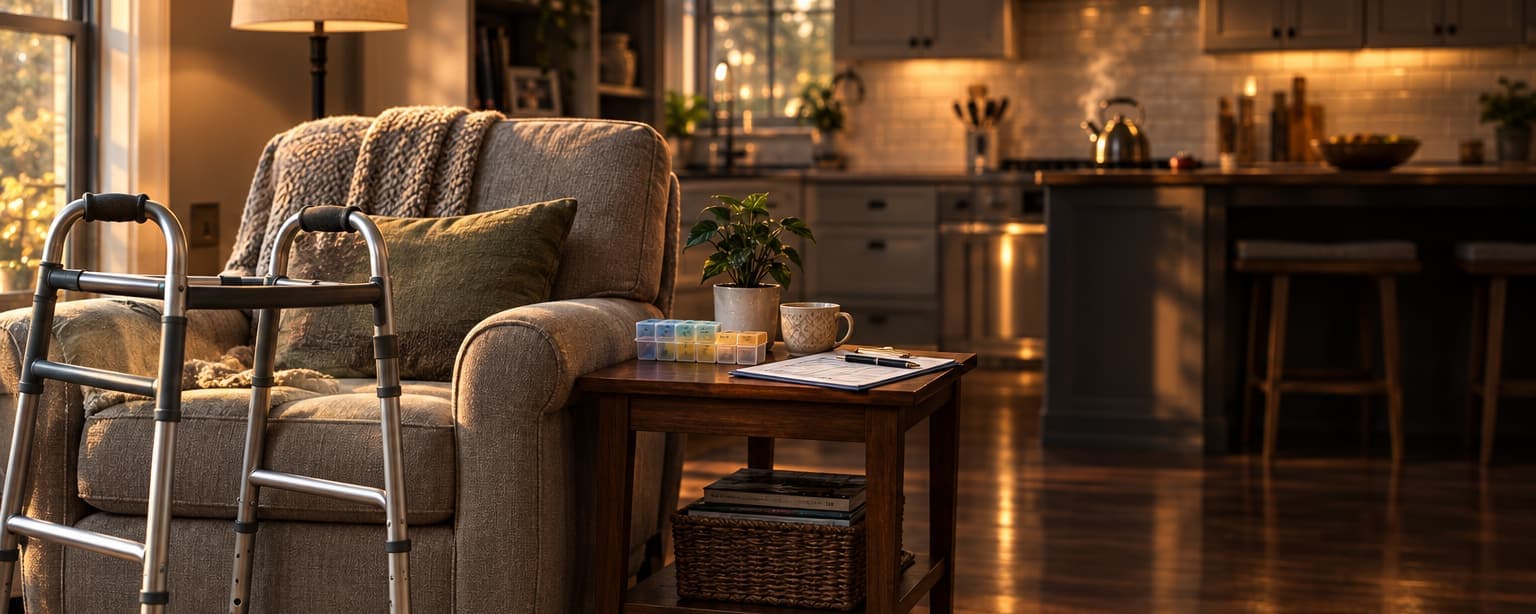
You are alone in someone's home with their parent and their belongings. The policy is written for exactly that.
An independent caregiver, a companion or a small non-medical home care business works inside a client's home, with a client who is frail and a family who is watching. Two claims follow from that: the client is hurt (a fall during a transfer, a medication given wrong) and something in the home goes missing or gets broken. A caregiver policy answers both with general and professional liability and a bond, and it is what a family or a placement agency asks to see before the first shift. We place it for individual caregivers, companion care agencies and non-medical home care businesses, with workers compensation for those with staff.
Tell us the situation.
One licensed human replies the same business day — not five agents, not an auto-responder. If the policy you have is already the right one, we will tell you.
We use this to quote and service your insurance, and we do not sell it or pass it to lead networks. Privacy policy.
Send us what you have. We’ll tell you if it’s right.
Your current policy paperwork, a renewal notice, or nothing at all. A licensed agent reads it and replies the same business day.
What caregiver businesses actually need.
General liability
Injury to the client or a family member, and damage to the home and its contents, arising from your presence and your work there.
Without it — A caregiver has no policy of their own, and the client's homeowners insurer subrogates against the person who broke the vase or left the stove on.
Professional liability
Claims that the care itself caused harm: a fall during a transfer, a missed dose, a wound not reported, a decline nobody flagged.
Without it — General liability excludes professional services, and care is a professional service the moment it is paid for.
Third-party crime (bond)
Theft from the client by a caregiver, which families and agencies require to be bonded.
Without it — A missing ring or a drained account is the accusation every caregiver fears, and the bond is what lets the family stop worrying.
Abuse and molestation
Defense of an allegation of abuse or neglect, with a sublimit.
Without it — Excluded on standard forms; an allegation from a confused client or a family dispute needs a defense whatever its merit.
Hired and non-owned auto
Liability when the caregiver drives the client to appointments in their own car or the client's.
Without it — The caregiver's personal auto policy may exclude business use, and the client is in the passenger seat.
Workers compensation
For agencies: caregiver injuries, above all from lifting and transfers.
Without it — Required from the first employee; home care has one of the highest back-injury rates of any occupation.
The claims we actually see.
Ordered by how often we see them, not by how dramatic they are. Each one names the coverage that answers it — and the policy people wrongly assume already does.
Most common
The client falls during a transfer or while walking with the caregiver
Covered by Professional and general liability
A fall with a hip fracture is a six-figure claim for an elderly client. Transfer training and a care plan are the defense and the application asks about both.
Common
Property missing from the home
Covered by Third-party crime bond
Whether or not the caregiver took it, the accusation is made. The bond pays the family and the caregiver keeps working.
Less common, severe
A medication error
Covered by Professional liability
Non-medical caregivers remind and assist; administering medication is a nursing act and outside most caregiver policies.
Common
An accident driving the client
Covered by Auto: the caregiver's personal policy first, then hired and non-owned
Tell the personal auto insurer the car is used to drive clients, or the claim is denied for business use.
Running an agency rather than working alone?
Every one of these is written for that specific operation — the coverages it needs, the questions underwriters ask it, and what it usually gets wrong.
- Home Care Agencies
We insure licensed non-medical home care agencies to the limits their state license requires, with the bond, the theft coverage and the auto coverage the license and the contracts add, placed by someone who owned and ran a home health agency.
What the policy will not cover.
Pick a procedure to see what the exclusion actually means and whether it can be placed somewhere else.
The policy is written for non-medical care: companionship, help with daily living, light housekeeping, transportation. Medical acts are a different license and a different policy.
Where a caregiver policy stops
Skilled nursing and medical procedures
Injections, wound care, catheters and administering medication are nursing acts requiring a nurse and a home health agency policy.
Can it be placed? Yes, on a home health agency policy with licensed staff.
Live-in arrangements without a contract
A caregiver living in the home without a written agreement is an employee of the family in most states, and the family owes workers compensation.
Can it be placed? Yes, once the arrangement is on paper.
Clients who are combative or wander
Dementia care is rated separately and some carriers require training to write it.
Can it be placed? Yes, with the training and the care plan disclosed.
Lifting without equipment or training
Two-person transfers done alone are the injury and the claim underwriters price for.
Can it be placed? Yes, with a lifting policy in place.
What the insurance company will ask about your caregiver business
We read the applications the markets use for businesses in this field and pulled out what they actually ask. Have these answers ready and a quote takes a day instead of a week, because nobody has to come back to you for the missing piece.
About the business
- What type of organization are you (for-profit or not-for-profit)?
- What year did you establish your organization?
- Do you have all the licenses and permits your state requires to operate?
- Has any of your licenses ever been lost, revoked, or suspended?
- What is your annual operating budget?
How you operate
- How many people do you serve (clients, students, or members)?
- What age groups do the people you serve fall into?
- Do you provide overnight housing or overnight supervision?
- Do you provide health screenings or other medical services to the people you serve?
- Do you operate or control any day care facilities?
Safety and controls
- Do people who receive health screenings or medical services sign liability waivers?
- Do you require all participants in sports activities to have accident and health insurance?
- Do you have written policies against abuse that define appropriate behavior, make clear you have zero tolerance, and say you will investigate and work with law enforcement?
- Do you run criminal background checks and check driving records on all employees and volunteers at hire and annually?
- Do you require employees and volunteers who drive to show proof of their personal auto insurance each year?
Your history
- Do you currently have insurance with another company?
- Has any of your insurance coverage ever been declined or cancelled because of losses or claims?
- Have there been any claims against you that say you were negligent or didn't follow licensing or safety rules?
- Are there any facts, circumstances, or situations right now that might lead to a claim?
Money and people
- How many employees and volunteers work for you (full-time and part-time)?
- Do any of your employees or volunteers use their personal cars for your business (like running errands or transporting people)?
- Do you spend more than $2,500 per year on renting or leasing vehicles?
- What is your annual revenue?
Have these ready
- Your basic business information including your name, address, and licenses
- Your current insurance information, including policy dates and what you paid last year (called a loss run)
- A list of all employees and volunteers by position, including whether you have degreed professionals
- Your written abuse prevention policies and employee screening procedures
- Information about any claims or incidents from the past several years
You answer what you can; a licensed agent fills the rest with you.
What our caregiver clients ask us.
Do I need insurance as an independent caregiver?
Families, placement registries and care agencies increasingly require proof of liability and a bond before a caregiver starts, and the policy is inexpensive for what it protects. Without it the caregiver is personally liable for a fall and personally accused when something goes missing, with no one to defend them.
How much does caregiver insurance cost?
For an individual caregiver, a few hundred dollars a year for liability and a bond together. For an agency, the price scales with the number of caregivers and hours, and workers compensation, priced on payroll, is the larger part. Dementia care and transportation of clients raise the liability rate.
What does a caregiver insurance application ask for?
The applications we work from ask what services you provide (companionship, personal care, transfers, transportation, medication reminders), whether any are medical, whether you care for clients with dementia or behavioral conditions, the number of clients and hours, whether you drive clients, your training and certifications, whether you are bonded and background-checked, the number of caregivers if an agency, and any claims or complaints. Services and client conditions set the rate.
Is a caregiver bond the same as insurance?
No. A bond pays the client for theft by the caregiver and then looks to the caregiver to repay it; liability insurance defends and pays claims for injury and damage caused by the work. Families ask for both, and a caregiver policy usually packages them.
Commercial insurance is 96% of what we do — it is not a department here, it is the whole business. Not ready to talk? The guides answer the questions this page raises in more depth. Already insured with us and need a certificate or a policy change? Ask the service team rather than starting a quote — it is faster and it goes to the people whose job it is. We also write home and auto, which is usually cheaper alongside the business policy than apart from it.
Handed a lease, a vendor packet or a client contract with insurance requirements? Paste it into the COI Requirements Decoder to see what each one means for your business, or read what the requirements mean.