
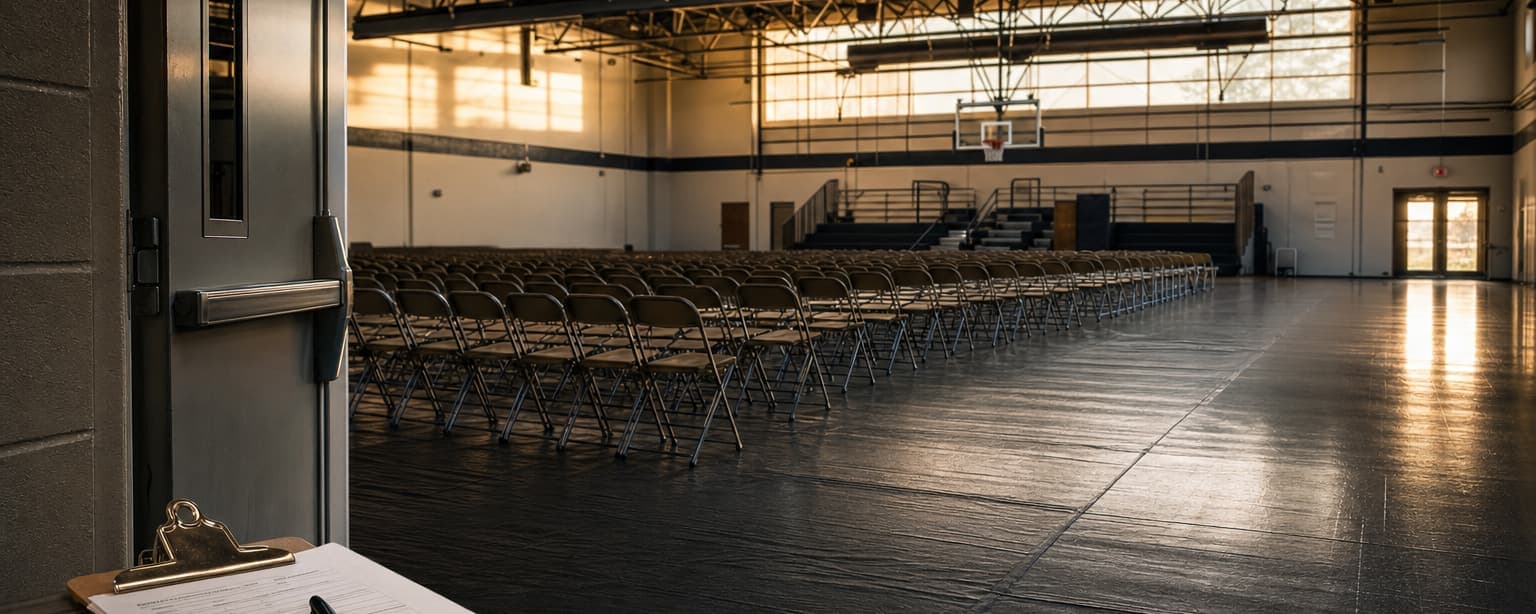
The venue is insured. The person renting it for one evening is not.
This program lets a venue sell short-term liability coverage to the people hiring it, so a university, arena or municipal facility can require insurance without turning away everyone who has none.
Tell us the situation.
One licensed human replies the same business day — not five agents, not an auto-responder. If the policy you have is already the right one, we will tell you.
We use this to quote and service your insurance, and we do not sell it or pass it to lead networks. Privacy policy.
Send us what you have. We’ll tell you if it’s right.
Your current policy paperwork, a renewal notice, or nothing at all. A licensed agent reads it and replies the same business day.
What tenant user liability actually covers.
Short-term liability for the facility user
Coverage for the individual or group hiring the space, for the dates they have it.
Without it — The hirer either produces a policy they do not have or the booking is refused.
The venue as additional insured
The facility, its board and its staff protected against claims arising from the hirer’s event.
Without it — The venue’s own policy absorbs an event it did not run and cannot control.
Host liquor where permitted
Alcohol served at the hired event, within the venue’s own rules.
Without it — The most likely claim at a private function is the excluded one.
Where tenant user liability shows up.
- Sports Facilities & Venues
A program that insures every hirer to your standard instead of you reviewing their certificates.
What clients with tenant user liability ask us.
Who buys TULIP: the venue or the renter?
The venue sets it up and the renter buys the individual policy, usually online and in minutes. The whole design comes to this: the facility gets a guarantee that every hirer is insured to its standard, without staff having to assess certificates from hundreds of small groups who have never bought insurance before.
We run a venue. Why would we bother?
Because the alternative is worse in both directions. Requiring certificates from every hirer means refusing bookings from people who cannot produce one and manually reviewing the ones who can, with staff who are not underwriters. Not requiring them means your own policy quietly covers every wedding, conference and recital in the building. A program removes both problems and takes the decision off the events team.
Does it replace the event organizer’s own insurance?
For a small one-off hire it usually is their insurance, and that is fine. For a commercial event, a promoter or anyone running events regularly, it is not. They need their own annual program, and the venue requirement is a floor rather than a ceiling. The distinction is roughly whether the event is a business.
Commercial insurance is 96% of what we do — it is not a department here, it is the whole business. Not ready to talk? The guides answer the questions this page raises in more depth. Already insured with us and need a certificate or a policy change? Ask the service team rather than starting a quote — it is faster and it goes to the people whose job it is. We also write home and auto, which is usually cheaper alongside the business policy than apart from it.
Handed a lease, a vendor packet or a client contract with insurance requirements? Paste it into the COI Requirements Decoder to see what each one means for your business, or read what the requirements mean.