
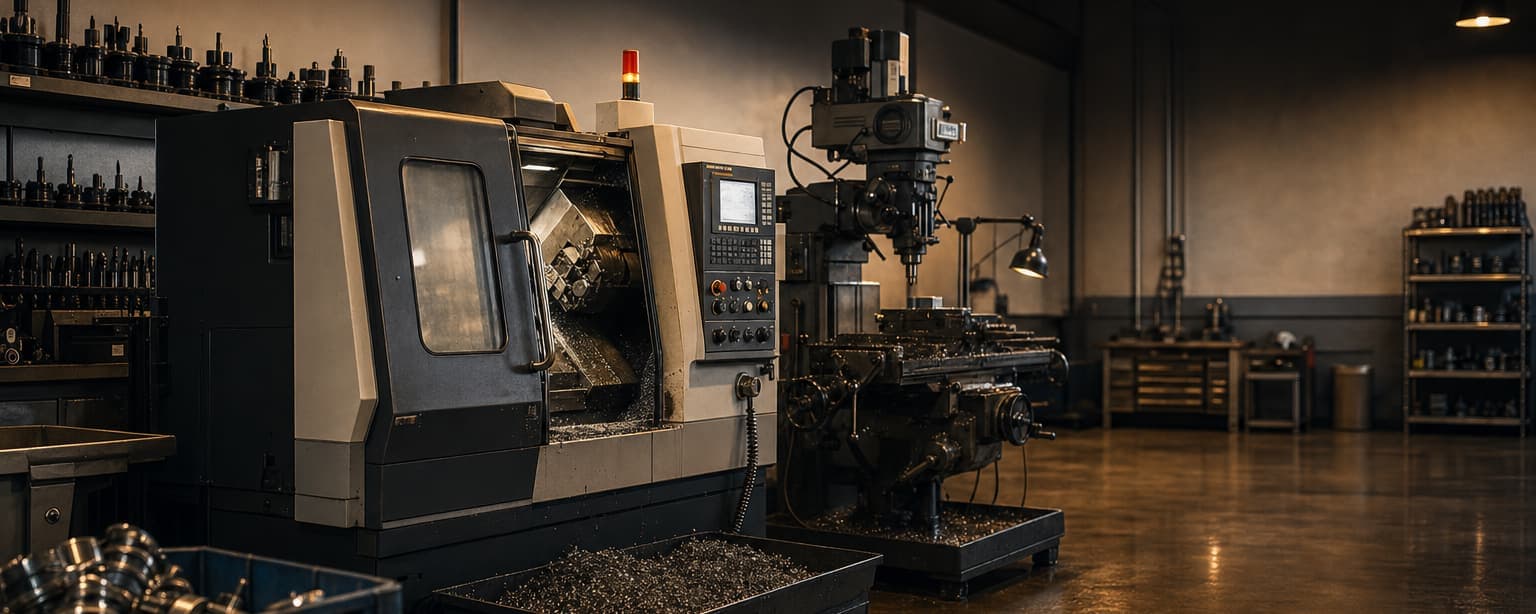
You made the part to their print. The failure is still yours to argue.
Your tolerances are the product, but the end use decides the exposure. We cover job shops, CNC machining and precision fabrication built to somebody else’s design.
Tell us the situation.
One licensed human replies the same business day — not five agents, not an auto-responder. If the policy you have is already the right one, we will tell you.
We use this to quote and service your insurance, and we do not sell it or pass it to lead networks. Privacy policy.
Send us what you have. We’ll tell you if it’s right.
Your current policy paperwork, a renewal notice, or nothing at all. A licensed agent reads it and replies the same business day.
What machine shop businesses actually need.
General liability
Injury and damage from the shop itself: a customer collecting parts, a delivery, work done at their site.
Without it — What every purchase order asks you to evidence before the first job runs.
Workers compensation
Machinists, setters and material handlers: the amputation and crush exposures that drive a shop’s mod.
Without it — A single guarding claim reprices the policy for three years.
Product liability
A part that fails in service, whoever drew it.
Without it — Working to a customer’s print is not a defense, and shops assume it is.
Customers’ property (bailee)
Material, castings, tooling and fixtures belonging to customers while in your shop.
Without it — Property policies cover what you own; a customer’s $40,000 die is not that.
Equipment breakdown
A CNC control, spindle or servo failing from the inside.
Without it — The most expensive single machine on the floor fails the one way property excludes.
Rework and rejected lots
The cost of a batch out of tolerance, where the policy can be extended to it.
Without it — Scrapped work is a pure margin loss and it is the everyday claim in this trade.
Group health and benefits
Machinists who can hold your tolerances without a second setup.
Without it — Skilled machinists are the constraint on what you can quote. Losing one narrows the work you can take.
What our machine shop clients ask us.
We machine to the customer’s drawing. Are we still liable?
For conformance, always. If the part is out of tolerance, that is yours. For the design itself you have a real defense, and it is weaker than most shops assume: it erodes the moment you suggested a change, chose a material, recommended a process or knew the intended use and said nothing. Shops that add value by advising acquire design exposure by advising. Keep the drawing revision, the quote and any engineering conversation, because the file is what decides this.
What is the end-use question really about?
How far a failure travels. A bracket in a shelving unit and the same bracket in a lifting assembly are the same machining job and completely different claims. Aerospace, medical, automotive safety systems, lifting and pressure work all price differently and some need a specialist market. Answer it accurately at quote: a shop that says "general industrial" and turns out to run aerospace lots has a coverage argument waiting.
Is our customers’ material covered while we hold it?
Only under a bailee or customers-property extension, which is not automatic. It matters more in this trade than most: a shop can be holding castings, forgings and customer tooling worth more than its own plant. Tooling is the piece most often missed: a customer-owned fixture sitting in your rack for years is still their property and still your responsibility.
Commercial insurance is 96% of what we do — it is not a department here, it is the whole business. Not ready to talk? The guides answer the questions this page raises in more depth. Already insured with us and need a certificate or a policy change? Ask the service team rather than starting a quote — it is faster and it goes to the people whose job it is. We also write home and auto, which is usually cheaper alongside the business policy than apart from it.
Handed a lease, a vendor packet or a client contract with insurance requirements? Paste it into the COI Requirements Decoder to see what each one means for your business, or read what the requirements mean.