
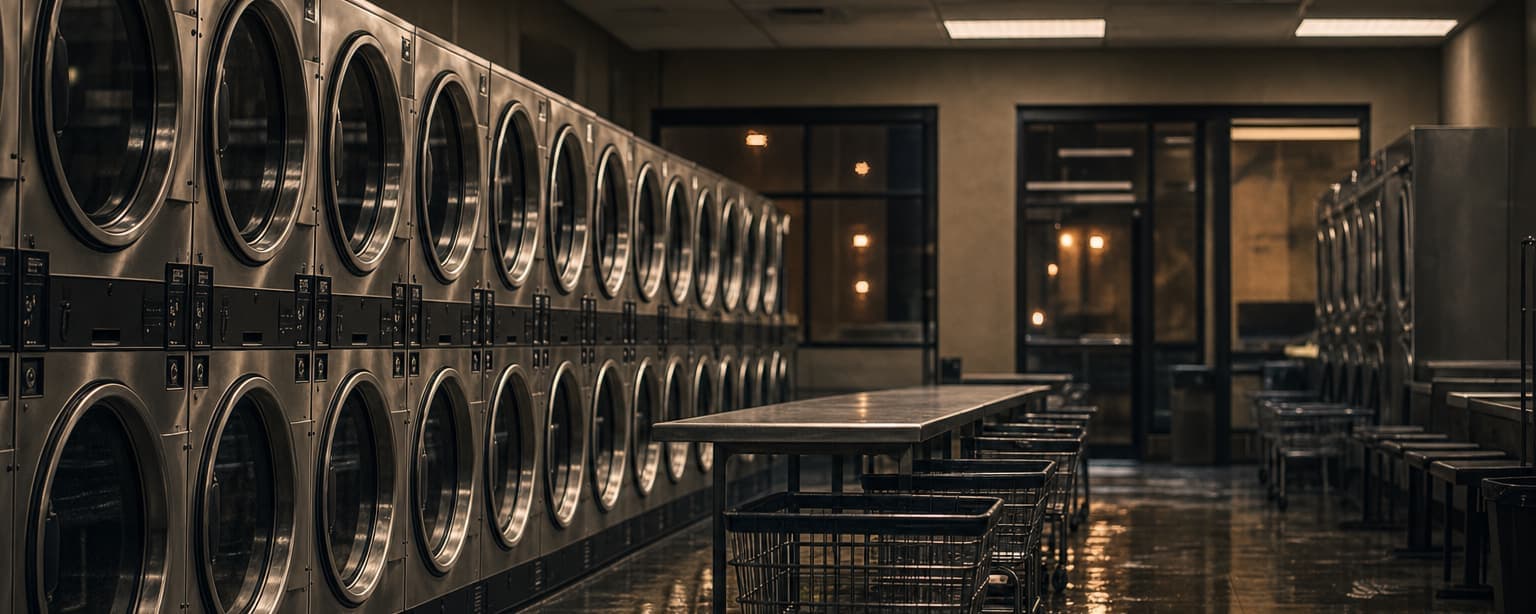
An unattended public room, open late, full of water and machinery.
We cover laundromats and coin laundries: the water damage the machines cause, vandalism and injury in a room with no staff in it, and the underwriting questions that 24-hour opening brings.
Tell us the situation.
One licensed human replies the same business day — not five agents, not an auto-responder. If the policy you have is already the right one, we will tell you.
We use this to quote and service your insurance, and we do not sell it or pass it to lead networks. Privacy policy.
Send us what you have. We’ll tell you if it’s right.
Your current policy paperwork, a renewal notice, or nothing at all. A licensed agent reads it and replies the same business day.
What laundromat businesses actually need.
Equipment breakdown
Washers, dryers, boilers, presses and water heaters.
Without it — A boiler failure is excluded by property as an internal cause.
Water damage
Escape of water from your machines, including into neighboring units.
Without it — A supply hose failure overnight reaches the whole building.
Customers’ goods (bailee)
Garments in your care: lost, damaged or destroyed.
Without it — Property policies cover what you own, and the clothes are not yours.
General liability
Slips on wet floors, burns, and injury around machinery.
Without it — An unattended public room with hot water and moving machinery.
Pollution, for dry cleaners
Solvent contamination of soil, groundwater or the building.
Without it — Historic solvent contamination is a large and specifically excluded liability.
Crime and social engineering
Coin and card revenue skimmed, and a route-servicer payment sent to a fraudulent account.
Without it — Coin and card revenue released to somebody posing as your route servicer is not burglary. Property coverage does not answer it; the social engineering sublimit does, once you have asked for it.
Group health and benefits
Attendants who keep an unattended room from becoming one.
Without it — Presence is the loss control in this business. A staffed floor has fewer water claims, fewer injuries and less vandalism.
The claims we actually see.
Ordered by how often we see them, not by how dramatic they are. Each one names the coverage that answers it — and the policy people wrongly assume already does.
Most common
A supply hose fails and floods the unit below
Covered by Property, and liability to the neighboring tenant
The big number is rarely your own damage. It is the neighbor’s stock and their lost trade, and in a multi-tenant building that claim arrives against you.
Most common
A customer slips on a wet floor with no staff present
Covered by General liability
Unattended is the aggravating fact: with nobody on site there is no inspection log, no wet-floor sign and no witness, so the claim is defended on your camera footage or not at all.
Common
Vandalism, machine break-ins or a coin box forced
Covered by Property, including vandalism
Check the vacancy and unattended wording, and check whether theft of cash from machines is covered or sits under a small crime sublimit.
Common
A washer, dryer or water heater fails internally
Covered by Equipment breakdown
Property covers a machine damaged by something external, and excludes the machine breaking itself, which is how a bank of machines actually goes down.
Less common, severe
Someone is injured or assaulted on the premises overnight
Covered by General liability, and assault and battery
A negligent security claim against an unattended 24-hour site meets the assault and battery exclusion on many general liability forms.
What our laundromat clients ask us.
Why is water damage the main event here?
Because you run dozens of high-volume water connections continuously, often unattended overnight, frequently in a building with other tenants below or beside you. A failed supply hose is a small mechanical event with a large consequence, and in a multi-tenant building the claim is the neighbors’ property and their lost trade as well as yours. Insurers ask about hose age and type, shut-off valves and leak detection, and braided stainless hoses on a replacement schedule is one of the cheapest risk improvements available.
Are customers’ clothes covered?
Only under a bailee extension, which is not automatic. A dry cleaner or wash-and-fold operator can be holding a very large aggregate value in garments at any moment, and a fire or flood destroys all of it at once, while your property policy covers only your own equipment and stock. Set the limit against your peak holding rather than an average, and check how the form values a garment, since replacement cost and depreciated value produce very different settlements on clothing.
Does being open 24 hours or unattended make it harder to insure?
Yes to both, and they are two separate questions rather than one. Unattended is about who is there when something goes wrong: no staff means no one to spot a leak, put out a wet-floor sign, intervene in an incident or call it in, so both the frequency and the severity of an ordinary claim go up. Twenty-four hours adds the overnight hours, which is when vandalism, loitering, break-ins and assaults happen, and an unattended room that is warm, lit and open all night is used for a great deal more than laundry.
Is dry cleaning covered here too?
It is a genuinely different risk and it has its own page. A laundromat is an unattended room full of water and machinery; a dry cleaner is a small chemical plant with a solvent liability that can outlive the business and the owner. If you do both — a laundromat with a dry cleaning plant or a drop counter attached — say so, because the solvent question changes the market and the pollution exposure does not appear on a laundromat policy.
Also in this family
Commercial insurance is 96% of what we do — it is not a department here, it is the whole business. Not ready to talk? The guides answer the questions this page raises in more depth. Already insured with us and need a certificate or a policy change? Ask the service team rather than starting a quote — it is faster and it goes to the people whose job it is. We also write home and auto, which is usually cheaper alongside the business policy than apart from it.
Handed a lease, a vendor packet or a client contract with insurance requirements? Paste it into the COI Requirements Decoder to see what each one means for your business, or read what the requirements mean.