
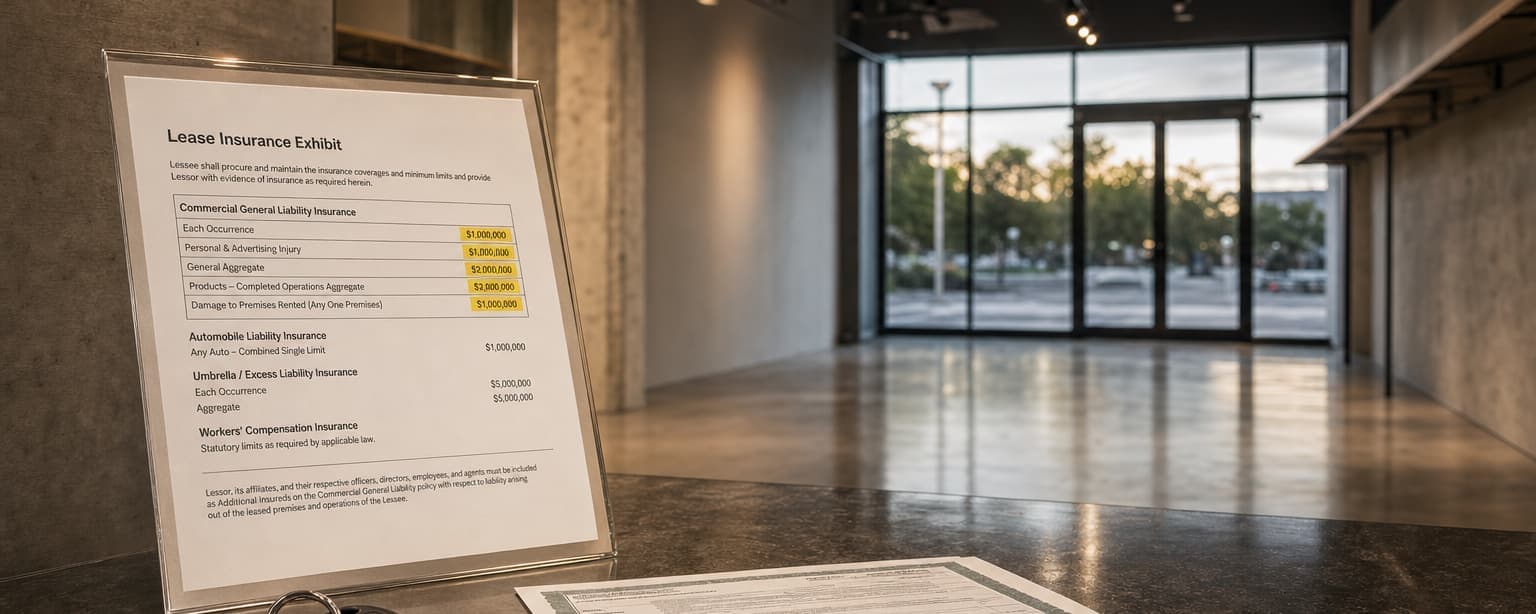
What insurance should I require from tenants, and why does my carrier care?
General liability at a stated limit, naming you as an additional insured, with a waiver of subrogation and evidence renewed every year. And your carrier cares because it is frequently their requirement rather than your preference: a lessor’s risk policy can be written on the understanding that tenants carry their own GL, and a landlord who does not enforce that is not simply taking a commercial risk, they may be out of step with their own policy.
Tell us the situation.
One licensed human replies the same business day — not five agents, not an auto-responder. If the policy you have is already the right one, we will tell you.
We use this to quote and service your insurance, and we do not sell it or pass it to lead networks. Privacy policy.
Send us what you have. We’ll tell you if it’s right.
Your current policy paperwork, a renewal notice, or nothing at all. A licensed agent reads it and replies the same business day.
The detail
Requiring tenants to carry general liability is commonly a condition imposed by the landlord’s own carrier on a lessor’s risk policy, not merely good practice.
Kevin Kelsey, agency placement experience
Preferred carriers frequently restrict lessor’s risk appetite to accounts whose tenants’ own general liability exposure would be acceptable to that carrier.
Kevin Kelsey, agency placement experience
What this means for you
- Specify a limit, never "adequate insurance". An unquantified clause is unenforceable in practice and tells a tenant nothing.
- Require additional insured status naming you, not certificate holder status. A certificate holder is on a mailing list; an additional insured has rights under the policy.
- Add a waiver of subrogation, so their insurer cannot come back at you after paying their claim.
- Diarise the renewals. The common failure is not a bad clause. It is a good clause enforced once at signing and never again.
- Ask what your own carrier requires before drafting. If it is a policy condition, the lease has to match it.
Go deeper on any of these
Related questions
- Certificate holder or additional insured: what is the difference?
A certificate holder is simply someone who receives a copy of the certificate. They have no rights under the policy and cannot claim on it. An additional insured is added to the policy by endorsement and has coverage for claims arising out of the named insured’s operations. As a landlord you want the second, and the certificate should evidence the endorsement rather than just listing you in a box. No mistake in lease insurance compliance is more common, and it stays invisible until somebody tries to claim.
- The difference, in detail
- Why does my carrier care what my tenants carry?
Two reasons, and the second is not published anywhere. First, an uninsured tenant’s claim lands on your policy by default, so your carrier is directly exposed to your enforcement. Second, many preferred carriers will only write lessor’s risk where the tenants’ own general liability would be within their appetite. A carrier with no appetite for restaurants does not want the building either. That means your tenant mix determines your market, and a single tenant can move the whole account out of preferred and into surplus lines.
- How tenants drive your rating
- What limits should I ask for?
It depends on the tenancy and the building, and the common structure is a per-occurrence general liability limit with a matching aggregate, plus umbrella for higher-hazard tenants. Anyone cooking, serving alcohol, doing hot work or drawing significant public foot traffic should carry more than a professional office. Ask your own carrier what they expect to see, because if it is a policy condition there is a number attached, and matching it is simpler than negotiating it later.
- What about residential tenants?
Require renters insurance with a liability limit, evidenced at move-in and at each renewal. It is worth enforcing rather than filing: a tenant’s cooking fire recovered from their insurer instead of yours is the difference between one bad year and three years of a loaded renewal, and tenant contents claims stop landing on your policy. Some habitational carriers now expect it as a matter of course on larger schedules.
- What renters insurance covers
Need this handled?
Reading about it and having it handled are different jobs, and the second one is ours. We place the accounts other brokers decline — claims history, a cancellation, an unusual operation, a business nobody wants to underwrite twice — and we will tell you when the policy you already have is the right one. Tell us the situation and a licensed human replies the same business day.
Written by the licensed brokers at Boring Insurance. Last updated 2026-08-22. See all guides.