
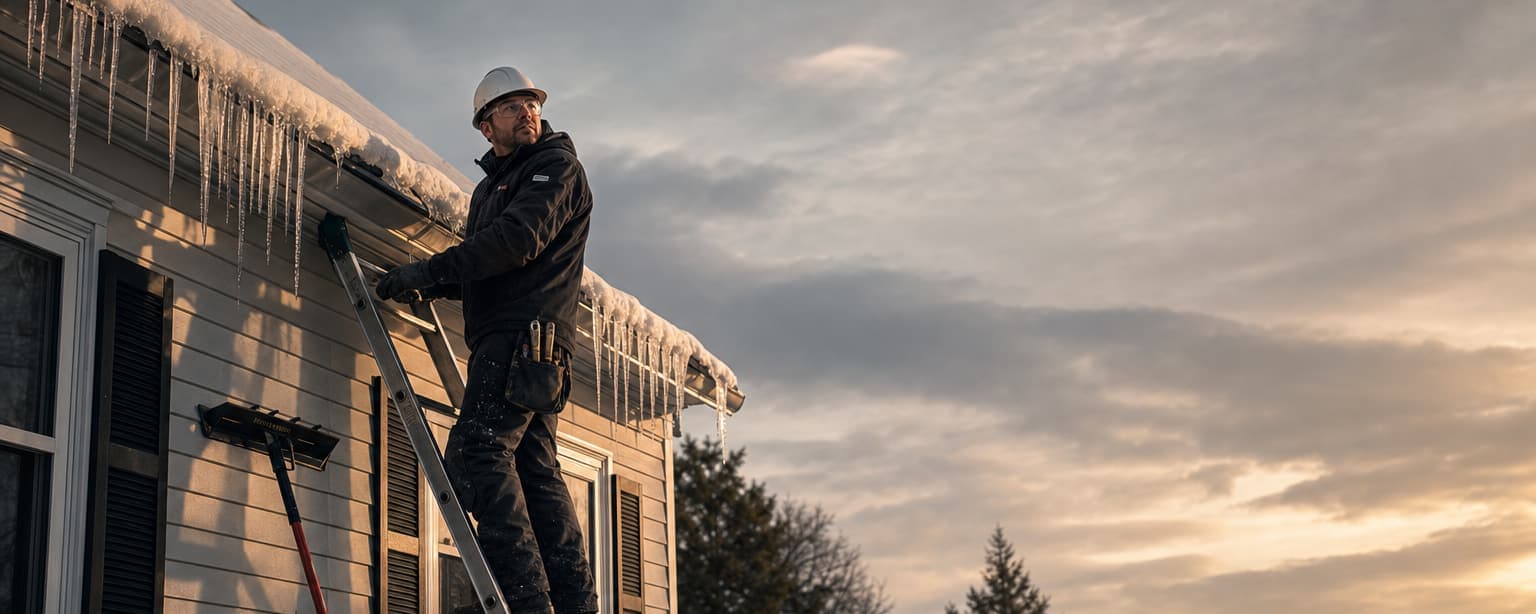
Does insurance cover ice dams and the weight of snow on a roof?
Generally yes, for the sudden damage. The standard forms cover interior water damage from thawing snow and ice on the building, and collapse from the weight of snow, ice or sleet is a named cause of loss. What they do not cover is removing the ice, the worn or neglected roof that let it happen, or a slow sag that was reported as a collapse.
Tell us the situation.
One licensed human replies the same business day — not five agents, not an auto-responder. If the policy you have is already the right one, we will tell you.
We use this to quote and service your insurance, and we do not sell it or pass it to lead networks. Privacy policy.
Send us what you have. We’ll tell you if it’s right.
Your current policy paperwork, a renewal notice, or nothing at all. A licensed agent reads it and replies the same business day.
The detail
The commercial special form excludes interior damage from rain, snow, sleet or ice “unless: (1) The building or structure first sustains damage by a Covered Cause of Loss to its roof or walls through which the rain, snow, sleet, ice, sand or dust enters; or (2) The loss or damage is caused by or results from thawing of snow, sleet or ice on the building or structure.” The second prong is the ice dam.
ISO CP 10 30 09 17, Causes of Loss – Special Form, limitation C.1.c
Collapse is covered when caused by one of the “specified causes of loss”, and that defined list includes “weight of snow, ice or sleet”. It is a separate additional coverage from the water damage.
ISO CP 10 30 09 17, Additional Coverage D – Collapse, and definition G.2
On the homeowners form, the dwelling is covered on an open-perils basis, and contents are covered against Peril 11: “weight of ice, snow or sleet which causes damage to property contained in a building”.
The Massachusetts Division of Insurance: “Generally damage to both the exterior and interior of a home resulting from weight of ice and snow or ice dams is covered under a homeowners policy. However, only the area damaged in the loss will be covered. Further damage sustained due to wear and tear or neglect will not be covered.”
Massachusetts Division of Insurance, homeowners insurance FAQ
The Connecticut Insurance Department: “Interior or exterior damage caused by an ice dam on a roof is generally covered, however many policies do not pay for ice dam removal”, and “Homeowner policies will normally cover sudden and accidental roof collapses. However damage caused by age or pre-existing damage could be denied.”
Connecticut Insurance Department, Winter Damage: Tips for Making Insurance Claims
After the winter of 2015, Massachusetts policyholders filed 125,631 ice dam claims with the top 25 home insurers and the FAIR Plan; 90.1% were fully paid, at $1,268,460,937 in total and an average of $11,050 per claim.
Massachusetts Division of Insurance, The 2015 Massachusetts Market for Home Insurance
A foot of fresh snow weighs from 3 pounds per square foot for light, dry snow to 21 for wet, heavy snow; an inch of ice weighs a little less than 5 pounds per square foot, and a foot of ice about 57. FEMA lists sagging ceiling tiles, popping and cracking noises, sagging roof members, doors and windows that no longer open, cracked members and severe roof leaks as the signs of overload, and says a building showing them “should be promptly evacuated”.
The Massachusetts building code’s design ground snow load is 40 pounds per square foot for Boston, 50 for Worcester and Lowell, 60 for Fitchburg and North Adams, 35 for Springfield, 30 for Plymouth, Fall River and Barnstable, and 25 for Nantucket and Edgartown.
Connecticut’s code sets a flat-roof snow load of not less than 30 pounds per square foot statewide, with ground snow loads of 30 for Hartford, New Haven, Bridgeport, Stamford, Danbury and New London, 35 for Waterbury and Litchfield, and 40 for Torrington, Norfolk and Salisbury.
2022 Connecticut State Building Code, § 1608.1.1 and Appendix P
An ice dam forms when the upper roof surface is above freezing and the eave is below it, so melt water refreezes at the edge and backs up under the shingles. “Ice dams can be prevented by controlling the heat loss from the home”: air-seal the ceiling first, then add insulation.
University of Minnesota Extension, Dealing with and preventing ice dams
What this means for you
- The water is covered. The cure is not. Both forms pay for the ceiling, the wall, the insulation and the contents the backed-up water reached. Neither pays to have the ice steamed off the roof, and neither pays for the attic air-sealing and insulation that would stop it happening again. Budget for those yourself; they are cheaper than the next claim’s deductible.
- Collapse means collapse. The form pays for an abrupt falling down, not for a roof that sagged over a winter. The FEMA warning signs are the moment to get people out and a structural engineer in, and the engineer’s report is what turns an “it started leaking” claim into a documented overload.
- Know your design load, and how far this winter is above it. A flat commercial roof in Worcester was designed to 50 pounds per square foot of ground snow; a foot of wet snow and an ice layer at the drains is most of that already. Drifts against a parapet or a rooftop unit are where roofs fail first, and they are where FEMA says to shovel first.
- Neglect is the word to avoid. Massachusetts and Connecticut both say sudden damage is covered and age, wear and neglect are not. A roof at the end of its life, gutters that had not been cleared, an ice dam that had been leaking every February for three years: each is a reason to pay less or nothing. Photograph the roof in the autumn and keep the maintenance invoices.
- 2015 is the number to remember. One winter produced 125,631 ice dam claims in Massachusetts alone, and carriers priced the following years accordingly. A building with a documented air-sealing job and a snow-removal plan is quoted differently from one without.
Go deeper on any of these
Related questions
- Who do I hire to clear the roof, and will insurance pay for it?
FEMA says a licensed, insured roofing contractor, leaving at least two inches of snow, using plastic rather than metal tools, removing drifts first and never stockpiling snow on the roof. Massachusetts’ Attorney General notes there is no particular license required for snow removal, which is why the contractor’s own insurance certificate matters. Removal is rarely a covered expense; the damage it prevents is the point.
- What a snow removal contractor should be carrying
- Is a roof collapse covered on a building that had been vacant?
Collapse from the weight of snow is not one of the causes the sixty-day vacancy condition removes, so it stays covered, but the payment is reduced by 15% once the building has been vacant more than sixty days. The water damage that follows through the opening is a different story, because water damage is on the list. A vacancy endorsement fixes both.
- The vacancy condition, in the frozen-pipe guide
- We had an ice dam last year and the carrier paid. Will it pay again?
Probably, and probably for less, and the renewal will ask what changed. A repeat ice dam at the same eave is the definition of a maintenance issue, and a second claim on the same cause is where “wear and tear or neglect” starts appearing in the adjuster’s letter. Fix the heat loss between the two winters and keep the invoice.
Need this handled?
Reading about it and having it handled are different jobs, and the second one is ours. We place the accounts other brokers decline — claims history, a cancellation, an unusual operation, a business nobody wants to underwrite twice — and we will tell you when the policy you already have is the right one. Tell us the situation and a licensed human replies the same business day.
Written by the licensed brokers at Boring Insurance. Last updated 2026-09-06. See all guides.