
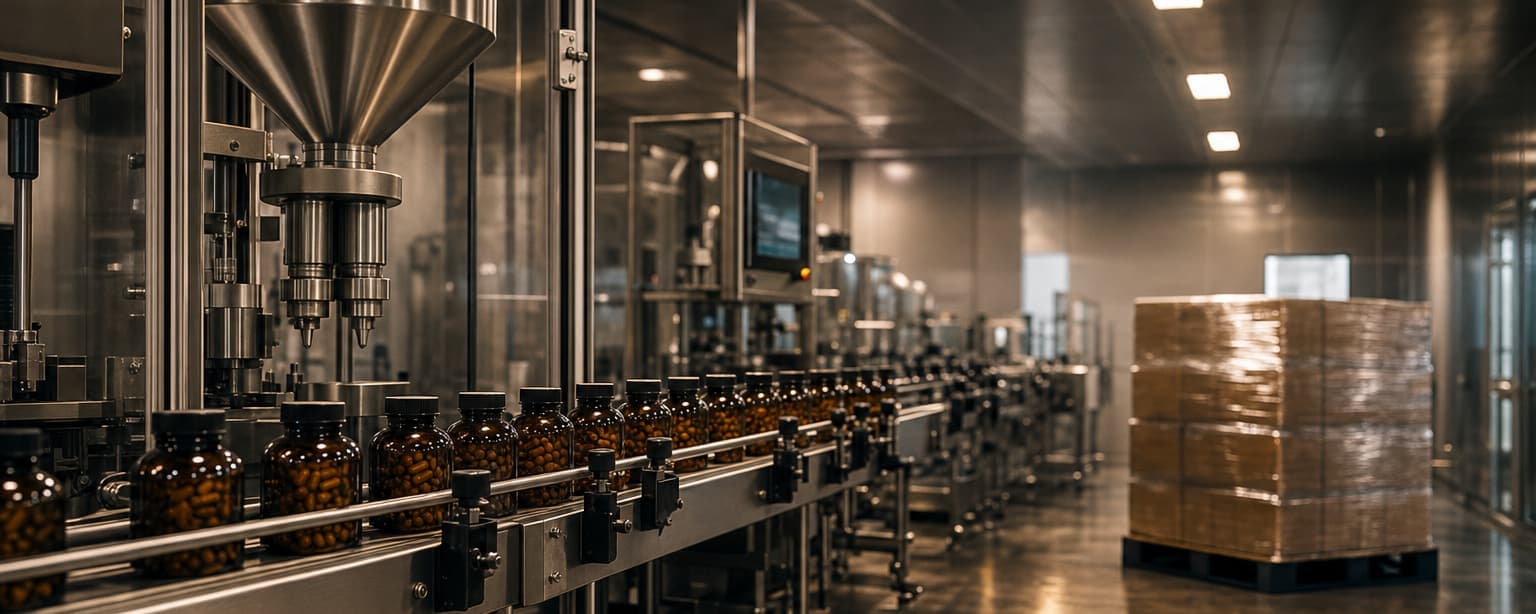
Nobody approved it before you sold it, and that is the underwriting problem.
A supplement is an ingested product sold without pre-market approval, so ingredients and marketing claims drive the risk. We cover the brands and the manufacturers behind them.
Tell us the situation.
One licensed human replies the same business day — not five agents, not an auto-responder. If the policy you have is already the right one, we will tell you.
We use this to quote and service your insurance, and we do not sell it or pass it to lead networks. Privacy policy.
Send us what you have. We’ll tell you if it’s right.
Your current policy paperwork, a renewal notice, or nothing at all. A licensed agent reads it and replies the same business day.
What dietary supplement businesses actually need.
General liability
Manufacturing, warehousing and any premises the public or a customer enters.
Without it — Retailers and marketplaces require it by name alongside product liability, and will not onboard you without it.
Products liability
Injury or illness attributed to an ingested product.
Without it — The exposure is per consumer, and a formulation reaches all of them.
Product recall
Withdrawal for contamination, adulteration or an undeclared ingredient.
Without it — Excluded from liability, and the likeliest event in the category.
Advertising and claims liability
Claims over what the label and marketing said the product does.
Without it — The most common suits in this sector are about the claim, not the capsule.
Contract manufacturer exposure
Your position when the maker is somebody else and the brand is yours.
Without it — The brand is who consumers sue whatever the manufacturing agreement says.
Retailer requirements
Limits, additional insured status and vendor wording that stockists demand.
Without it — A retail listing is contingent on a certificate you must be able to produce.
Group health and benefits
Formulation and QA staff who know your specifications.
Without it — Your product is the formula and the process behind it, and both live in a small number of heads.
A new health supplement company asked us to review the NEXT policy it had bought online. The business had been classified as a health store, and the first exclusion on the form removed any product manufactured by the insured or sold under its own label.
We showed them that their biggest exposure was not covered at all, and moved the account to a policy with full products liability for their own formulations. A policy that issues in minutes insures the business it assumed you were, and for a brand that puts its name on an ingested product, that assumption was the whole risk.
What our dietary supplement clients ask us.
Why is this sector hard to insure?
Because supplements are not approved before sale, the ingredient list moves, and the claims are made in marketing. Underwriters respond by reading the formulation and the website rather than the balance sheet. Specific ingredients — stimulants, hormone precursors, botanicals with known interactions, weight loss and anything targeted at children, athletes or pregnancy — restrict or close the market. So do structure-function claims that edge toward treating a condition.
We use a contract manufacturer. Are we covered by theirs?
Not meaningfully. Being an additional insured on the manufacturer’s policy is worth having and is not a substitute: the brand owner is who consumers, retailers and regulators pursue, and the manufacturer’s limits are shared across every brand they produce for. An adulteration event usually affects several of their clients at once, which is exactly when a shared limit fails. Carry your own, and get the indemnity in the manufacturing agreement reviewed.
What about the claims we make on the label?
They are a real and often uninsured exposure. Class actions over efficacy and labeling are more common in this category than injury suits, and a general liability policy’s personal and advertising injury coverage is narrower than brands assume. It is aimed at defamation and infringement, not at whether the product works. Get the marketing copy reviewed against what the substantiation actually supports, and ask specifically how the policy treats a false advertising claim.
Commercial insurance is 96% of what we do — it is not a department here, it is the whole business. Not ready to talk? The guides answer the questions this page raises in more depth. Already insured with us and need a certificate or a policy change? Ask the service team rather than starting a quote — it is faster and it goes to the people whose job it is. We also write home and auto, which is usually cheaper alongside the business policy than apart from it.
Handed a lease, a vendor packet or a client contract with insurance requirements? Paste it into the COI Requirements Decoder to see what each one means for your business, or read what the requirements mean.