
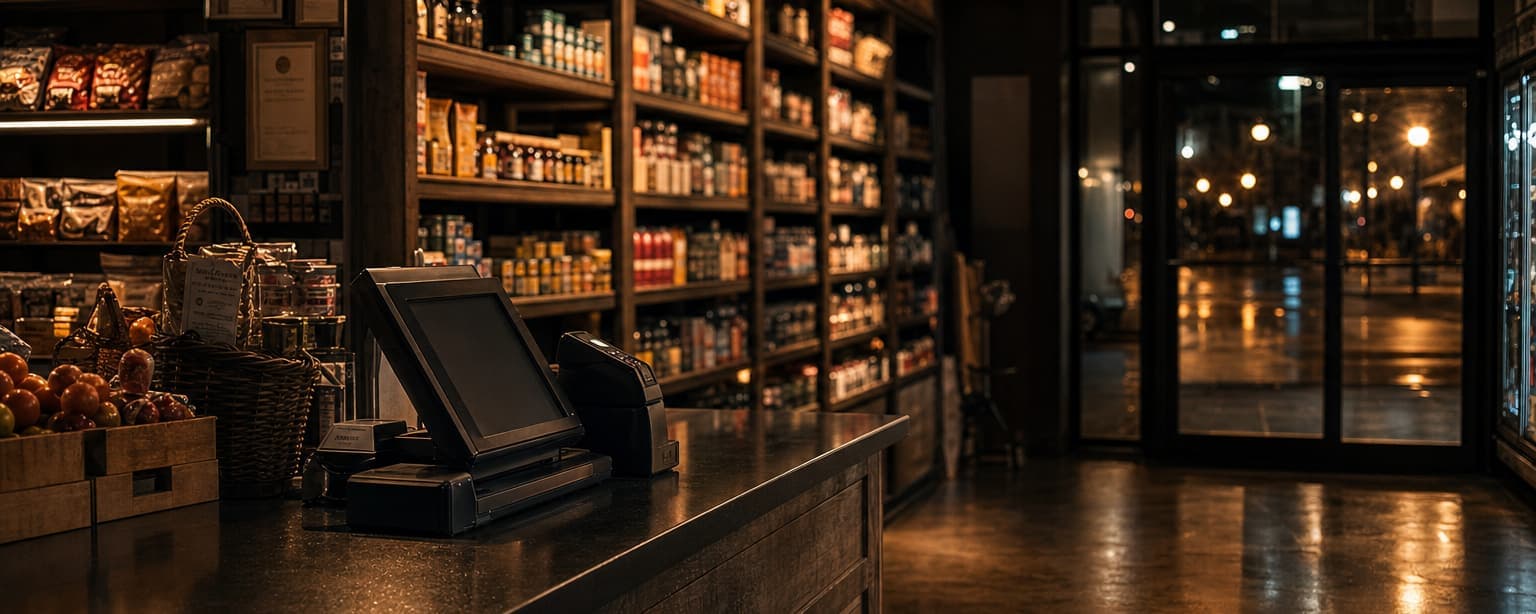
Cover the counter, the stock, and the lease you signed.
Commercial insurance for storefront retail, boutiques and tobacco and vape shops. Matched to what your lease and your suppliers require.
Tell us the situation.
One licensed human replies the same business day — not five agents, not an auto-responder. If the policy you have is already the right one, we will tell you.
We use this to quote and service your insurance, and we do not sell it or pass it to lead networks. Privacy policy.
Send us what you have. We’ll tell you if it’s right.
Your current policy paperwork, a renewal notice, or nothing at all. A licensed agent reads it and replies the same business day.
What retail businesses actually need.
General liability
Third-party bodily injury and property damage. It is the line nearly every contract names by default.
Without it — A customer injured in the store has a direct claim, and your lease almost certainly requires the coverage anyway.
Commercial property
Buildings and contents, valued at what it costs to rebuild today rather than what you paid.
Without it — Stock, fixtures and tenant improvements have to be replaced out of cash after a fire or a burst pipe.
Business owners policy
General liability and property packaged together. Cheaper than buying them separately when you qualify, and most small businesses do.
Without it — Buying property and liability separately usually costs a small retailer more.
Crime & employee dishonesty
Theft by your own staff, funds transfer fraud, and the dishonesty bond a home care contract will ask you for by name.
Without it — Till shortages, employee theft and the scam where staff are talked into handing the cash over. No other line touches any of it.
Cyber
Breach response, ransomware and the notification costs that follow, plus the card-brand assessments a business that takes payments gets billed for whoever was at fault. The customer database, the mailing list and the loyalty program are the assets at stake, and general liability excludes all of it by name.
Without it — Card data, the loyalty list and the mailing list are all yours to lose, and a breach through the point of sale is billed back to you by the card networks whether or not it was your fault.
Workers compensation
Required in almost every state the moment you have employees. Priced on payroll and class code, which is why the class code is worth arguing about.
Without it — Staff injuries on the floor or in the stockroom become uncapped claims.
Employment practices liability
Wrongful termination, discrimination and harassment claims brought by your own employees. General liability specifically excludes these.
Without it — Wrongful termination and harassment claims from retail staff are excluded from general liability.
Group health
Employer-sponsored medical coverage for a small or mid-sized group, marketed to carriers each year rather than renewed by default. It is bought as much for retention as for care. For a business competing on pay and hours, it is often the benefit that decides which of two similar jobs somebody takes.
Without it — The cheapest way to stop losing trained staff to the store down the road, and it costs considerably less than most owners assume.
The claims we actually see.
Ordered by how often we see them, not by how dramatic they are. Each one names the coverage that answers it — and the policy people wrongly assume already does.
Most common
A customer slips, trips or is struck by falling stock
Covered by General liability
Nothing exotic. It is simply the most frequent claim retail makes, and it is why every lease demands the coverage before you get keys.
Most common
Theft of stock, by customers or by staff
Covered by Property for burglary; crime or employee dishonesty for staff
A property policy covers a break-in, and specifically excludes theft by your own employees. Internal theft is the larger loss in most retail businesses and needs its own coverage.
Common
A card breach through the POS
Covered by Business cyber
The card networks recover their costs down the chain to the merchant regardless of fault. That assessment is a contractual liability, which is precisely what general liability does not pay.
Common
Something you sold injures the buyer
Covered by Products liability
Selling it puts you in the chain of supply. If the manufacturer is overseas, dissolved or untraceable, you are the party the injured customer can actually reach.
Common
Staff are talked into handing over the day’s takings
Covered by Crime — social engineering
The employee handed it over willingly, so it is not burglary and property does not answer it. Social engineering is a named sublimit that has to be asked for, and it is frequently absent.
Less common, severe
Fire or water damage closes the store
Covered by Property, plus business income
Replacing the fit-out is the visible loss. The invisible one is a season of trading, and the rent that runs the whole time the doors are shut.
Businesses like this one, with their own page.
Every one of these is written for that specific operation — the coverages it needs, the questions underwriters ask it, and what it usually gets wrong.
- Vape Shops
A vape shop is a retailer that most retail carriers refuse: the products are regulated as tobacco, the batteries catch fire, the e-liquid is ingested, and the customers must be verified as adults at every sale. The policy that works is a specialty package with products liability that names vapor products and lithium batteries, general liability for the store, property for the inventory, and cyber where online sales exist. The application is longer than a retailer expects because the carrier is underwriting the supply chain: where the devices come from, whether the batteries are branded and wrapped, whether the e-liquid is made in-house, and whether the shop ships. We place it for single stores, small chains, lounges and shops that mix vapor, glass and CBD.
- Electronics Stores
An electronics store carries the most theft-prone inventory in retail: phones, laptops, tablets and accessories that fit in a pocket and sell the same day. Burglary and smash-and-grab are the claims that define the class, so the property policy is built around theft limits, alarms and safes rather than fire. Behind the counter, most stores also repair, which adds a claim the property policy does not answer: the customer's device damaged in your hands, or the data on it lost. Add a growing stock of lithium batteries and the fire question comes back. We place independent electronics retailers, phone and computer stores, repair shops and franchise locations, with the theft, bailee and repair liability sized to what is on the shelves.
What our retail clients ask us.
Someone called the store pretending to be head office. Are we covered?
Only if you bought social engineering coverage, and most retailers have not. The scam is well-known and it works: somebody calls a store claiming to be a regional manager or a senior executive, tells the employee on shift that another member of staff is under investigation for theft, and instructs them to take everything in the till to a wire transfer counter or buy gift cards immediately, with the urgency and the implied threat to their job doing the work. A frightened junior employee complies, and the money is gone in minutes.
Should a small retailer offer group health?
It is worth pricing, and most owners have never actually priced it. They have an impression from years ago and are working from that. Two things are usually true at once: retail competes for staff largely on pay and hours, and health coverage is the benefit that moves people between two jobs paying the same. It is the cheapest retention tool available to a business with high turnover, and turnover in retail is expensive in a way that rarely appears on a line of the P&L: recruiting, training, the errors a new person makes, and the shifts covered at premium rates while a role sits open.
What does my lease usually require?
Most commercial leases require general liability at one million per occurrence, name the landlord as an additional insured, and require a waiver of subrogation. Many also require you to insure tenant improvements, the build-out you paid for, which landlords do not cover. Send us the lease and we will match the certificate to the exact wording rather than to a template.
Do you cover tobacco and vape shops?
Yes. It is a class many carriers decline outright, which is the main reason shops end up either uninsured or badly overpaying. It takes going to markets that will look at it, which is what an independent agency is for.
Is my stock covered at cost or retail?
Almost always at your cost to replace it, not what you would have sold it for. That surprises people after a loss. Worth setting your limit against actual replacement cost including current supplier pricing, and reviewing it whenever inventory levels change materially.
Commercial insurance is 96% of what we do — it is not a department here, it is the whole business. Not ready to talk? The guides answer the questions this page raises in more depth. Already insured with us and need a certificate or a policy change? Ask the service team rather than starting a quote — it is faster and it goes to the people whose job it is. We also write home and auto, which is usually cheaper alongside the business policy than apart from it.
Handed a lease, a vendor packet or a client contract with insurance requirements? Paste it into the COI Requirements Decoder to see what each one means for your business, or read what the requirements mean.