
You are the obvious suspect in any burglary at a property you worked on.
A locksmith is the first person suspected after a break-in. We cover that, damage caused during entry, the key control and faulty-work exposures, and the bonding customers ask for.
Tell us the situation.
One licensed human replies the same business day — not five agents, not an auto-responder. If the policy you have is already the right one, we will tell you.
We use this to quote and service your insurance, and we do not sell it or pass it to lead networks. Privacy policy.
Send us what you have. We’ll tell you if it’s right.
Your current policy paperwork, a renewal notice, or nothing at all. A licensed agent reads it and replies the same business day.
What locksmith businesses actually need.
General liability
Damage to doors, frames, vehicles and property during the work.
Without it — Forced entry damages property by design, and disputes follow.
Errors and omissions
A lock incorrectly fitted, a system misconfigured, a key issued wrongly.
Without it — A burglary through a lock you fitted is a professional claim, not a premises one.
Care, custody and control
Damage to the vehicle or property you are working on.
Without it — General liability excludes the very thing in your hands.
Tools and stock
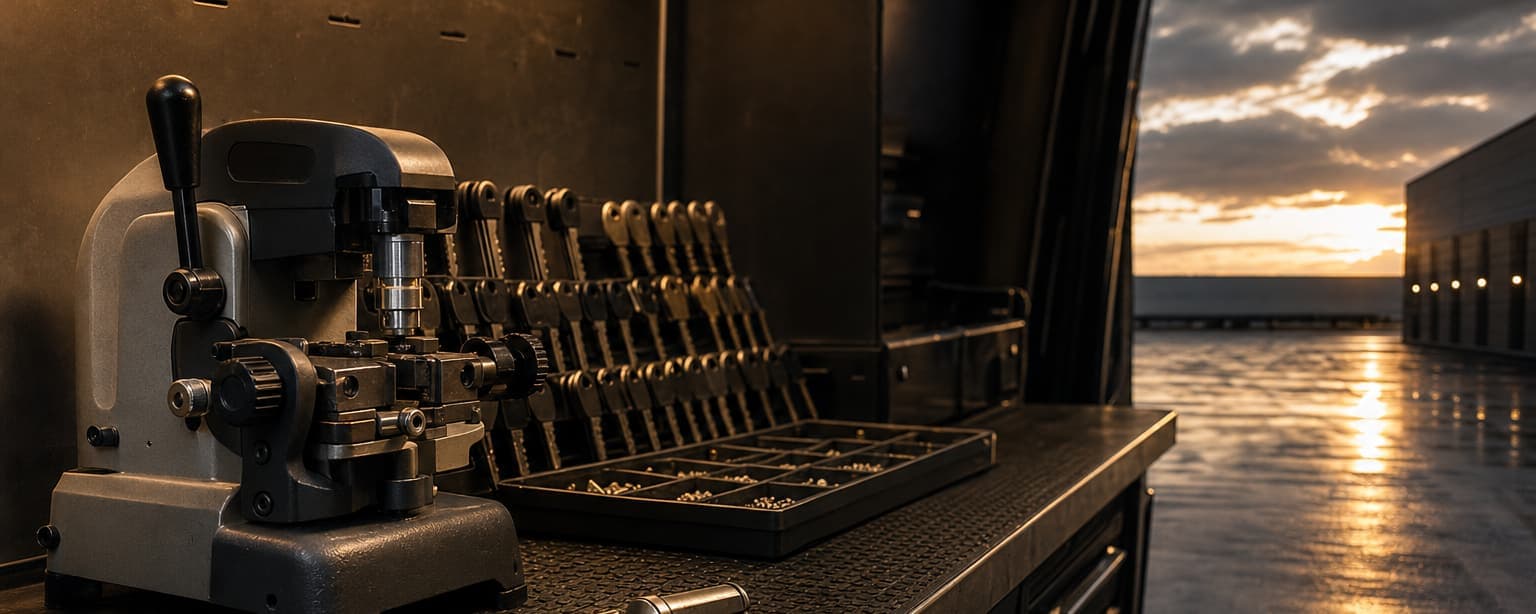
Key machines, picks, blanks and stock, in the van.
Without it — The van is the workshop and vans get broken into.
Bonding
A license or surety bond, which many states and customers require.
Without it — It is frequently a licensing condition, and it is not insurance for you.
Group health and benefits
Locksmiths you have vetted and trained on your key control.
Without it — You are trusted with access to other people’s property, so who works for you is itself the risk. Vetting is expensive to repeat.
What our locksmith clients ask us.
What is the key control exposure?
That you hold, cut and control access to other people’s premises, so when a burglary happens with no sign of forced entry, the locksmith who last worked there is an obvious line of inquiry. That is a professional liability and sometimes a crime exposure rather than a general liability one. Practically, it is defended by records: who cut what, when, on whose authority, what identification was checked, and who had access to blanks and codes.
Is a bond the same as insurance?
No, and the difference matters to you specifically. A bond guarantees your performance to the customer or the state. If it pays out, it pays them and then comes after YOU for repayment. Insurance pays the loss on your behalf. Customers say "licensed, bonded and insured" as one phrase, and it is three separate things: permission to trade, a guarantee to them, and protection for you.
Am I covered for damage to a car I am opening?
Only with the right extension. Damage to the vehicle you are working on is property in your care, custody and control, which general liability excludes, so an unendorsed policy leaves you paying for the door trim, the window or the electronics yourself. Automotive locksmiths should confirm this explicitly, because it is the single most likely claim in that side of the trade.
Commercial insurance is 96% of what we do — it is not a department here, it is the whole business. Not ready to talk? The guides answer the questions this page raises in more depth. Already insured with us and need a certificate or a policy change? Ask the service team rather than starting a quote — it is faster and it goes to the people whose job it is. We also write home and auto, which is usually cheaper alongside the business policy than apart from it.
Handed a lease, a vendor packet or a client contract with insurance requirements? Paste it into the COI Requirements Decoder to see what each one means for your business, or read what the requirements mean.